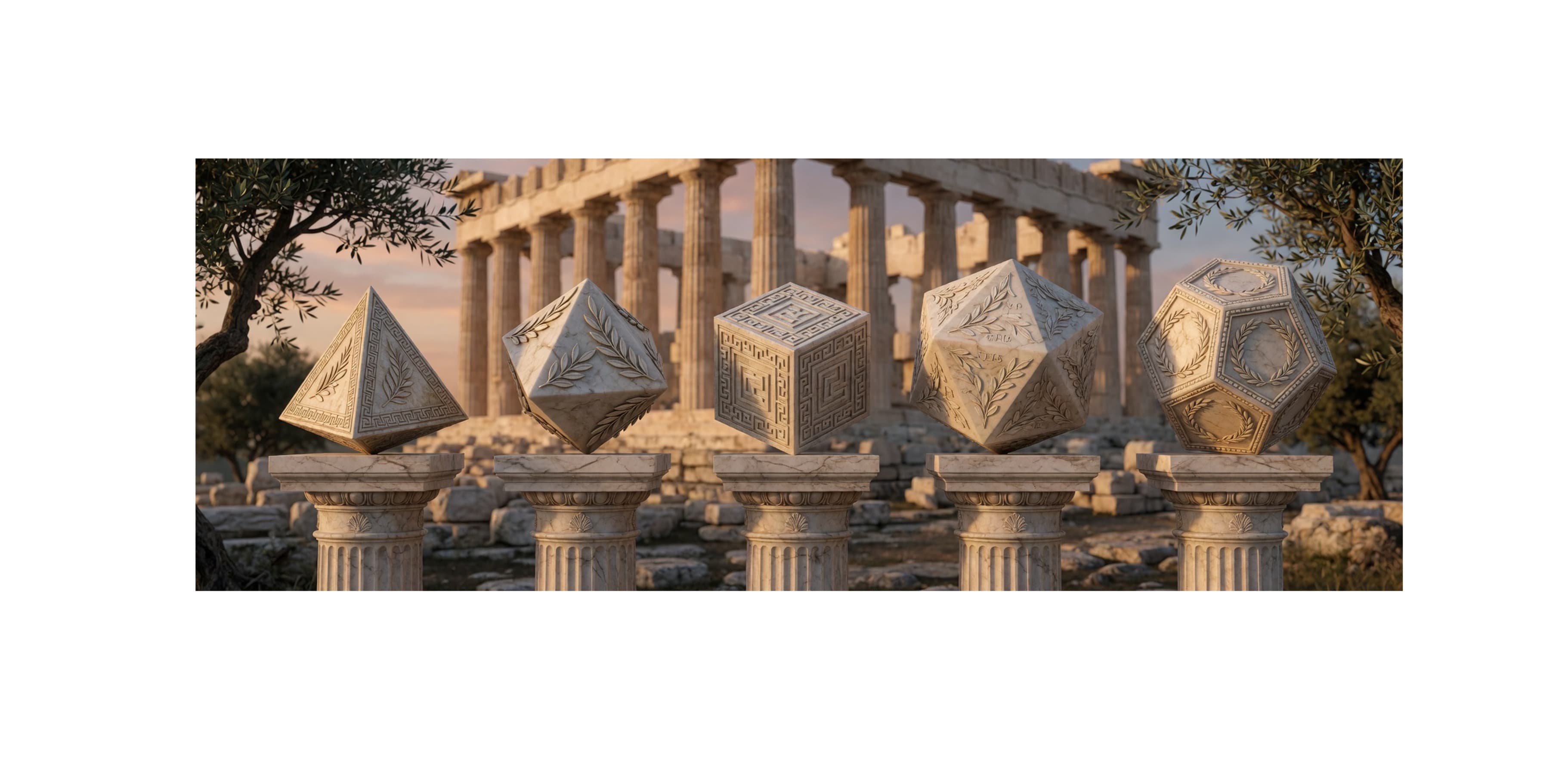
Platonic Solids: Time to Break Free
For over two millennia, the Platonic solids — tetrahedron, cube, octahedron, icosahedron, and dodecahedron — have fascinated mathematicians and philosophers alike. Yet their true significance remains obscured by definitions that are too narrow and expectations that are too low. Treated as a closed chapter of classical geometry, they are celebrated for their symmetry and then set aside. Ffellonic geometry proposes something more ambitious: that these five forms are not endpoints but milestones — stages in a living, geometric process that Nature has been running all along.
1. Boxed In by Definition
The standard definition is precise and, in its way, suffocating. A Platonic solid is a convex polyhedron with congruent regular polygonal faces and the same number of faces meeting at each vertex. Count the faces, verify the symmetry, move on. This checklist approach fits on a single page — and that is the problem. It says nothing about why the icosahedron appears in the protein shells of viruses, or why tetrahedral geometry governs molecular bonding. Reducing these forms to their polyhedral properties strips away exactly the relational context that makes them interesting.
2. Static Objects in a Dynamic Universe
Traditional geometry presents the Platonic solids as isolated, inert objects — frozen in textbook diagrams, defined by shape alone, with no account of growth, transition, or connection. Kepler tried to embed them in a model of planetary orbits; Plato associated them with the classical elements. Both were reaching for something real, but neither had the geometric framework to make the connection precise. The result is that the solids have long been treated as philosophical curiosities rather than structural principles — puzzle pieces that nobody quite assembles.
3. Counting Five Instead of Understanding Them
The number five attracts more attention than it deserves. Yes, there are exactly five Platonic solids in three-dimensional space — a consequence of Euler's formula and the constraints of convex geometry, not a cosmic mystery. More instructive is their internal structure: the tetrahedron is self-dual; the cube and octahedron are duals of each other; the icosahedron and dodecahedron form a third dual pair. These relationships point toward something richer than a count. Ffellonic geometry exploits them directly, treating the solids not as five separate objects but as waypoints within a 12-level developmental hierarchy, linked through vertex coordination rather than face enumeration.
4. A Curriculum That Stops at the Surface
In most classrooms, the Platonic solids make a brief appearance — usually as a paper-folding exercise — and then disappear. Students build a tetrahedron, perhaps a cube, and move on without ever learning that the octahedron is the structural unit of common salt crystals, or that icosahedral symmetry governs the architecture of entire virus families. The educational treatment matches the definitional one: it covers the minimum and calls it done. Ffellonic geometry offers a more generative entry point, using sphere-packing to show how these forms arise naturally from simple contact rules — building geometric intuition from the ground up rather than handing students a finished shape.
5. The Unresolved Connection to Nature
Despite two thousand years of use, nobody has given a fully satisfying account of why the Platonic solids appear so reliably in the natural world. Kepler's nested-sphere model of the solar system failed. Plato's elemental correspondences were poetic. Yet the forms keep turning up — in crystals, in molecular geometry, in viral capsids, in the organisation of bubbles and foams. Ffellonic geometry addresses this not by cataloguing appearances but by providing a mechanism: the solids emerge as stable coordination states within a sphere-based hierarchy governed by free-energy minimisation. They are not arbitrary shapes that Nature happens to favour. They are the predictable geometric outcomes of a single local rule operating across scales.
A New Framework
Ffellonic geometry recasts the Platonic solids as participants in a continuous 12-level progression — from a single contact at Level 1 to the tetrahedral-octahedral honeycomb that forms the thermodynamic ground state at Level 12. Each level represents a stable coordination milestone, arrived at not by design but by the logic of symmetric nearest-neighbour attachment under free-energy minimisation. The solids do not sit at the end of this story as achievements to be admired. They appear within it as necessary stages — as inevitable as crystallisation.
Break the Mold
The Platonic solids have earned their reputation. What they have not yet received is an adequate framework — one that explains not just what they are but why they exist, where they come from, and what role they play in the self-organisation of matter. Ffellonic geometry provides that framework. It moves the solids from the museum into the laboratory, from static definition into dynamic process. For mathematicians, scientists, and anyone puzzled by geometry's strange persistence in Nature, the invitation is straightforward: look at these ancient forms again, through a lens that treats them not as relics but as evidence of something still unfolding.
Comments
No comments yet. Be the first to share your thoughts.