The Principle of Least Resistance: How Nature Moves Without Effort
Patterns repeat across nature once you know where to look. Rivers branch like the vessels in a lung. Stars pass through stages as predictable as a season turning. Ecosystems swing through cycles that bend without breaking. Living things grow in sequences that rarely vary. The eye catches structure first — order, repetition, a sense of design.
Watch longer, though, and something else comes into view. Strip away the labels we layer onto these processes, the diagrams and mechanisms we use to explain them, and what's left isn't complexity at all. It's flow — unforced, uncontested, carrying no record of resistance. Nature doesn't struggle against what is; it simply moves through it, continuously and with almost nothing wasted.
Once you start looking for this quality, it turns up everywhere.
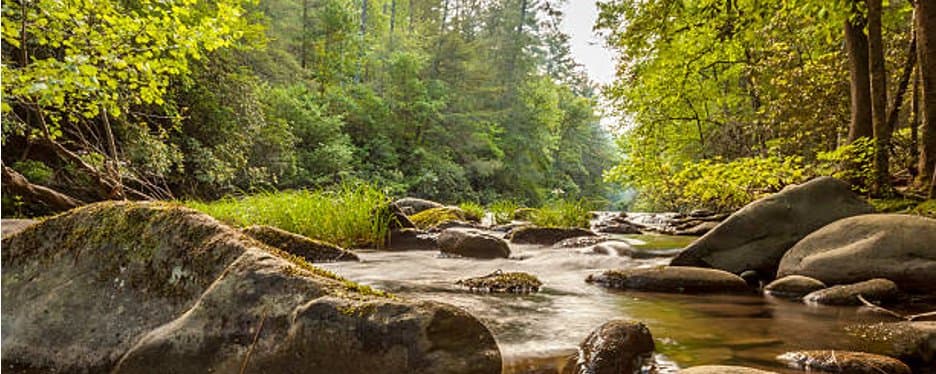
A mountain stream slips around every stone it meets, never pausing to fight the obstacle, only ever finding the gap that lets it keep moving down. Bamboo gives way entirely to a strong wind, bending as far as the gust demands, then springing back with no trace of strain. A drop of water settles on a leaf into a near-perfect sphere, its surface tension resolving into the lowest-energy shape almost instantly. A river doesn't choose its course so much as discover it, tracing the land's contours along whatever path costs least, carrying sediment and life forward without complaint.
These aren't just pleasing images. They're physical expressions of something physics already formalises: the principle of least action. Between any two states, a system's actual path is the one that minimises the action integral — the most economical trade-off of energy and time available. Light bends this way. Particles move this way. The "effort" is mathematically real, and it's always the smallest effort that wins.
Quantum mechanics pushes the same idea further down. A system in superposition isn't choosing between possibilities — it's holding all of them at once, with no preference imposed. The wave function evolves smoothly, continuously, with nothing forcing one outcome over another. What we call "collapse" looks less like coercion and more like alignment finding its resting point.
Taken together, and without adding interpretation on top, the picture that emerges is simple: natural processes are effortless by structure. Large transformations happen against almost no resistance. Change doesn't stall or grind — it flows. And persistence, it turns out, doesn't require trying.
This isn't a theory laid over nature from outside. It's what's left once you stop narrating and just watch — a leaf falling, breath moving in and out, water finding its way downhill.
We call this way of seeing Ffellonics: the study of effortless flow as the basic operating principle of reality. It doesn't start from complexity — it starts from sustained, quiet attention to what's already happening. It treats the principle of least action not as a calculation trick but as a description of nature's own intelligence — old in its intuitive form (the Taoist idea of wu wei), and exact in its modern one (variational principles, quantum field theory).
Approaching nature this way doesn't add a new framework on top. It clears away the ones that were getting in the way of seeing clearly. What's left is understanding that arrives the way water finds its level, or a tree leans toward light — without forcing it.
Nature already knows what to do. It just keeps doing it.
And in that uninterrupted continuing is the most elegant structure there is.
Comments
No comments yet. Be the first to share your thoughts.