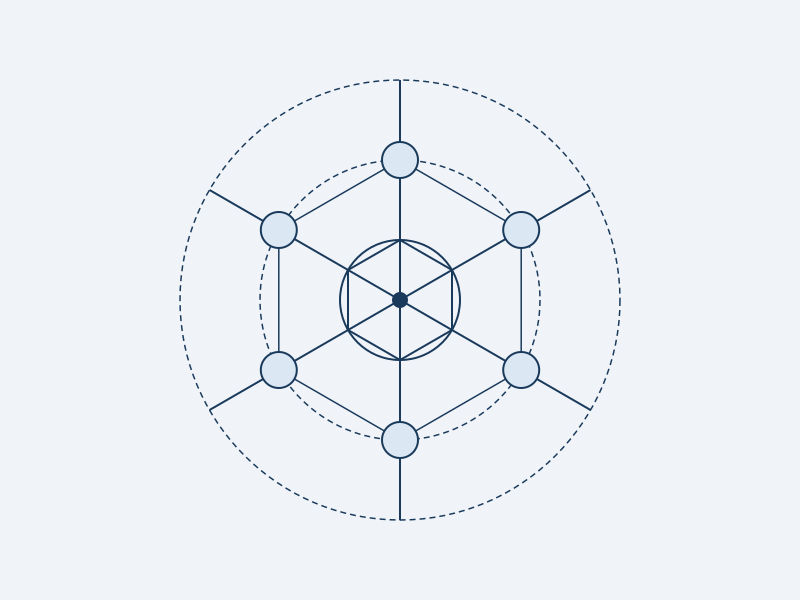
Ffellonic Geometry: Emerging from the Linkage of Defining Points Embodying Pure Symmetry
· 5 min read
ByDavid Fell
Ffellonic Geometry: Emerging from the Linkage of Defining Points Embodying Pure Symmetry
Introduction: The Essence of Geometric Emergence
In the realm of mathematics and natural philosophy, geometry has long been viewed as an abstract construct, often detached from the tangible world. Yet, Ffellonic geometry, as articulated in Ffellonic Geometry: A Sphere-Based Symphony of Symmetry by David Fell, challenges this notion by emerging from the linkage of defining points that embody pure symmetry. These points—vertices representing the centres or radical centres of naturally attaching spheres—form the foundation of a 12-level hierarchy, transforming abstract ideals into a dynamic model of natural development. This article delves into how Ffellonic geometry arises from this symmetrical linkage, contrasting it with traditional geometries and highlighting its implications for understanding space, stability, and evolution. The linkage of these points builds a coherent, symmetrical narrative of growth.
The Defining Points: Vertices as the Building Blocks
Ffellonic geometry's emergence begins with defining points, the vertices where spheres interact. Unlike Euclidean geometry's arbitrary lines and planes, Ffellonic geometry is rooted in the physical reality of spheres—Nature's fundamental units, such as atoms or bubbles—that attach based on proximity and energy minimization. These vertices are not isolated; they link through natural connections, embodying pure symmetry.
• Linkage Mechanism: The hierarchy progresses as each vertex gains the ability to connect with others, starting with two spheres forming a line (Level 1, one connection) and culminating in the tetrahedral-octahedral honeycomb (Level 12, twelve connections per sphere). The Ffellonic Forms (tetrahedron at Level 3, octahedron at Level 4, icosahedron at Level 5) arise from linking the centers of four, six, and twelve spheres, respectively. Their Canalicchio Duals (self-dual tetrahedron, cube, dodecahedron) emerge from connecting the radical centers (equidistant points from three touching spheres), creating a symmetrical duality.
• Pure Symmetry Embodied: Each linkage preserves symmetry, with groups evolving—T_d (order 24) at Level 3, O_h (order 48) at Level 4, I_h (order 120) at Level 5, and Fm-3m (cubic) at Level 12. This pure symmetry, capped by the kissing number (twelve spheres surrounding one), ensures balanced force distribution, reducing stress and instability. The vertices, serving as the system's structural code, encode this symmetry, transforming points into a cohesive whole.
This linkage is not arbitrary; it reflects Nature's efficient packing, where symmetry minimizes energy, as seen in crystal lattices and viral capsids.
Emergence from Linkage: A Dynamic Hierarchy
Ffellonic geometry emerges as the linkage of these symmetrical points creates a 12-level hierarchy, divided into two parts: the Ffellonic Forms and their Canalicchio Duals. This progression is inherently limited, allowing only twelve similar-sized spheres to surround another, embodying Schelling's "mastery through limitation."
• Finite Emergence (Levels 1–5): The linkage begins simply, with two points forming a line (Level 1), evolving to the tetrahedron (Level 3, four points linked in 3D symmetry). The octahedron (Level 4) and icosahedron (Level 5) further refine this, their points linking to form complex, stable Forms. This mirrors molecular assembly, where symmetrical linkages reduce entropy.
• Infinite Emergence (Levels 6–12): The linkage extends infinitely at Level 6's tessellation, forming a one-level lattice, and reaches maximum symmetry at Level 12's honeycomb. The extensive line at Level 7 (central point linked to seven others: one on each side, one beneath, two on each side of both central and lower spheres) transitions to denser structures, with points linking in repeating patterns that embody pure symmetry.
The vertices' code guides this emergence, ensuring each linkage adds order without chaos.
Contrast with Traditional Geometries
Traditional geometries, such as Euclidean or Platonic, define shapes from abstract points without inherent linkage rules, often resulting in static Forms. Ffellonic geometry, however, emerges from the natural linkage of symmetrical points, making it dynamic and rooted in reality. Platonic Forms, while symmetrical, are finite and isolated; Ffellonic extends them into a hierarchy, where linkage creates evolution. This emergence challenges the one-dimensional view of shapes as mere parameters, revealing them as points in a living network.
Implications for Nature and Human Understanding
The linkage of symmetrical points in Ffellonic geometry has profound implications. In Nature, it models stable structures—e.g., Level 5's icosahedron in viral capsids, where symmetrical points ensure self-assembly with minimal energy. Philosophically, it aligns with Plato's eternal Forms, emerging from ideal points, and Schelling's confined mastery, where limitation (twelve points) yields greatness. For human understanding, the hierarchy provides a tangible model for spatial cognition, where points link to form 3D awareness, like a learner connecting ideas to grasp a language's structure.
Conclusion: A Geometry Born of Symmetrical Linkage
Ffellonic geometry emerges from the linkage of defining points that embody pure symmetry, transforming abstract vertices into a 12-level hierarchy of natural growth. Capped by the kissing number, this system, encoded by the vertices' code, offers a dynamic alternative to traditional geometries, mirroring Nature's efficient designs and a learner's structured journey. It invites us to see symmetry not as static but as the emergent force of creation.
Share:
Comments
No comments yet. Be the first to share your thoughts.