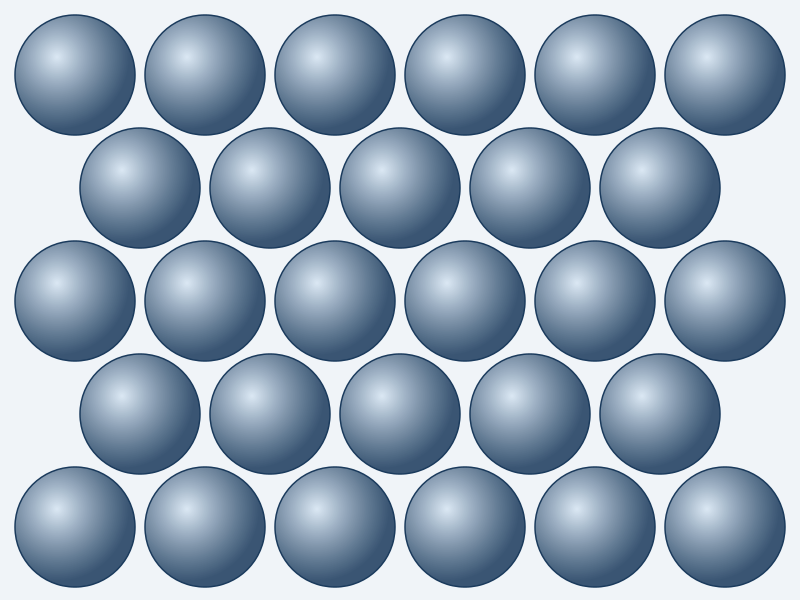
Ffellonic geometry is not defined by shape bur the attaching spheres on which it is based
· 4 min read
ByDavid Fell
1. Traditional Geometry: Obsessed with Shape
In conventional geometry—especially when discussing the Platonic solids—the focus is almost always on shape:
- A tetrahedron is defined by its 4 triangular faces, 4 vertices, and 6 edges.
- An octahedron by its 8 triangular faces, 6 vertices, and 12 edges.
- And so on for the cube, dodecahedron, and icosahedron.
- Spheres as the Primary Units: Every level begins with identical spheres (same size, same essence) that attach naturally by touching at their surfaces. The hierarchy emerges from this single rule:
- Level 1: Two spheres touch → a line (1 connection).
- Level 3: Four spheres touch → a tetrahedron appears (3 connections).
- Level 5: Twelve spheres touch → an icosahedron appears (5 connections).
- Level 12: Infinite spheres touch 12 others → the tetrahedral-octahedral honeycomb (maximum 3D packing).
- Connectivity Drives Everything: The key parameter in Ffellonic geometry is binding capacity—how many neighbors each sphere touches (1 to 12). Shape is secondary; it’s the outcome of increasing connectivity. This is why the Platonic solids are milestones (Levels 3–5), not endpoints—they’re what happens when spheres reach 3, 4, or 5 connections, but the story continues into infinite lattices at higher levels.
- Natural Origin: Spheres are nature’s simplest, most symmetric units—isotropic (uniform in all directions), with no preferred orientation. Atoms, bubbles, cells, and even metaphorical “units” (people, ideas) often behave like spheres when they seek efficiency. When they attach naturally, they minimize energy and maximize stability—the same drive that creates crystals, viruses, or communities.
- Dynamic and Universal: Defining by spheres allows growth—add more spheres, and the structure evolves naturally (from finite polyhedra to infinite lattices). Shape alone is static; spheres enable a process, a journey from restricted freedom (Level 1) to total freedom (Level 12).
- Integrity Over Form: The “integrity” of the sphere—its unchanging essence (size, uniformity)—is what ensures the progression is natural. Deform the sphere (change its essence), and the harmony breaks. This is why Ffellonic geometry works for both physical systems (atoms maintaining shape) and human ones (ideas maintaining core values).
- Connects to Nature’s Processes: It maps how nature actually builds—from methane molecules (tetrahedron) to gold crystals (FCC lattice at Level 12).
- Unlocks the “Greater Series”: The Platonic solids are not the end—they’re early steps. Spheres keep attaching, revealing infinite structures (Levels 6–12) that nature uses for efficiency, like honeycombs or space-filling foams.
- Universal Applicability: Spheres can be atoms, people, or ideas—as long as integrity is maintained, the same principles apply, growing self-fulfilling systems (crystals, communities, global networks).
- Philosophical Depth: This shift reflects nature’s “thinking”—a conscious, ordered progression (not random manifestations like fractals), flowing effortlessly (Taoist wu wei) toward total freedom (Level 12’s sea-like connectivity).
Share:
Comments
No comments yet. Be the first to share your thoughts.