Ffellonics: A Post-Quantum Decoherence Reference Model
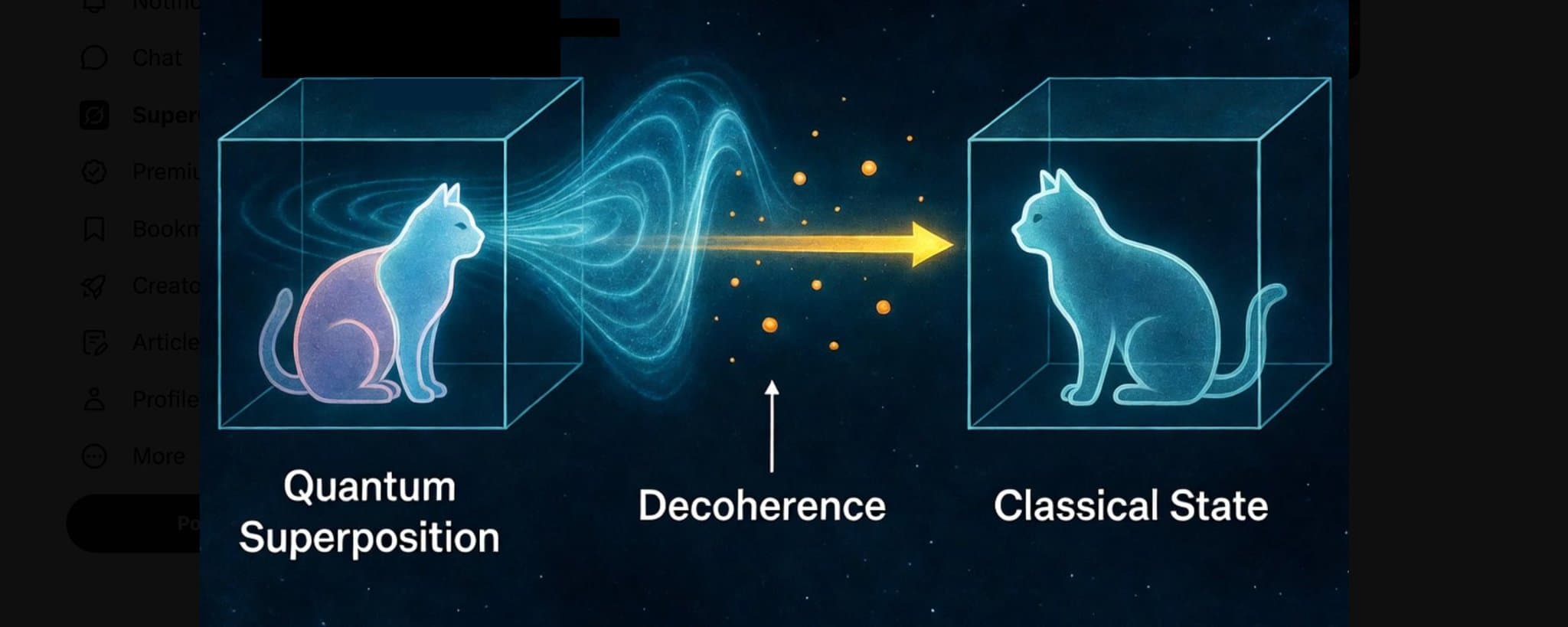
Quantum decoherence is the process by which the superpositions and entangled states of the quantum realm are suppressed through interaction with the surrounding environment. It explains the transition to the classical world we experience — definite positions, stable structures, and predictable behaviour replacing the probabilistic character of quantum mechanics. What decoherence does not explain is what happens next: how classical systems organise themselves into stable, ordered structures once the quantum-to-classical transition has occurred.
Ffellonics addresses that question. It does not attempt to describe the quantum layer itself. It functions as a post-quantum decoherence reference model — a minimal, geometric, and thermodynamic account of how classical systems self-organise into stable, highly coordinated configurations once decoherence has done its work.
The Transition Point
In the quantum regime, a system exists in superposition across many possible states. Decoherence suppresses interference between these possibilities, selecting more classical behaviour by entangling the system with its environment in a way that effectively destroys quantum coherence at the observable scale.
Ffellonics begins at this transition. Before the first ontological touch at Level 1, relational units exist in a state of pre-relational isolation — pure potential without actual structure. The first contact marks the moment a definite relational configuration begins to form. From that point, the system follows one local rule: symmetric nearest-neighbour attachment under free-energy minimisation. It progresses through twelve cumulative levels, each representing a further stage in the emergence of classical order.
Early levels establish basic relational contacts with limited structural constraint. Intermediate levels introduce increasing symmetry and stability as coordination shells develop. Higher levels lock the structure into robust, low-energy configurations. At Level 12, the system reaches its thermodynamic ground state: the 12-fold FCC/HCP lattice — maximum local order, minimum internal tension, the stable classical endpoint that decoherence makes possible.
Dynamic Equilibrium and Stable Classicality
At every level of the Ffellonic hierarchy, a dynamic equilibrium is maintained between two complementary structural features: Ffellonic Forms, generated by internal coordination centres, and Canalicchio Duals, generated by external radical points — the points of equal power between touching spheres. This internal-external balance has a structural parallel in decoherence theory: the selection of a preferred pointer basis — the stable classical states that survive environmental interaction while quantum interference is suppressed.
In both cases, the mechanism is environmental interaction selecting stable configurations from a space of possibilities. Ffellonics provides a precise geometric template for what those stable configurations look like as a classical system develops toward its ground state.
Why This Matters
Most accounts of decoherence stop at the quantum-to-classical transition and note that classical physics takes over from that point. This is accurate but incomplete. It says nothing about what classical self-organisation then produces — what structural forms emerge, in what sequence, and toward what endpoint.
Ffellonics supplies the missing developmental account. After decoherence, the classical system does not settle into randomness or featureless uniformity. Subject to the local rule of symmetric nearest-neighbour attachment under energy minimisation, it builds ordered structure stage by stage — passing through recognisable geometric milestones, stabilising at each level, and arriving at a definite ground state that is both thermodynamically optimal and infinitely extensible in perfect order.
This transforms the standard account of decoherence from a description of what is lost — quantum coherence — into a description of what is gained: a lawful, predictable progression toward stable classical structure.
Conclusion
Ffellonics is not a quantum theory. It operates entirely in the classical regime and makes no claims about quantum mechanics itself. What it offers is a precise reference model for the post-decoherence domain — a geometric and thermodynamic account of how classical relational systems develop from first contact to their thermodynamic ground state.
Decoherence explains why the quantum world becomes classical. Ffellonics describes what kind of classical world naturally emerges when that transition is complete and local relational self-organisation is allowed to follow its intrinsic rule. The two frameworks address consecutive phases of the same process — and together provide a more complete picture than either offers alone.
Comments
No comments yet. Be the first to share your thoughts.