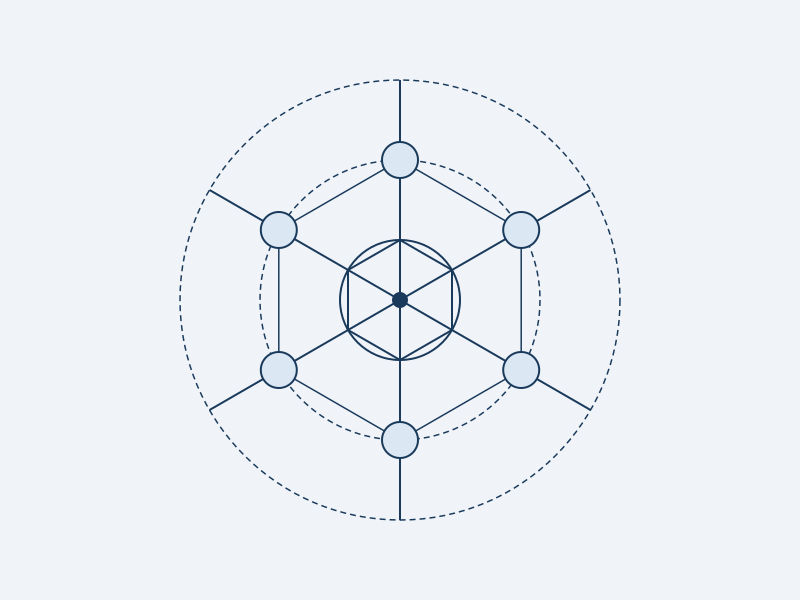
Aristotle, in his Metaphysics and Poetics, offered one of the most enduring definitions of a great form or beautiful whole. He argued that for something to be truly complete and admirable, it must possess three essential qualities:
- Order (taxis) — a proper, proportionate arrangement of parts into a coherent whole
- Symmetry (symmetria) — harmonious balance and commensurability among the parts
- Limitation (horismenon) — a definite boundary, size, and sense of completion; nothing indefinite or boundless can be truly beautiful or perfect.
For Aristotle, these were not merely aesthetic preferences. They were metaphysical necessities: a form without order, symmetry, and limitation could not achieve full actuality. It would remain incomplete, chaotic, or infinite in a way that prevents wholeness.Ffellonics — the 12-level relational hierarchy generated by symmetric nearest-neighbor attachments of identical spheres under energy minimization — aligns with Aristotle’s definition with striking precision. It does not merely satisfy these criteria; it demonstrates how they can emerge naturally from the simplest possible relational process. In doing so, Ffellonics turns Aristotle’s abstract ideal of the great form into a living, generative mechanism observable in nature.1. Order: The Progressive, Cumulative HierarchyAristotle insisted that a great form must exhibit taxis — a rational, proportionate ordering of parts. In Ffellonics, order is not imposed from above; it is generated step by step from the bottom up.The hierarchy begins with the first symmetric touch (Level 1–2: dyad and triangle) and proceeds through clearly defined stages: tetrahedral and octahedral clusters, icosahedral forms, hexagonal tessellation, linear trusses, octahedral spaceframes, and finally the dense 12-fold lattice. Each level is a necessary precondition for the next. Earlier structures are not discarded; they are incorporated and transcended. The triangle is contained within the tetrahedron, the tetrahedron within the truss, the truss within the lattice. This is cumulative order in its purest form.Ffellonics therefore realises Aristotle’s demand for order not as a static blueprint, but as a dynamic, developmental sequence — exactly the kind of ordered becoming Aristotle sought in natural forms.2. Symmetry: An Active, Dynamic PrincipleAristotle’s symmetria meant harmonious balance and proportion. In Ffellonics, symmetry is far more than a static property of the finished form. It is an active requirement the system must continuously maintain if it is to advance.At every attachment, the new sphere must choose a position that preserves or enhances overall symmetry. Asymmetric placements increase surface energy and reduce coordination potential, making them thermodynamically unfavourable. The system is therefore under constant pressure to solve symmetry problems at each step. Major transitions (such as the shift from planar tessellation at Level 6 to 3D extension at Level 7) succeed only when symmetry is restored in the new dimension.This dynamic maintenance of symmetry is what allows the hierarchy to reach its peak in the perfectly isotropic 12-fold lattice. Ffellonics shows that symmetry is not a passive feature of the final product — it is the guiding force that shapes the entire journey. In this sense, Ffellonics deepens Aristotle’s insight: symmetry is not merely a quality a great form has; it is a quality a great form must actively sustain.3. Limitation: The Power of a Definite EndAristotle repeatedly emphasised that the infinite or boundless cannot be beautiful. A form must have horismenon — clear boundaries, a definite size, and a sense of completion.Ffellonics satisfies this criterion with exceptional clarity. The hierarchy has:- A precise beginning (the first symmetric touch)
- A fixed number of stages (exactly 12)
- A definite endpoint (the 12-fold coordination lattice, the geometric and thermodynamic maximum possible in 3D space)
There is no thirteenth level. The process reaches completion when every sphere achieves the maximum symmetric coordination allowed by three-dimensional Euclidean geometry. This limitation is not a flaw; it is what gives Ffellonics its coherence, predictability, and sense of wholeness. The definite end turns the entire progression into a complete narrative arc — from pure potential to full relational actualisation.The Significance of This AlignmentThe convergence between Aristotle’s ancient definition and Ffellonics is not coincidental or superficial. It reveals something deeper:- Aristotle’s Ideal Is Realised in Nature’s Generative Processes
Aristotle described what a great form should look like. Ffellonics shows how nature actually produces such forms through a simple relational mechanism. It demonstrates that order, symmetry, and limitation are not imposed by an external designer or artist; they emerge spontaneously when identical units follow consistent local rules under physical constraints. - Symmetry as an Active Efficiency Strategy
Ffellonics adds a modern, thermodynamic layer to Aristotle’s insight. Symmetry is not only harmonious — it is the most efficient way to minimise free energy, maximise coordination, and achieve stability. Nature “chooses” symmetry because it is the cheapest, most effective path to order. - A Bridge Between Ancient Philosophy and Modern Science
Ffellonics offers a contemporary geometric language for Aristotle’s metaphysics. It shows that the qualities Aristotle prized in great forms are not abstract ideals floating in a Platonic realm. They are the natural, predictable outcomes of relational self-organisation in three-dimensional space. - Predictability and Universality
Because Ffellonics satisfies Aristotle’s criteria so completely, it gains strong predictive power. Any system that begins to self-organise through symmetric local relations in 3D space is likely to follow a similar staged, ordered, symmetric, and limited pathway. This explains why certain motifs (tetrahedral clusters, icosahedral shells, hexagonal layers, dense lattices) recur across crystals, colloids, viruses, and even aspects of biological development.
ConclusionAristotle taught that a great form must possess order, symmetry, and limitation. Ffellonics reveals that nature repeatedly produces great forms by obeying exactly these principles — not as static ideals, but as the inevitable consequence of simple relational rules operating under physical constraints.In Ffellonics, order emerges through cumulative progression, symmetry is actively maintained at every step, and limitation provides the definite boundary that makes the whole hierarchy coherent and complete. The framework therefore does more than align with Aristotle’s definition. It actualises it. It shows how the ancient philosopher’s vision of beauty and wholeness can arise naturally from the geometry of becoming itself.This alignment is significant because it suggests that Aristotle’s criteria for greatness are not merely human aesthetic preferences. They may reflect deep, universal principles that govern how ordered complexity arises in the physical world. Ffellonics, by making those principles visible and testable in a minimal geometric system, offers a powerful bridge between ancient wisdom and contemporary science — reminding us that the most profound forms in nature are those that achieve order, symmetry, and limitation through their own relational labour.In the end, Ffellonics does not merely reflect Aristotle’s ideal.
It demonstrates that nature itself is constantly striving to realise it — one symmetric touch at a time.