Ffellonics and Causal Emergence
Two frameworks have recently converged in a suggestive way. One is Ffellonics — a deterministic geometric model of relational self-organisation built on a single local rule. The other is causal emergence — a concept from complexity science that quantifies how higher-level descriptions of a system can possess greater causal power than the micro-level details beneath them. Together, they point toward something neither provides alone: a structural account of how agency might develop, paired with a rigorous way to measure causal power in general. Whether the two are describing the same process, rather than two independently interesting ones, is the open question this essay is actually asking — not a result it has already established.
Ffellonics: The Geometry of Relational Emergence
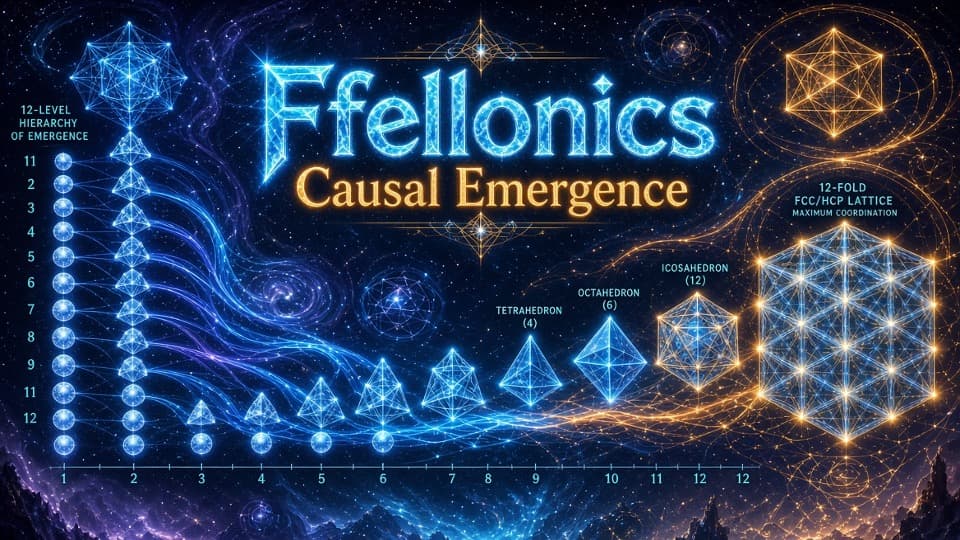
Ffellonics models how ordered reality emerges through the self-assembly of identical relational units — visualised as spheres — under one local rule: symmetric nearest-neighbour attachment under free-energy minimisation. Starting from pre-relational isolation, the process unfolds as a deterministic 12-level hierarchy:
Early levels — simple dyads, triangles, tetrahedrons, octahedrons, and icosahedrons appear as natural stability milestones.
Mid levels — progressive coordination shells build toward higher-order close-packed structures.
Level 12 — a fully symmetric, 12-fold coordinated FCC/HCP lattice: maximum connectivity and minimum free energy among the configurations the local rule can reach.
One caveat worth carrying into this piece as it has into the others: FCC is often treated as the ground state for hard-sphere packing, but the free-energy difference between FCC and HCP is extremely small in the colloidal-physics literature, and which one is favored remains a live question. Level 12 is best read as the class of maximal 12-fold coordination, not a single, sharply preferred endpoint — the argument below doesn't need more than that.
At each step, the system gains deeper interdependence and stability. There is no randomness and no external designer — once the first contact occurs, the developmental arc is implicit in the local rule. Ffellonics reframes emergence not as mysterious or stochastic but as a lawful, geometric progression toward a class of maximally coordinated states.
Causal Emergence
Causal emergence, formalised by Erik Hoel and collaborators, challenges the intuition that micro-level details always provide the best explanation. In many complex systems, higher-level descriptions can possess greater causal power — they predict and influence outcomes more reliably than the underlying micro-dynamics. This is measurable, using tools such as effective information (EI) and, more recently, integrated information decomposition (ΦID).
A 2026 paper by Pigozzi and Levin, The Causally Emergent Alignment Hypothesis, applies this measurement to reinforcement learning agents across six environments and multiple architectures. The finding is specific and worth stating precisely: causal emergence in agents' latent-space representations, computed with ΦID, was consistently predictive of final reward early in training, and its trajectory tracked with performance gains in most tasks. Learning, in this account, reorganises internal representations in a way that increases macro-level causal power over the agent's own future states.
It's important to be precise about what this paper does and doesn't establish. It measures a general property — causal emergence in neural-network latent representations — across a range of RL settings. It says nothing about spheres, coordination shells, twelve-level hierarchies, or any Ffellonics-specific geometry. It is real, direct evidence that causal emergence as a phenomenon shows up in trained agents and predicts their success. It is not evidence, direct or indirect, that those agents' representations pass through anything resembling the Ffellonic pathway. Any connection between the two has to be argued for, not read off the paper.
Where the Frameworks Might Align — and Where That's Still a Hypothesis
Ffellonics and causal emergence are complementary in an obvious sense: Ffellonics describes a mechanism — a precise, step-by-step way relational order could build. Causal emergence supplies a general measurement — a way to quantify increases in effective causation, wherever they occur, independent of the mechanism producing them. That pairing is worth taking seriously as a research question: does a system that develops through something like the Ffellonic pattern — from weak, fragmented coordination toward deep, symmetric interdependence — show a corresponding, measurable increase in causal emergence?
The Pigozzi and Levin result makes that question more interesting than it would otherwise be, because it shows causal emergence is not just a theoretical curiosity but something that actually rises during real learning and predicts real performance. What it does not do is show that RL agents' representational reorganisation resembles the Ffellonic hierarchy specifically, rather than some other trajectory that also increases causal power. Testing that would require something the essay doesn't have: a direct comparison between the geometric structure of an agent's learned representations and the coordination-shell structure Ffellonics predicts. Until that comparison is made, the honest claim is that Ffellonics offers a candidate mechanism for how causal emergence might arise developmentally, and causal-emergence research offers a method that could in principle test whether that mechanism is the right one — not that the RL result has already validated Ffellonics.
This reframes what would otherwise be a gap in emergence theory. Purely information-theoretic accounts of emergence often lack a concrete developmental mechanism; process accounts like Ffellonics often lack a rigorous way to measure whether the process is actually producing the causal gains it claims. Putting the two in contact is a genuine opportunity — but it's an opportunity to run the comparison, not a result that already exists.
Broader Implications — As Directions, Not Conclusions
These are places the hypothesis, if it holds up, would matter — not places it has yet been shown to apply:
AI and machine learning: if a system's causal emergence trajectory does track a Ffellonics-style progression, training regimes might be designed to encourage that progression directly, as a route to more causally coherent agents. This is a proposal for future work, not a demonstrated technique.
Biology and consciousness: Ffellonics offers a developmental map across molecular assemblies, neural networks, and social systems; causal emergence offers a way to ask, at which point in that map does effective agency — and possibly experience — become measurable. Both halves of that sentence remain speculative, and the consciousness claim in particular should be read as Ffellonics' own philosophical extension rather than something causal-emergence research implies.
Physics and philosophy: the framework's determinism (a local rule encoding the entire developmental arc) sitting alongside genuine higher-level causal power (macro descriptions with real predictive force) touches long-running debates in philosophy of mind about the relationship between determinism and agency — a resonance worth noting, not a settled bridge.
Complex systems generally: in medicine, engineering, and systems design, a validated version of this link could offer tools to measure and guide systemic maturation rather than only controlling behaviour at the micro level — again, contingent on the comparison above actually being run.
Conclusion
Ffellonics and causal emergence together suggest a picture worth investigating: that relational development might proceed through a geometric hierarchy of increasing coordination, and that this increasing coordination might be exactly what causal-emergence measures are built to detect. The Pigozzi and Levin result establishes that causal emergence really does rise during successful learning and really does predict outcomes — a solid empirical anchor for half of the picture. It does not yet establish that the specific pathway Ffellonics describes is the one those agents are taking.
The question this leaves is a genuinely open and testable one: is causal emergence the measurable signature of something like Ffellonic maturation specifically, or of developmental trajectories in general, of which the Ffellonic pathway is only one possible shape? Answering that would mean computing effective information or ΦID directly over Ffellonics-style hierarchies and checking whether the resulting curve looks like the one RL agents actually show. Until that work is done, the connection between the two frameworks is a well-motivated hypothesis, not a demonstrated finding — but it's a hypothesis specific and structured enough to be worth someone actually running the numbers on.
Comments
No comments yet. Be the first to share your thoughts.