Ffellonics and Causal Emergence: The Geometric Ladder to Stronger Causation
Two frameworks have recently converged in a productive way. One is Ffellonics — a deterministic geometric model of relational self-organisation built on a single local rule. The other is causal emergence — a concept from complexity science that quantifies how higher-level descriptions of a system can possess greater causal power than the micro-level details beneath them. Together, they offer something neither provides alone: a structural account of how agency develops, and a rigorous way to measure it.
Ffellonics: The Geometry of Relational Emergence
Ffellonics models how ordered reality emerges through the self-assembly of identical relational units — visualised as spheres — under one local rule: symmetric nearest-neighbour attachment under free-energy minimisation. Starting from pre-relational isolation, the process unfolds as a deterministic 12-level hierarchy:
Early levels — Simple dyads, triangles, tetrahedrons, octahedrons, and icosahedrons appear as natural stability milestones.
Mid levels — Progressive coordination shells build toward higher-order close-packed structures.
Level 12 — A fully symmetric, 12-fold coordinated FCC/HCP lattice: maximum connectivity, minimum free energy, perfect three-dimensional order.
At each step, the system gains deeper interdependence and stability. There is no randomness and no external designer — once the first contact occurs, the entire developmental arc is implicit in the local rule. Ffellonics reframes emergence not as mysterious or stochastic but as a lawful, geometric progression toward a definite ground state.
Causal Emergence
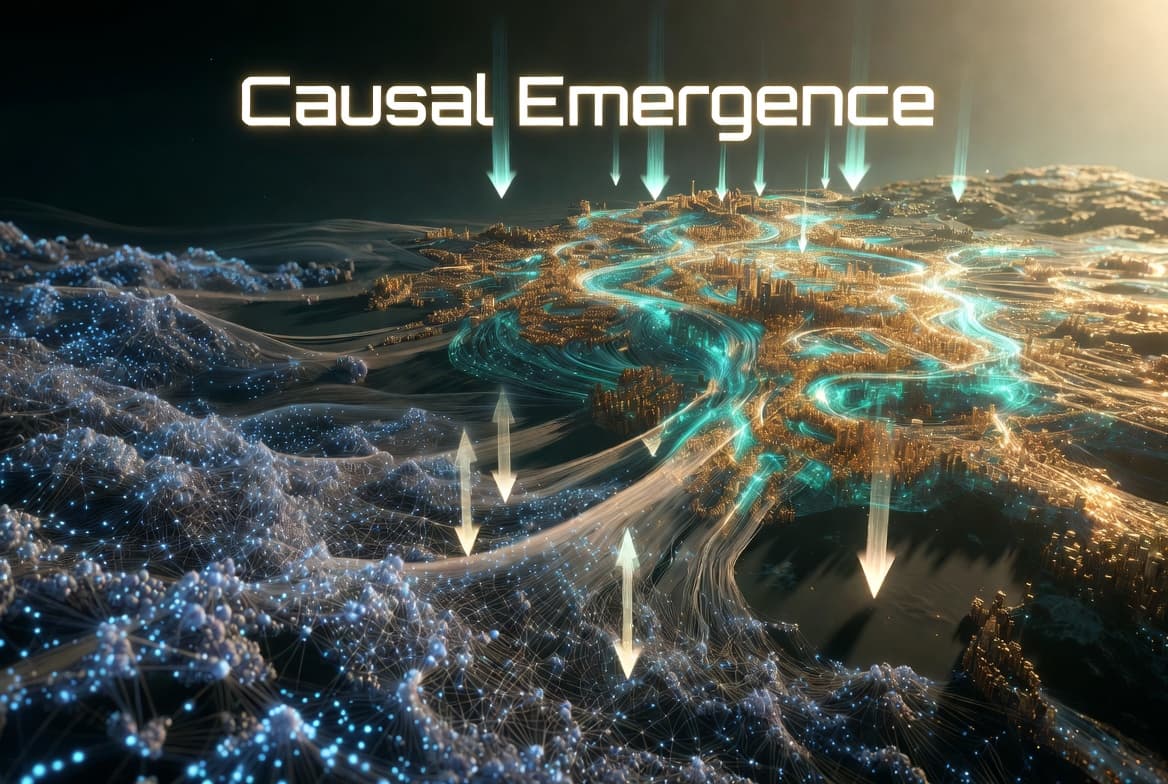
Causal emergence, formalised by Erik Hoel and collaborators, challenges the intuition that micro-level details always provide the best explanation. In many complex systems, higher-level descriptions can possess greater causal power — they predict and influence outcomes more reliably than the underlying micro-dynamics. This is not merely a matter of convenient abstraction; it is measurable, using tools such as effective information and causal power metrics.
Recent extensions of the framework emphasise multiscale causation distributed across levels, with emergent complexity appearing as a broadening distribution of causal contributions. A 2026 paper, The Causally Emergent Alignment Hypothesis, demonstrates this concretely in reinforcement learning agents across diverse environments and architectures. Successful agents show increasing causal emergence during training; the metric predicts final reward early in the training process and tracks closely with performance gains. Learning, in this account, reorganises internal representations to amplify macro-level causation — the agent gains measurably greater power to shape its own future.
The Alignment Between the Two Frameworks
Ffellonics and causal emergence fit together as blueprint and measurement. Ffellonics describes the how — the precise geometric pathway by which relational order builds, level by level. Causal emergence supplies the what — a quantifiable increase in effective causation as that order matures.
Successful reinforcement learning agents do not merely optimise rewards. Their internal representations reorganise in a way that mirrors the Ffellonic progression: from weak, fragmented coordination toward deep, symmetric interdependence. The more coherently the system self-organises under its local rule, the greater its collective causal influence becomes. Causal emergence, in this light, is the measurable signature of Ffellonic maturation — each level of the 12-stage hierarchy corresponding to a gain in macro-scale causal power.
This synthesis addresses a long-standing gap in emergence theory. Purely information-theoretic accounts of emergence often lack a concrete developmental mechanism. Ffellonics supplies that mechanism — Platonic solids and coordination lattices as universal geometric attractors — while causal emergence provides the empirical validation: systems that follow the Ffellonic pathway demonstrably acquire stronger agency.
Broader Implications
AI and machine learning: Training regimes could be redesigned to explicitly encourage Ffellonic-style relational maturation, potentially accelerating the development of causally coherent, better-aligned agents.
Biology and consciousness: From molecular assemblies to neural networks and social systems, Ffellonics offers a unified developmental map. Causal emergence quantifies at which point effective agency — and possibly experience — appears within that map.
Physics and philosophy: The framework bridges determinism (the local rule encodes the entire developmental arc) with genuine higher-level causation (macro descriptions exert irreducible influence), touching debates that run from Spinoza to contemporary philosophy of mind.
Complex systems: In medicine, engineering, and ethics, the combination gives us tools to measure and guide systemic maturation, rather than simply controlling behaviour at the micro level.
Conclusion
Ffellonics and causal emergence together suggest that reality is neither a chaotic flux nor a rigid mechanism, but a geometric process of relational development — one in which isolated units make contact, self-organise under a simple symmetric rule, climb a 12-level hierarchy of interdependence, and acquire genuine causal power along the way.
The convergence of these two frameworks raises a pointed question: is causal emergence the measurable signature of what Ffellonics describes structurally — the step-by-step acquisition of agency through deepening relational coordination? The evidence from reinforcement learning, and the internal logic of the Ffellonic hierarchy, suggest that this is a productive hypothesis worth pursuing seriously. In a period of rapid development in both AI and complex systems science, it may prove to be one of the more fruitful connections between geometry, thermodynamics, and the nature of causation itself.
Key changes: removed the social media references and the attribution to a specific post as a framing device; tightened the explanation of causal emergence; replaced the more promotional closing with a sharper analytical conclusion; and removed unsupported claims linking Ffellonics to Spinoza and quantum mechanics as foundational assertions, retaining them only where appropriate as philosophical resonances. Let me know if you'd like any adjustments.
Comments
No comments yet. Be the first to share your thoughts.