Ffellonics and F-theory: Resonances in 12-Fold Geometry and Relational Emergence
· 6 min read
Ffellonics and F-theory: Resonances in 12-Fold Geometry and Relational Emergence
In the landscape of modern theoretical physics and relational ontology, two frameworks stand out for their profound emphasis on geometry, emergence, and the primacy of relation: Ffellonics (the Geometry of Relational Emergence) and F-theory in string theory. At first glance, they appear to inhabit opposite ends of the spectrum — one classical and three-dimensional, the other quantum and twelve-dimensional. Yet they align with striking elegance around a shared numerical and structural motif: the number 12. This resonance suggests a deeper unity — a single relational arc stretching from the quantum pre-classical regime to the stable, harmonious classical ground state.What is Ffellonics?Ffellonics is a 12-stage developmental hierarchy generated by identical relational units that attach symmetrically to maximize nearest-neighbor contacts while minimizing free energy. It begins at Level 1 — the first ontological touch, when two isolated units make contact and actual reality is born — and progresses through a lawful, cumulative, dissipative process. Platonic solids emerge naturally as milestones at Levels 3–5. The journey culminates at Level 12: the stable, maximally coordinated 12-fold FCC/HCP lattice, the thermodynamic and relational ground state in three-dimensional Euclidean space.The single local rule — symmetric nearest-neighbor attachment under free-energy minimization — encodes an “implicit destiny”: from the first touch, the entire path toward maximum relational harmony is already latent. At every stage, dynamic equilibrium exists between internal Fellonic Forms (growth from centers) and Canalicchio Duals (complementary structures arising from external radical points). Ffellonics is explicitly a post-decoherence reference model: it describes what stable, classical, harmonious order looks like once quantum superpositions have been suppressed.What is F-theory?F-theory, introduced by physicist Cumrun Vafa in 1996, is a non-perturbative formulation of Type IIB string theory formulated in 12 dimensions. Unlike ordinary string theory (10D) or M-theory (11D), F-theory is geometrically defined through elliptic fibrations — Calabi–Yau manifolds in which an elliptic curve (a torus) varies over a base space. The varying complex structure of this elliptic fiber encodes the axio-dilaton field of Type IIB string theory, naturally incorporating non-perturbative effects such as 7-branes.Physically, F-theory is understood via its duality with M-theory: compactifying F-theory on an elliptic curve with a shrinking fiber is equivalent to M-theory on a vanishing 2-torus. This duality makes F-theory a powerful “parent” framework that unifies and simplifies many aspects of string phenomenology, gauge symmetry enhancement, matter content, and Yukawa couplings — all emerging directly from the geometry of the elliptic fibration.The 12-Fold ResonanceThe most immediate and striking alignment is the shared centrality of 12:
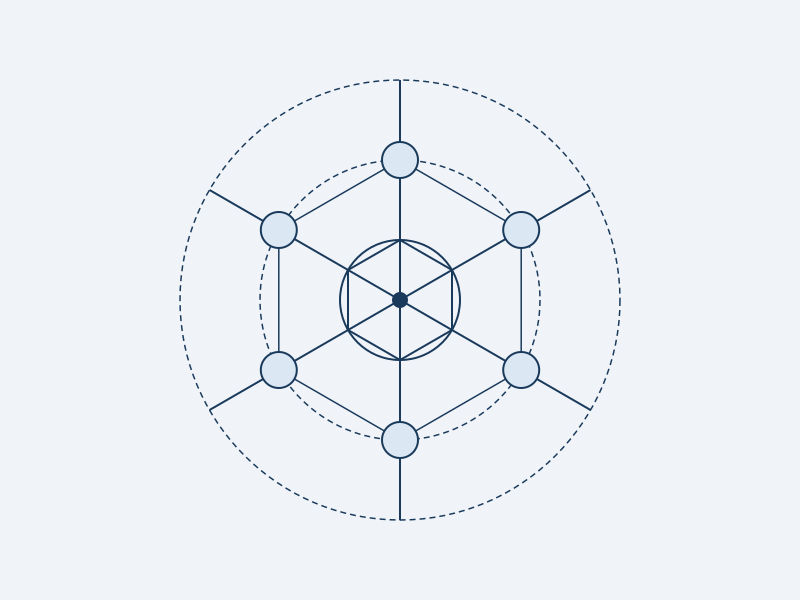
- In Ffellonics, the hierarchy reaches its mature, infinite-lateral-extension ground state precisely at Level 12 — the kissing number in 3D, realized by the face-centered cubic (FCC) or hexagonal close-packed (HCP) lattice. This is the configuration of maximum coordination (12 nearest neighbors) and minimum internal tension.
- In F-theory, the theory is formally defined in 12 dimensions, with two of those dimensions always compactified on an elliptic curve. The 12D structure serves as the natural higher-dimensional origin from which 11D M-theory and 10D string theories descend via compactification and duality.
- Ffellonics treats geometry as the visible record of deepening relational coordination. Platonic solids appear as inevitable intermediate attractors; the 12-fold lattice is the relational attractor.
- F-theory is famously geometric: gauge groups, chiral matter, and Yukawa couplings arise from the singularities and degenerations of the elliptic fibration (Kodaira classification). The entire low-energy physics is read off from the geometry of the Calabi–Yau four-fold.
- F-theory operates in the high-dimensional, quantum, pre-classical regime. It supplies the microscopic origin story in which spacetime, particles, and forces emerge from collective brane dynamics and geometric moduli.
- Ffellonics operates in the classical, three-dimensional, post-decoherence regime. It supplies the developmental ladder that stable order inevitably follows once quantum coherence is lost: a lawful 12-stage journey toward minimum free energy and maximum interdependence.
Share:
Comments
No comments yet. Be the first to share your thoughts.