Ffellonics and the Nature of Emergence
Lessons from "Large Language Models and Emergence: A Complex Systems Perspective" (Krakauer, Krakauer & Mitchell, arXiv:2506.11135, June 2025)
The 2025 paper by David C. Krakauer, John W. Krakauer, and Melanie Mitchell offers a measured, complexity-science critique of claims that Large Language Models (LLMs) exhibit genuine "emergent capabilities." The authors argue that true emergence is not simply "more is better" scaling; it is a specific phenomenon in which large numbers of interacting components produce qualitatively new, higher-level properties that can be described by lower-dimensional effective theories. They further suggest that intelligence itself is an emergent property characterised by increasing efficiency — "less is more" — where systems achieve greater capability with simpler or more compressed internal models.
Ffellonics provides a clean, minimal, and geometrically precise illustration of exactly this kind of emergence. It is not the only such example — the Ising model, Conway's Game of Life, Bénard convection cells, and Turing's reaction-diffusion systems all satisfy the general criteria — but it has a specific feature that sets it apart: its emergence terminates in a provably optimal, finite-depth hierarchy rather than continuing indefinitely. That specific structure maps unusually well onto the paper's framework, and it is worth examining carefully.
Many-Body Interactions Producing Novel Higher-Level Order
The paper emphasises that genuine emergence arises when many simple components interact locally, giving rise to new collective phenomena that cannot be easily extrapolated from the parts alone. Ffellonics demonstrates this with clarity:
It begins with identical spheres obeying one single local rule: symmetric nearest-neighbor attachment under free-energy minimisation.
Through purely local interactions, entirely new higher-level structures appear — the tetrahedron at Level 3, the octahedron at Level 4, and the icosahedron at Level 5.
These Platonic solids are not present in the individual spheres; they are genuine emergent forms that arise only when sufficient numbers of spheres interact under the local rule.
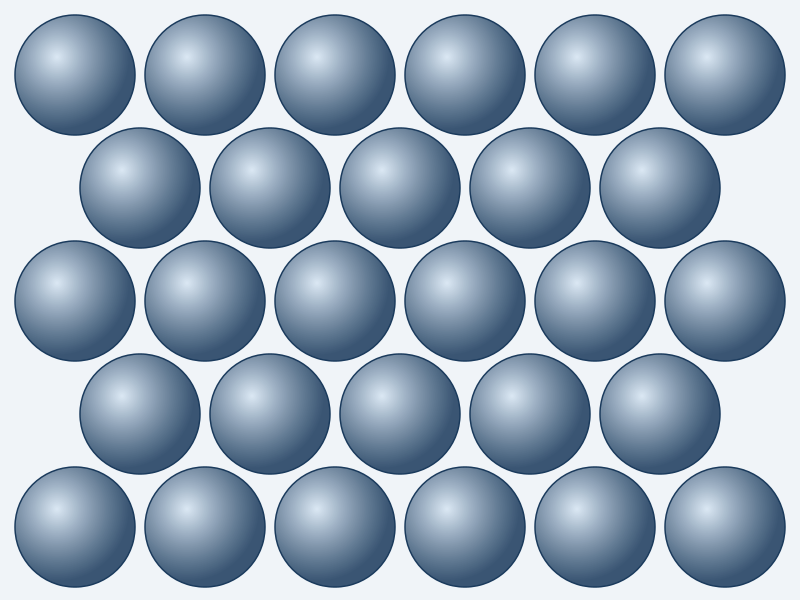
By Level 12, the system reaches the stable 12-fold FCC/HCP lattice — a qualitatively new regime of maximal coordination and infinite stable extension.
Each transition is a textbook instance of "more is different": quantitative increase in the number of interacting units produces qualitative leaps in order, symmetry, and stability.
Finite Depth and Lower-Dimensional Effective Theories
Krakauer et al. stress that true emergence replaces high-dimensional microscopic descriptions with lower-dimensional effective theories. Ffellonics does precisely this — and does so with a feature that distinguishes it from open-ended scaling systems:
The high-dimensional configuration space of thousands or millions of spheres is compressed into a simple 12-Level hierarchy.
The final ground state at Level 12 can be described by a single compact structure: the 12-fold lattice, characterised by its coordination number, symmetry group, and packing fraction.
Once Level 12 is reached, the system no longer generates new hierarchical levels; it extends laterally while remaining fully described by the same low-dimensional geometry.
This finite-depth hierarchy followed by infinite lateral extension is the sharpest point of contact with the paper's framework. Most scaling systems — including LLMs — do not terminate in a stable effective theory; they simply grow. Ffellonics reaches a genuine endpoint where the emergent description is both complete and compact. Whether other minimal emergence models such as the Ising model achieve an analogous endpoint is a question worth pursuing; the Ising ground state is also a simple lattice description, and the comparison would be instructive.
"Less Is More" — Efficiency and Optimal Compression
The paper argues that intelligence and high-level emergent order are marked by increasing efficiency: systems achieve more while using less. Ffellonics embodies this principle:
The entire 12-Level structure is generated by one local rule.
Each attachment is the lowest-free-energy move available, producing maximal coordination with no wasted moves and no backtracking.
By Level 12, the system has reached a global thermodynamic minimum where further hierarchical growth is unnecessary, and maintains low free energy while extending indefinitely.
The system follows the steepest descent in the free-energy landscape at each step, deterministically and without detours — a particularly clean instance of "less is more" precisely because no stochastic exploration or parameter tuning is required.
What Ffellonics Does Not Show
An honest account requires acknowledging the limits of the illustration. Ffellonics is a deterministic classical model. Many of the most important examples of emergence in complex systems — symmetry breaking in the Ising model, pattern selection in Turing systems, convective onset in Bénard cells — depend on stochastic fluctuations playing a constructive role: noise drives the system across symmetry-breaking thresholds that purely deterministic dynamics would not cross. Ffellonics emergence operates in the idealised, noiseless limit. Extensions incorporating thermal fluctuations or probabilistic attachment would be needed to reach the full generality the paper discusses, particularly in the context of biological and neural systems where stochasticity is integral rather than incidental.
This is not a flaw in the model so much as a statement of its scope: Ffellonics demonstrates what emergence looks like at its most deterministic and geometrically clean. That is a useful limiting case, but it should not be confused with a complete account.
Ffellonics as a Reference Case in the LLMs Debate
The paper is largely a critique of over-enthusiastic claims about emergence in LLMs. Ffellonics is not a better system than an LLM in any general sense — they were designed for entirely different purposes. What Ffellonics offers is something more specific: a reference case in which the criteria for genuine emergence are satisfied unambiguously and without statistical approximation. When the criteria are contested — as they are in the LLMs debate — having a case where they are clearly met helps clarify what those criteria actually require in practice.
In Ffellonics, emergence is deterministic, geometrically verifiable, thermodynamically grounded, and terminates in a provably optimal ground state. Against this reference, the question of whether LLM capability jumps constitute genuine emergence can be posed more precisely: do they produce a lower-dimensional effective theory? Do they terminate in a stable, compact description? Do they satisfy "less is more"? The reference case does not answer these questions, but it makes them more concrete.
Conclusion
Ffellonics resonates with the complex-systems perspective in Krakauer et al. because it is a genuine instance of the kind of emergence the authors defend: many identical components, one local rule, qualitatively new higher-level order at each transition, and a final ground state described by a compact and stable effective theory. Its most distinctive contribution to the emergence literature is the finite-depth termination — the 12-Level hierarchy ends, rather than scaling indefinitely, and what remains is a single, interpretable lattice geometry.
This makes Ffellonics a useful reference model in conversations about emergence in artificial systems: not as a claim to be the singular or pre-eminent illustration of emergence, but as a minimal, fully interpretable case that satisfies the rigorous criteria clearly enough to serve as a benchmark for comparison. In that role — precise, thermodynamically grounded, geometrically transparent, and honest about its deterministic scope — it earns a place in the conversation the paper opens.
Comments
No comments yet. Be the first to share your thoughts.