Ffellonics as a Geometric Framework for Social Theory: Relational Ontology and Hierarchical Emergence
· 4 min read
ByDavid Fell
Ffellonics as a Geometric Framework for Social Theory: Relational Ontology and Hierarchical Emergence
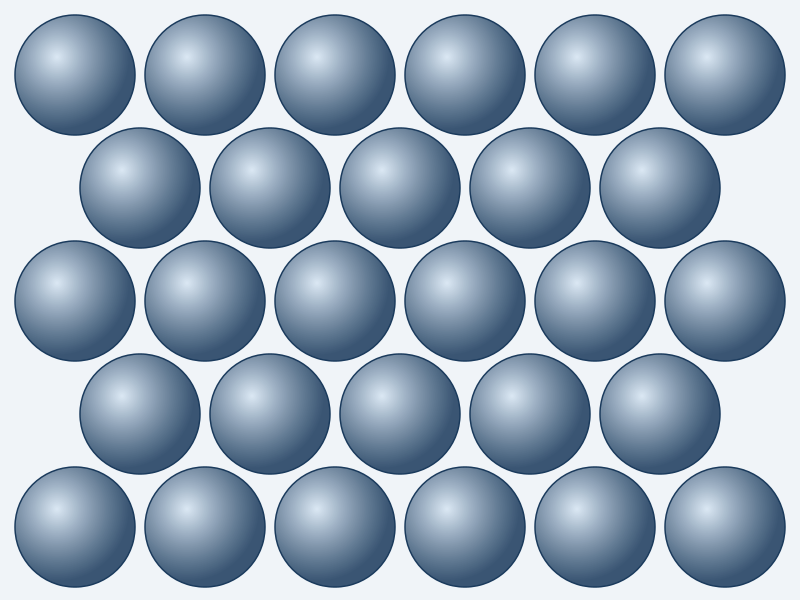
Ffellonics, the 12-level hierarchical model developed by David Fell, is fundamentally a geometric system where identical spheres—serving as ontological primitives—attach through symmetric nearest-neighbor contacts to generate emergent structures from minimal dyads to maximal dense lattices. While primarily rooted in physical self-assembly (e.g., crystals or virus capsids), its relational logic extends naturally to social theory. In Ffellonics, isolated spheres have no intrinsic identity; structure and meaning arise solely through "touches" — relational events that propagate into complex symmetries. This mirrors key concepts in social theory, particularly relational ontology (where relations precede entities) and hierarchical emergence (where local interactions build layered social networks). By analogizing spheres to social actors (individuals, ideas, or groups) and attachments to interactions (bonds, exchanges, or affiliations), Ffellonics offers a visual, geometric lens for understanding how social systems self-organize from simple connections into resilient hierarchies. This article explores these parallels, highlighting Ffellonics' potential to bridge geometry and sociology.Relational Ontology: Touches as the Primacy of RelationsRelational ontology posits that social phenomena are constituted by relations rather than independent entities—relations are ontologically primary, shaping what "things" become. In Ffellonics, this is literal: spheres (actors) exist as pure potential until a "touch" (interaction) occurs, creating the first link (dyad, level 1). Subsequent attachments build identity through interdependence—e.g., a triangle (level 2) introduces closure, much like a triad in social networks provides stability over dyadic pairs.This aligns with thinkers like Vygotsky, whose relational ontology views development as connecting individuals to their world, eliminating subject-object dualism. In social theory, Mustafa Emirbayer's manifesto for relational sociology critiques substantivist views (entities first), advocating for relations as the core unit of analysis. Ffellonics visualizes this: social "spheres" (people) gain roles through bonds (friendships, collaborations), unfolding into hierarchies like communities or institutions. The phrase "from one touch comes everything" underscores this depth—relations are generative, echoing Deleuze's difference preceding identity or Wildman's relational ontology where interconnections define essence.In tourism studies, relational ontology highlights how interactions constitute experiences; Ffellonics could map this as attachments forming "lattice-like" social fabrics. Overall, Ffellonics provides a geometric scaffold for relational social theory, showing how minimal bonds cascade into meaningful social forms.Hierarchical Emergence: From Local Bonds to Global NetworksFfellonics' progression—early levels building internal symmetry (1–6), later ones integrating environmentally (7–12)—parallels hierarchical emergence in social networks, where local ties evolve into layered structures. Social hierarchies often arise from endorsements or interactions, as in networked endorsement dynamics where preferences create leader nodes at hierarchy pinnacles. In Ffellonics, this is the shift from planar tessellations (level 6) to trusses (level 7), where a stable axis enables infinite extension—analogous to how social triads (level 2 equivalents) stabilize into cliques, then hierarchies.Studies show humans navigate multiple status domains, with hierarchies emerging from dyadic ties and group perceptions. Ffellonics models this: low levels (dyads/triads) represent basic social bonds, mid-levels (polyhedra) form cliques or teams, and high levels (lattices) depict dense networks like organizations or societies, with 12-fold coordination symbolizing maximal interconnectedness (e.g., high-density social capital).Cultural algorithms and multiagent systems further illustrate emergence: local rules lead to hub networks, much like Ffellonics' attachments yield leader-like high-CN nodes. In physics-inspired social models, hierarchies transition from egalitarian to stratified states via reputation or interaction dynamics, independent of size—echoing Ffellonics' energy-minimizing progression.Applications: Ffellonics as a Tool for Social AnalysisFfellonics offers practical value in social theory by providing a visual metaphor for relational dynamics. For instance, in network sociology, weak ties (low-CN attachments) bridge clusters, while strong ties (high-CN) build dense cores—mirroring the hierarchy's early sparse levels to late integrated lattices. It could analyze social inequality: low-CN "isolates" represent marginalized actors, while 12-CN hubs depict elites in hierarchical societies.In regenerative or commoning theories, Ffellonics' symmetry-driven harmony suggests pathways for equitable networks, where "touches" foster inclusive emergence. Fell himself extends Ffellonics to human systems, noting its potential for modeling social bonds unfolding into harmonious networks.Conclusion: A Geometric Bridge to Social RelationalismFfellonics enriches social theory by offering a relational, hierarchical model where "from one touch comes everything"—bonds precede entities, and local interactions yield global order. It complements relational ontology by visualizing interdependence and hierarchical emergence by mapping network growth. As a tool, it invites interdisciplinary applications, from analyzing power structures to designing equitable communities. In a world of networks, Ffellonics reminds us that social reality is woven from relations, one touch at a time.
Share:
Comments
No comments yet. Be the first to share your thoughts.