Ffellonics: The Bridge Between Quantum Chaos and Ordered Emergenc
· 3 min read
Quantum chaos describes quantum systems whose classical counterparts exhibit extreme sensitivity to initial conditions — the “butterfly effect” — producing statistical signatures such as level repulsion, delocalised eigenstates, and random-matrix behaviour. It is the realm of creative scrambling, fractal-like complexity, and apparent unpredictability at the quantum scale.Ordered emergence, by contrast, is the spontaneous appearance of stable, hierarchical, highly symmetric structures — crystals, virus capsids, molecular assemblies — that exhibit maximal coordination and thermodynamic stability.Ffellonics provides the precise geometric and thermodynamic bridge between these two regimes.The Quantum-Chaotic SubstrateIn the early stages of many quantum many-body systems (Rydberg atom arrays, ultracold gases, or strongly interacting bosons), the dynamics are quantum-chaotic: the wavefunction explores configuration space sensitively, energy levels repel, and the system behaves statistically like a random matrix. This corresponds to the brief, fluctuation-dominated phase in Ffellonics (Levels 1–3). Small deviations in attachment could, in principle, lead to disordered clusters. The system is still “scrambling” possibilities.The Thermodynamic FunnellingOnce dissipation and symmetry constraints are active, the system rapidly relaxes out of the chaotic regime. The single local rule of Ffellonics — symmetric nearest-neighbor attachment under continuous free-energy minimization — becomes dominant. Entropy production powers an irreversible, self-reinforcing flow. Chaotic fluctuations are damped, and the hierarchy locks onto the symmetry-maximizing pathway:
- Level 3: Tetrahedron — first closed symmetric shell
- Level 4: Octahedron
- Level 5: Icosahedron — final Platonic milestone
- Levels 6–11: Successive shells refining coordination
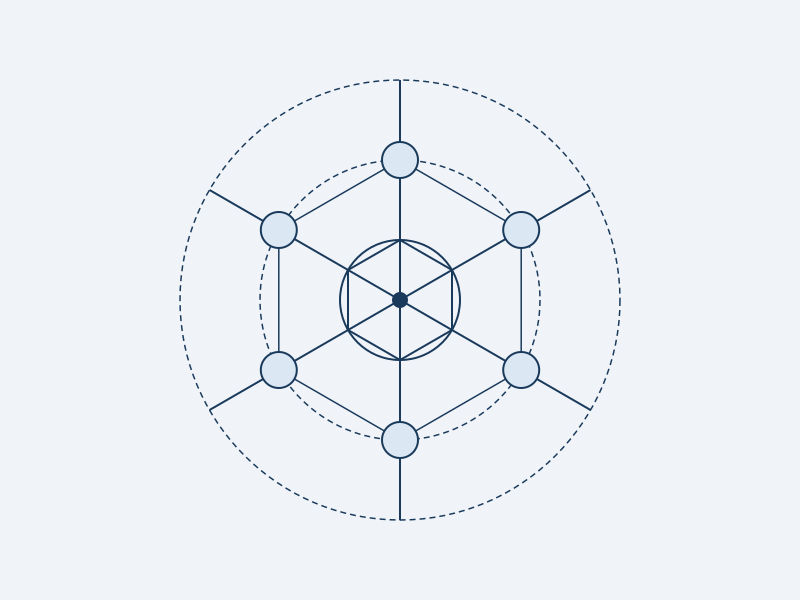
- Level 12: Stable 12-fold FCC/HCP lattice — the thermodynamic and geometric ground state
- It retains the deterministic, local-rule character of both quantum chaos and ordered emergence.
- It shows how symmetry preservation and free-energy minimization actively suppress chaotic sensitivity and select the lowest-free-energy configurations.
- It has finite hierarchical depth (exactly 12 Levels) — the precise point at which chaos ends and stable order begins — followed by infinite lateral extension in the non-chaotic 12-fold lattice.
Share:
Comments
No comments yet. Be the first to share your thoughts.