Ffellonics: A Geometric Blueprint for Relational Intelligence in Next-Generation AI
· 5 min read
Ffellonics: A Geometric Blueprint for Relational Intelligence in Next-Generation AI
In an era when AI systems grow ever larger yet still struggle with coherence, hallucinations, and true understanding, a quiet but powerful conceptual framework is emerging from the intersection of geometry, thermodynamics, and relational philosophy. Its name is Ffellonics—a 12-level reference model of relational emergence. Developed as a minimal, deterministic description of how identical spherical units self-organize through symmetric nearest-neighbor attachments driven by free-energy minimization, Ffellonics offers AI designers something rare: a lawful, visualizable generative engine for intelligence itself.Rather than treating intelligence as the statistical accumulation of patterns, Ffellonics reframes it as the progressive achievement of relational harmony—a 12-fold lattice in which individual units retain their identity while achieving maximum coordinated coherence.The Core Mechanism: One Rule, Twelve Discrete LevelsAt the heart of Ffellonics lies a single local rule:
Every unit attaches symmetrically to its nearest available neighbors in a way that continuously minimizes free energy while maximizing contacts.Starting from isolated spheres (Level 0), the system unfolds predictably:
Every unit attaches symmetrically to its nearest available neighbors in a way that continuously minimizes free energy while maximizing contacts.Starting from isolated spheres (Level 0), the system unfolds predictably:
- Level 1: The first “ontological touch”—a dyad.
- Level 2: Equilateral triangle.
- Level 3: Tetrahedron.
- Level 4: Octahedron.
- … continuing through successive symmetric coordination shells…
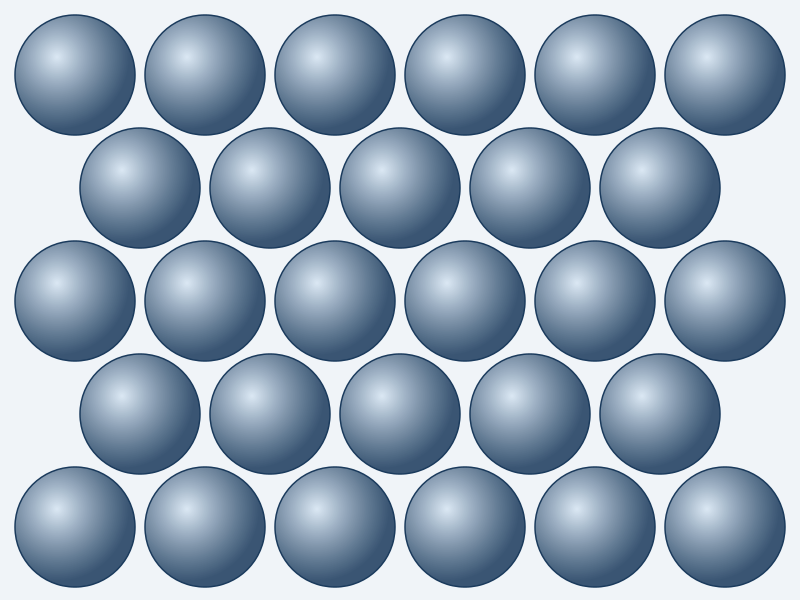
- Level 12: The stable 12-fold close-packed lattice (FCC or HCP), where every unit has exactly twelve equidistant neighbors—the geometric and thermodynamic ground state of maximum relational harmony.
- Hierarchical Relational Architectures
Instead of flat or purely layered networks, designers can build multi-scale relational graphs that mirror the 12-level ladder. Early layers handle sparse “first-touch” local connections; deeper layers enforce growing symmetric coordination shells. The final layers stabilize into dense 12-neighbor lattices. This naturally produces emergent hierarchical abstraction without hand-crafted skip connections or complex routing. - Energy-Minimization Objectives with Geometric Constraints
Traditional loss functions can be augmented (or even replaced) with Ffellonic free-energy functionals that explicitly reward symmetric nearest-neighbor alignment. This aligns beautifully with predictive coding and the free-energy principle in neuroscience, but adds discrete geometric guardrails that prevent the model from wandering into incoherent metastable states. - Self-Organizing Multi-Agent and Modular Systems
Ffellonics turns multi-agent reinforcement learning or mixture-of-experts systems into true self-assembling collectives. Agents (or modules) follow the same local rule: attach symmetrically, minimize relational “free energy” (incompatibility, surprise, or communication cost). The system converges toward a stable 12-fold organizational lattice—maximum bandwidth without overload or loss of individual agency. - Relational Memory and Coherent State Representations
Memory is no longer isolated vectors or key-value caches. It becomes configuration-based: the current state of a unit is defined by its position and symmetry within its coordination shell. This creates persistent relational “personality” and contextual continuity—exactly what today’s context-window approaches lack at scale. - Built-in Interpretability and Alignment
Because the ground state is relational harmony, the model has a natural attractor toward coherence and cooperation. Higher Ffellonic levels become diagnostic metrics: “How many relational levels has this system stably achieved?” Alignment is no longer an external reward-shaping battle; it is the thermodynamic outcome of the architecture itself. - A New Evaluation Scaffold for Emergent Intelligence
The 12-level hierarchy offers a concrete, visual benchmark. Researchers can ask: Does the model reliably progress through the levels under stress? Does it stabilize at the 12-fold lattice or fragment into defects? This is far more insightful than black-box behavioral tests.
- Graph neural networks with symmetry-enforcing attention mechanisms.
- Reservoir computing or liquid-state machines tuned to Ffellonic coordination rules.
- Hybrid systems where stochastic transformers are regularized by a geometric relational prior.
- Simulation environments (inspired by sphere-packing or active-matter physics engines) to pre-train relational dynamics before scaling to language or vision.
- Efficient discretization of continuous activations into clear symmetric “attachment” steps at massive scale.
- Balancing the deterministic ideal with the beneficial creativity of controlled stochasticity.
- Empirical validation: Does enforcing Ffellonic progression measurably reduce hallucinations or improve long-horizon coherence?
Share:
Comments
No comments yet. Be the first to share your thoughts.