Relativity and Relational Emergence: A Deep Philosophical Connection
Relativity and Relational Emergence: A Deep Philosophical Connection
Einstein's Theory of Relativity and Ffellonics belong, on the surface, to different domains — one a cornerstone of modern physics, the other a geometric framework for understanding classical self-organisation and emergence. Yet they share a foundational philosophical commitment: the primacy of relation over substance.
Einstein's Relational Revolution
Classical Newtonian physics rested on the assumption of an absolute background — fixed, independent space and time that existed whether or not anything occupied them. Matter moved within this unchanging container, and the container itself was never in question.
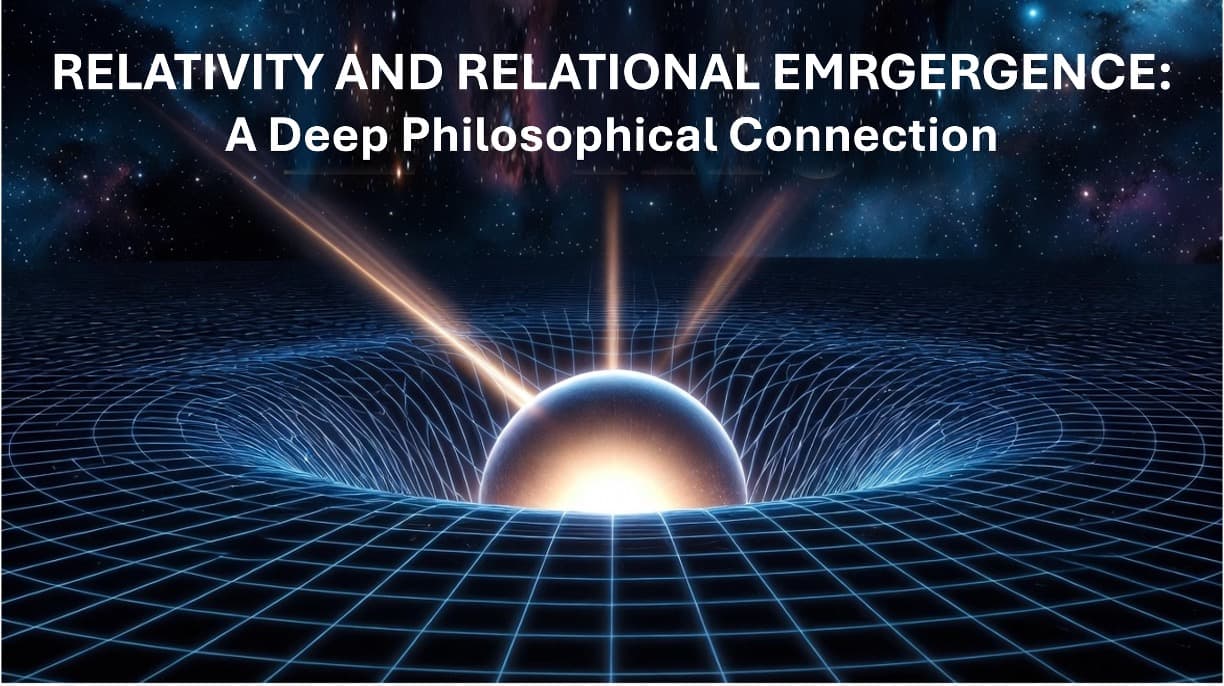
Special and General Relativity dismantled this picture. Space and time are not absolute. Their structure depends on the distribution of matter and energy, and on the relative motion of observers. Gravity is not a force acting across a pre-existing void, but the curvature of spacetime itself — shaped by mass-energy. There is no privileged vantage point outside of relationships.
Einstein's insight was, at its core, ontological: reality is not made of things sitting in a container. Reality is made of relationships.
Ffellonics: Extending the Relational Insight
Ffellonics carries this relational turn into the classical domain of geometric self-organisation. Its starting point is radical in a complementary way:
Before the first ontological touch, there is only pre-relational isolation — pure potential, without actual existence or structure.
The moment two relational units make contact (Level 1), ordered reality is born. From that single event, one local rule governs all further development: symmetric nearest-neighbour attachment under free-energy minimisation. No global blueprint. No central designer. Only local symmetry-seeking and energy-minimising interactions.
From this minimal foundation, a clear 12-stage developmental hierarchy unfolds:
Early levels establish basic bonds and simple symmetries.
Intermediate levels naturally generate the Platonic solids — triangle, tetrahedron, octahedron, icosahedron — as stable geometric milestones.
Level 12 reaches the stable 12-fold FCC/HCP lattice: the thermodynamic ground state of maximum coordination and minimum free energy.
This progression is not imposed from above. It emerges purely from local interactions, arriving at a genuine stable attractor rather than perpetual flux.
A Natural Continuum
Relativity shows that at the deepest physical level, there are no absolute frameworks — everything is relational. Ffellonics shows what naturally follows in the classical regime: once relation begins, it traces a lawful, geometric path toward ever-deeper coordination and order.
Where Einstein revealed the relational nature of spacetime, Ffellonics reveals the relational nature of emergent classical structure — from atoms forming crystals to cells forming tissues. Crucially, Ffellonics does not claim to be a theory of everything. It does not account for quantum gravity, the origin of physical laws, or the fine-tuning of constants. What it offers, with unusual clarity, is a minimal reference model: how ordered reality self-organises once relation has begun.
A Unified Philosophical Vision
Together, these two frameworks suggest a coherent picture across scales:
At the fundamental level, Einstein showed us there are no independent things in an absolute container. In the classical domain, Ffellonics shows how stable, meaningful structures arise through progressive relational coordination — from one rule, one geometry, one developmental arc.
This is not mere analogy. Both frameworks challenge the intuition that reality is built from isolated building blocks. Both argue, in their respective registers, that relation is ontologically prior to substance. And both arrive at the same philosophical conclusion: that order, symmetry, and coherence are not imposed on the universe from outside — they emerge from within it, through the internal logic of relation itself.
Why This Matters
This connection is more than academic. It suggests that the relational turn Einstein initiated over a century ago has implications well beyond physics — for how we understand consciousness, meaning, and the emergence of complex social and cognitive structures.
In Ffellonics, the sense Einstein described — that everything dances according to deeper laws — finds precise geometric expression. Once the first touch occurs, the system does not wander. It follows a determinate path toward the mature 12-fold ground state: maximum harmony, minimum internal tension.
At Level 12, individuality is not erased. It is fulfilled within a larger coherent whole — perhaps the clearest geometric expression we have of the philosophical intuition that unity and multiplicity are not opposites, but perfectly compatible in mature relational order.
Einstein liberated us from absolutes. Ffellonics shows how meaningful structure is built in the relational universe he revealed. The two ideas together point toward a deeper truth: reality is relational at every scale — and from that relational ground, ordered and coherent existence naturally emerges.
Comments
No comments yet. Be the first to share your thoughts.