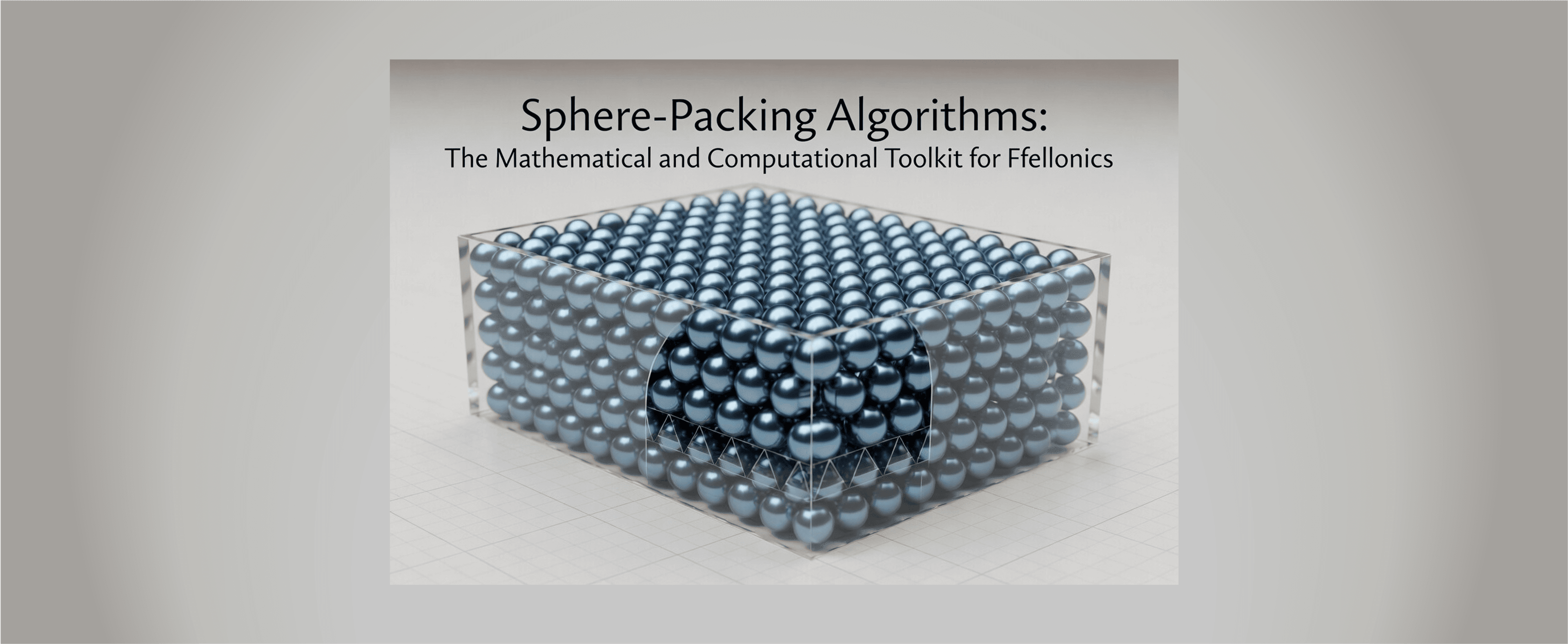
Sphere-Packing Algorithms: The Mathematical and Computational Toolkit for Ffellonics
Ffellonics (also called Fellonic geometry or the Fellonic hierarchy) offers a distinctive lens on geometry: a generative, hierarchical system in which identical spherical units self-assemble through simple local rules into increasingly complex, symmetrical structures. At its core lies a profound reliance on the mathematics and algorithms of sphere packing—the problem of arranging non-overlapping spheres to maximize density and stability.
Sphere-packing algorithms do not merely inspire Ffellonics; they supply its precise toolkit. They model the “natural attachment” of spheres, the emergence of hierarchy from minimal beginnings, the drive toward symmetry and energy minimization, and the progression toward densest possible configurations.
The Foundations of Ffellonics
Ffellonics begins with the simplest possible connection: two spheres touching. This dimer forms Level One of the hierarchy and seeds an expanding network. Subsequent spheres attach according to local rules of contact and symmetry, building polyhedral clusters and eventually denser arrangements. The framework is often described as a finite 12-level progression that moves from basic linear or planar forms to complex three-dimensional matrices.
Posts from its primary source describe it this way: “The FFELLONIC hierarchy begins when two spheres attach” and “Ffellonic geometry is created when spheres of similar binding potential are allowed to naturally combine.” The endpoint frequently highlighted is the principle of densest sphere packing itself.
This is not abstract philosophy alone. It is a structured interpretation of how ordered, relational structures emerge from repeated application of minimal geometric rules—precisely what sphere-packing algorithms compute and simulate.
Sphere Packing: The Core Mathematical Problem
Sphere packing asks: How can we arrange equal spheres in space so that they do not overlap while occupying as much volume as possible? In three dimensions, the answer—proven by Thomas Hales—is the family of close-packed structures (face-centered cubic or FCC, and hexagonal close packing or HCP), each achieving a density of
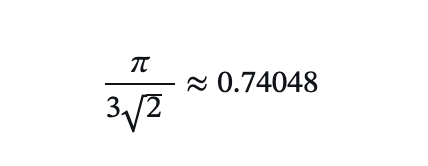
Every interior sphere touches exactly 12 neighbors. These structures arise from simple constructive rules that Ffellonics adopts as its generative
Key Algorithms as Ffellonic Toolkit
1. Greedy / Sequential Attachment Algorithms
The most direct parallel is the family of greedy or sequential attachment methods. These algorithms add one sphere at a time in the position that maximizes contacts or stability—typically the deepest “pocket” formed by existing spheres.Start with two touching spheres.
Place the next sphere in a triangular depression → tetrahedral cluster.
Continue → octahedral, icosahedral, and larger polyhedral arrangements.
This mirrors Ffellonic “natural attachment” exactly. The process is local, rule-based, and produces the early hierarchical levels of Fellonic forms. It requires no global plan—only repeated application of the same contact rule. In Ffellonics, this local rule is elevated to a philosophical principle of relational emergence.nature.com
2. Layered Close-Packing Constructions
A second foundational algorithm builds infinite or large-scale structures by stacking hexagonal layers:
- Create a compact hexagonal plane (Layer A).
- Place the next layer in one of two possible sets of depressions (Layer B or C).
- Repeat with chosen stacking sequence (ABAB… for HCP; ABCABC… for FCC).
These constructions generate the densest known packings and directly correspond to the higher levels of the Fellonic hierarchy, where symmetry and coordination reach their maximum. Ffellonics views the resulting dense matrices as the “pinnacle of complexity.”
3. Energy-Minimization and Molecular-Dynamics Simulations
Algorithms such as the Lubachevsky–Stillinger (LS) method simulate physical compression or sphere expansion through event-driven collision detection. Spheres start small or randomly placed and grow or the container shrinks until the system jams into a stable configuration.
These simulations naturally produce both ordered close packings and disordered random-close packings (~0.64 density). They embody the Fellonic emphasis on symmetry as nature’s way of minimizing energy and achieving stability. The “rattlers” and jammed states that emerge in LS runs parallel the idea of structures relaxing into efficient, symmetrical forms through local interactions.
4. Optimization and Heuristic Methods
Linear programming, nonlinear optimization, genetic algorithms, and specialized solvers (e.g., RRR algorithm in higher dimensions) find optimal or near-optimal arrangements under constraints. In the Fellonic context, these provide the computational means to explore the “spectrum of pure geometric constructs” and to verify that symmetrical pathways lead to efficient outcomes.
Mapping Algorithms to Ffellonic Hierarchy
The correspondence is remarkably tight:
Level 1: Two-sphere dimer — starting configuration in every attachment algorithm.
Early levels (2–6): Tetrahedral, octahedral, and icosahedral clusters — direct output of greedy attachment.
Intermediate levels: Layered and polyhedral growth — produced by stacking and continued local attachment.
Higher levels / Pinnacle: Dense close-packed matrices — the mathematical optimum proven by Kepler/Hales and simulated by energy-minimization algorithms.
Ffellonics adds a narrative and philosophical layer: it treats this progression not as one possible arrangement among many, but as a necessary developmental sequence governed by symmetry preservation and local energy minimization.
Beyond Computation: Emergence and Philosophy
Sphere-packing algorithms are purely mathematical or physical tools. Ffellonics transforms them into a model of relational emergence. Isolated spheres possess no inherent structure; order arises only through connections. Symmetry is not decorative—it is the mechanism by which systems make the most efficient use of space, energy, and “time in a system’s life.”This perspective resonates with observations in nature (crystal growth, granular materials, biological packing) and has inspired speculative extensions, including reinterpretations in quantum gravity where sphere attachments become entangling operations and the hierarchical progression models multipartite entanglement.
Conclusion
Sphere-packing algorithms—greedy attachment, layered constructions, energy-minimization simulations, and optimization techniques—supply the rigorous mathematical and computational foundation upon which Ffellonic geometry is built. They furnish the precise mechanisms by which two spheres can grow, through repeated local rules, into hierarchical networks that culminate in the densest possible arrangements.
Ffellonics does not replace these algorithms; it interprets and elevates them. It asks not only what configurations are possible, but in what ordered sequence they arise when identical units follow a single minimal rule of natural attachment and symmetry. In doing so, it bridges discrete geometry, computational simulation, and a broader philosophy of relational self-organization.
The two-sphere seed and the algorithmic pathways that follow from it remain the enduring toolkit for exploring how order, efficiency, and complexity emerge in both mathematical space and the physical world.
Comments
No comments yet. Be the first to share your thoughts.