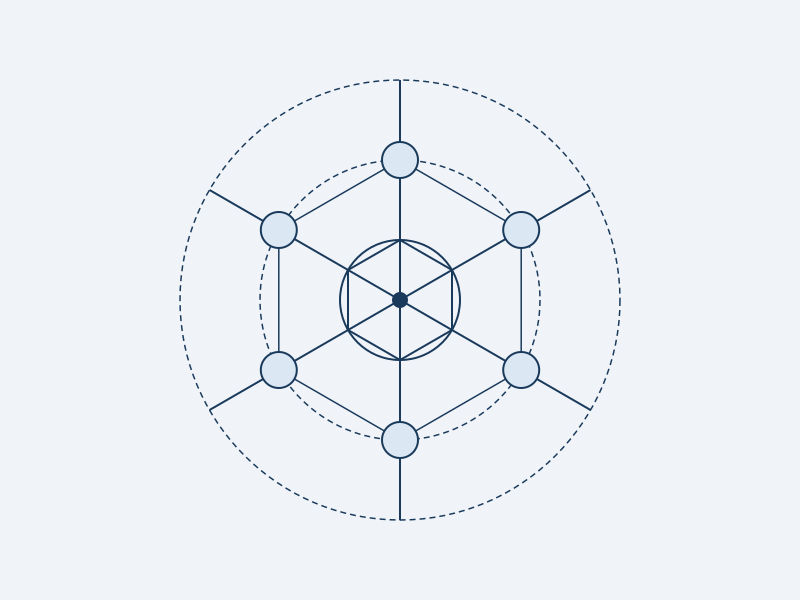
Symmetry: The Cornerstone of Hierarchical Processes
· 4 min read
Hierarchical processes, whether in nature, engineering, or computational models, often rely on structured layers of organization to achieve efficient outcomes. At the heart of this efficiency is symmetry—a property that minimizes redundancy, reduces energy consumption, and enables smooth progression. This article explores how symmetry facilitates energy-efficient advancement in hierarchical systems, drawing on principles from physics, materials science, and biology. By examining key examples and mechanisms, we uncover the role of symmetry in optimizing hierarchical evolution, ultimately revealing a blueprint for low-energy progression.
Introduction to Hierarchical Processes and Energy Efficiency
A hierarchical process is one that builds complexity through successive levels, where each stage depends on and expands upon the previous. Examples include biological growth (e.g., from cells to organisms), computational algorithms (e.g., generative models), and physical systems (e.g., heat engines). Efficiency in these processes means achieving the desired outcome—such as stable structures or optimal performance—with the lowest energy input, avoiding waste through chaos or imbalance.
Symmetry plays a pivotal role here, as it imposes order that streamlines transitions between levels. In symmetric systems, equivalent parts behave uniformly, reducing the energy needed for coordination or correction. For instance, rotational symmetry in energy conversion systems can increase output work, while reflection symmetry enhances efficiency by balancing forces. This symmetry-driven efficiency is not accidental but a fundamental requirement for hierarchical progression, as asymmetry often leads to energy losses through instability or friction.
Symmetry in Natural and Biological Hierarchies
In nature, hierarchical processes like cellular organization or brain dynamics demonstrate how symmetry minimizes energy. For example, symmetry breaking in space-time hierarchies shapes brain dynamics, where network connectivity forms a timescale hierarchy, enabling efficient information flow with low energy. This symmetry ensures that neural signals propagate smoothly, avoiding wasteful detours.
Biological structures, such as hierarchical chiral honeycombs, further illustrate this. These designs, with layered symmetry, improve energy absorption by 53.8% compared to conventional forms, distributing impact forces evenly and reducing material strain. Symmetry here allows the hierarchy to progress from micro (cellular) to macro (organism) levels with minimal energy, as each layer reinforces the next without excess deformation.
Symmetry in Engineered and Physical Systems
In engineering, symmetry is engineered into hierarchical systems to optimize energy use. For electric vehicles, symmetry-guided designs in road conditions and driver behavior reduce energy consumption by balancing factors like speed and terrain. Hierarchical symmetries in heat engines, such as those with time-dependent protocols, create global response relations that enhance efficiency, where symmetry minimizes entropy production.
Symmetry analysis methodologies for energy conversion systems show that stronger rotational symmetry generates more work, while reflection symmetry boosts efficiency at constant heat capacity. In materials generation, symmetry-aware hierarchical models create stable structures with low energy costs, using generative flows to explore symmetric configurations efficiently. These examples highlight symmetry as a prerequisite for hierarchical advancement, ensuring minimal energy expenditure through balanced progression.
The Role of Symmetry in Minimizing Energy
Symmetry reduces energy in hierarchical processes by:
• Eliminating Redundancy: Symmetric configurations allow uniform distribution of forces or resources, avoiding wasteful asymmetry.
• Facilitating Transitions: In driven systems, hierarchical symmetries like Onsager relations ensure smooth cycle progression with low dissipation.
• Optimizing Stability: Fractal or chiral hierarchies, with embedded symmetry, enhance energy absorption and stability, as seen in honeycombs.
This energy minimization is crucial for progression, as asymmetry often leads to higher entropy and inefficiency. Conservation laws in physics further underscore this, where symmetry under transformations (e.g., rotation) conserves energy, enabling hierarchical systems to evolve without excess loss.
Applications and Implications
In energy systems, symmetry optimizes performance, as seen in multi-objective designs for heat exchangers where symmetric corrugations reduce energy use. In materials, hierarchical topological states with symmetry-enforced transitions enable low-energy states. These applications show symmetry as essential for efficient hierarchical evolution, with implications for sustainable design and AI models.
Conclusion
Symmetry is the cornerstone of energy-efficient progression in hierarchical processes, enabling structured growth with minimal loss. From biological networks to engineered systems, it ensures balanced transitions, conserving resources and maximizing output. As research advances, symmetry will continue to guide efficient hierarchical designs, paving the way for innovations in energy conservation and beyond.
Share:
Comments
No comments yet. Be the first to share your thoughts.