The Ffellonic Progression: From Two Nodes to Twelve — Gradual Advantages in Relational Emergen
Ffellonic geometry, or Ffellonics for shorthand, is a hierarchical framework where identical spheres serve as foundational units, attaching through symmetric nearest-neighbor contacts to build increasingly complex structures. At its core is a 12-level progression, starting from the simplest dyad (two nodes, level 1) and culminating in dense lattices with maximal 12-node coordination (the endpoint, reflecting the mathematical limit for equal spheres in 3D space). This journey isn't arbitrary; it follows low-energy, dissipative paths that mirror natural self-assembly, gradually conferring advantages in stability, efficiency, resilience, symmetry, and synergy.
In Ffellonics, "nodes" refer to the coordination number (CN) — the number of direct attachments per sphere. A two-node setup (CN=1 per sphere in the dyad) represents pure potential: fragile, isolated, and high-energy. As the hierarchy unfolds, CN increases step by step, transforming local simplicity into global robustness. Below, we explore this progression, highlighting the cumulative benefits that emerge as the system evolves toward 12-node mastery.
The Starting Point: Two Nodes — Minimal Relation and High Potential Energy
At level 1, the dyad forms when two spheres touch at a single point. This is the "first event" — a minimal bond with CN=1 per sphere. Advantages are scant: it establishes relational existence, but the structure is inherently unstable. Any external force (vibration, shear) can sever the lone connection, and the system retains high surface energy with vast empty space around it.This mirrors nature's nascent stages: think of two atoms forming a diatomic molecule (e.g., H₂) — functional but fragile, with limited capacity for further growth or resilience. The dyad's "advantage" is its simplicity: low barrier to initiation, setting the stage for expansion. However, without progression, it remains isolated and inefficient, embodying the raw chaos before order.
Early Progression: Building to Intermediate Coordination (Levels 2–5, CN=2–5)
As spheres attach, CN rises gradually. Level 2 (triangular polygon, CN=2) introduces basic redundancy: three spheres form a stable plane, distributing forces across multiple bonds. This confers the first real advantage — planar stability. The triangle resists deformation better than a line, echoing why nature favors triangular motifs in early development (e.g., carbon rings in organic molecules or cell trusses in tissues).
By levels 3–5 (tetrahedron CN=3, octahedron CN=4, icosahedron CN=5), advantages accumulate:
Volumetric enclosure: The tetrahedron (level 3) creates the first closed 3D system, enclosing space with minimal material — a leap in efficiency. It provides rigidity against compression, similar to how tetrahedral bonds in diamonds confer extreme hardness.
Increased resilience: With CN=4–5, bonds share loads, reducing failure risk. The octahedron adds rotational symmetry, while the icosahedron maximizes surface enclosure for given nodes, mirroring virus capsids that protect genetic material with minimal proteins.
Emergent symmetry:These stages introduce polyhedral harmony, minimizing internal stress. Nature replicates this in early embryonic folding (blastula to gastrula), where cells attach to form symmetric shells for protection and growth.
Cumulatively, intermediate CN (2–5) shifts from linear fragility to 3D robustness, enabling the system to withstand perturbations while conserving energy. Empty space decreases, and the structure gains "identity" through relations — no longer mere points, but bounded forms.
Mid-to-Late Progression: Network Expansion and Global Coherence (Levels 6–9, CN=6–9)
Here, the hierarchy transitions to tessellations and trusses, with CN reaching 6–9. Advantages deepen into network-level benefits:
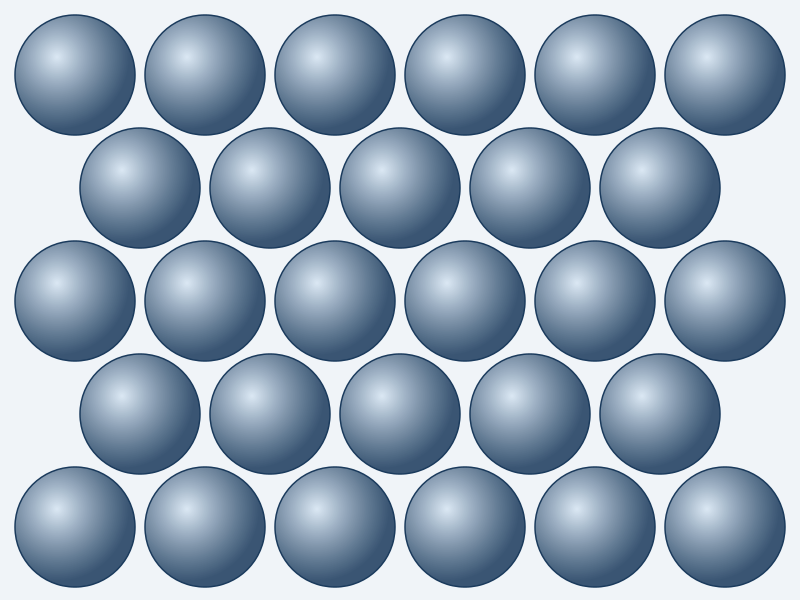
Space-filling efficiency: Level 6 (hexagonal tessellation, CN=6) introduces planar filling, reducing voids dramatically. This mirrors honeycomb structures in bee hives or epithelial tissues, where hexagonal packing minimizes material while maximizing strength and storage.
Structural redundancy: Linear trusses (level 7, CN=7–8) and octahedral spaceframes (level 8, CN=8–9) create interconnected beams, distributing forces across paths. Fail one bond, and alternatives compensate — a key advantage over low-CN fragility, seen in cytoskeletal networks where microtubules (CN up to 8) provide cellular rigidity without collapse.
Scalability and modularity: Mid-levels allow infinite extension (tessellations), conferring adaptability. In nature, this parallels branching in blood vessels or neural dendrites, where mid-coordination balances local flexibility with global support.
By CN=6–9, the system gains mechanical synergy: individual bonds contribute to collective properties like elasticity and vibration damping, far surpassing the dyad's isolation.
The Culmination: Twelve Nodes — Maximal Harmony and Synergistic Mastery
At the hierarchy's end (levels 10–12, CN=10–12 in dense FCC/HCP lattices), Ffellonics achieves the theoretical optimum. Each sphere connects to 12 equidistant neighbors, forming a cuboctahedral coordination polyhedron. Advantages peak:
Ultimate density and efficiency: Atomic packing factor reaches 74.05% — the highest possible, minimizing voids and energy. This mirrors close-packed metals (e.g., gold, copper) with high ductility and conductivity.
Omnidirectional resilience: With 12 bonds, forces distribute isotropically — no weak axes. Structures resist shear, compression, and tension uniformly, explaining why 12-CN crystals have superior toughness compared to lower-CN ones (e.g., diamond CN=4 vs. FCC metals).
Full emergent synergy: Properties like delocalized electrons (metallicity) or phonon transport arise only at high CN — unpredicted by dyads. In biology, 12-fold symmetry in virus pentamers enables efficient genome enclosure and infection.
Global order without defects: The lattice achieves long-range coherence, minimizing entropy and enabling scalability to infinite sizes while retaining stability.
Compared to two nodes, 12 confers exponential gains: from 1 bond to 6 per node (12 shared), fragility to robustness, isolation to interconnected harmony. Nature converges on 12-CN because it balances maximal contacts with minimal strain — the sweet spot for enduring complexity.
Conclusion: Gradual Conferral of Advantages in Nature's Mirror
The Ffellonic progression from two to twelve nodes gradually builds advantages: starting with basic relation (stability initiation), through redundancy and enclosure (resilience), to density and synergy (efficiency mastery). This mirrors natural development — from molecular bonds to cellular tissues — because Ffellonics abstracts the same rule: local attachments under energy minimization yield global order. As Fell notes, it "mirrors the pure natural process," reminding us that nature's complexity arises not from design, but from the cumulative power of simple, progressive connections. In a world of networks, reaching twelve isn't just better — it's the pinnacle of relational potential.
Comments
No comments yet. Be the first to share your thoughts.