The Genericity of Ffellonic Geometry: A Universal Blueprint for Emergent Symmetry in Nature
· 3 min read
The Genericity of Ffellonic Geometry: A Universal Blueprint for Emergent Symmetry in Nature
www.ffell.com
The Genericity of Ffellonic Geometry: A Universal Blueprint for Emergent Symmetry in Nature
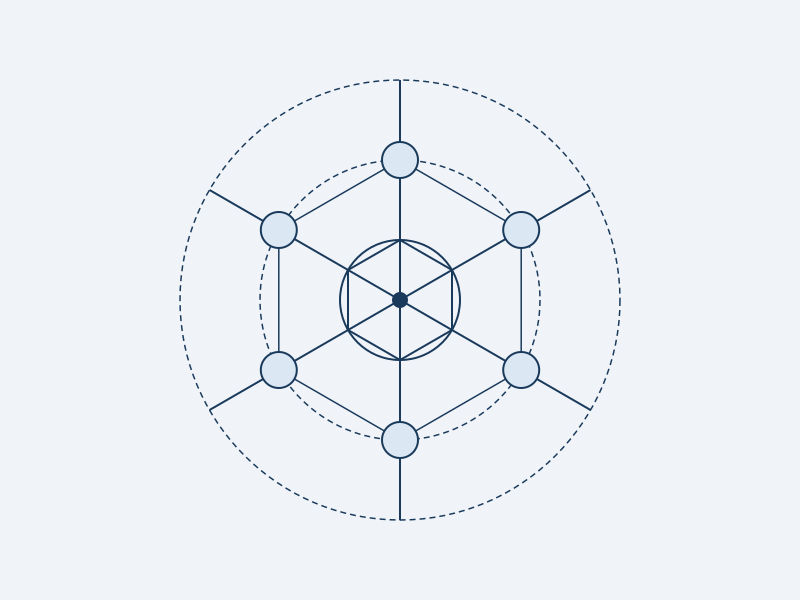
Ffellonic geometry, introduced in 2025 as a sphere-centric framework for understanding three-dimensional symmetry, stands out for its remarkable genericity. At its core lies a single generative axiom: identical spheres attach naturally, maximizing contacts while preserving symmetry and integrity. This simple rule unfolds into a 12-level hierarchy, from minimal dyads (Level 1, coordination k=1) to the densest regular packing in face-centered cubic (FCC) or hexagonal close-packed (HCP) lattices (Level 12, k=12).
What makes Ffellonic "generic" is not its specificity to one domain, but its ubiquity: the same pattern of relational emergence and energy-minimizing progression appears across physics, biology, cosmology, and beyond. It is not a rigid theory imposing structure on nature; rather, it describes the effortless, self-organizing flow that nature repeatedly follows when identical units interact locally to achieve harmony. This genericity stems from Ffellonic's alignment with fundamental principles like free-energy minimization, dissipative structures, and natural induction, making it a versatile lens for interpreting natural processes.
Genericity in Physics: Packing and Order from Chaos
In physics, sphere packing hierarchies are a cornerstone of understanding dense matter and phase transitions. Ffellonic's progression mirrors hard-sphere models, where particles self-assemble into ordered structures to minimize free energy. For instance, in granular media and colloids, systems evolve from disordered fluids to crystalline lattices (akin to Levels 6–12), driven by entropy maximization at high densities. This is evident in atomic crystals like gold or copper adopting FCC packing, reflecting Level 12's maximal efficiency.
High-dimensional extensions (e.g., 8D E8 lattice) further highlight genericity, linking to communications theory and quantum bounds. Viazovska's 2016 solution for 8D and 24D packings underscores how Ffellonic-like hierarchies solve longstanding problems in generic spaces.
Genericity in Biology: Self-Assembly and Adaptive Order
Biology abounds with Ffellonic patterns, as seen in viral capsids adopting icosahedral symmetry (Level 5) for energetic efficiency. Forests and ecosystems exhibit similar hierarchies: trees branch in fractal-like patterns optimizing space, akin to Ffellonic's relational growth. In planetary science, granular solids like regolith form packings with variable porosities, mirroring Ffellonic's density-driven order.
Levin's natural induction—repeated perturbation-relaxation yielding adaptive structures—directly aligns, as cells in biobots self-organize into symmetric forms without genetic blueprints, reflecting Ffellonic's bottom-up emergence
Genericity in Cosmology: Large-Scale Structure Formation
In cosmology, sphere packing models inform the cosmic web's hierarchical clustering. Galaxies form dense nodes in filamentary networks, progressing from sparse voids to high-coordination clusters—echoing Ffellonic's ascent to Level 12. Simulations show counterintuitive results in dilute mixtures, similar to Ffellonic's generic applicability across densities.
This genericity extends to planetary regolith and rubble-pile asteroids, where arbitrary porosities follow packing hierarchies.
Conclusion: The Power of Genericity
Ffellonic geometry's strength lies in its universality: a single axiom generates patterns that recur in billions of systems, from quantum lattices to cosmic webs. By focusing on relational becoming rather than imposed forms, it reveals nature's effortless logic—minimal effort yielding maximal harmony. This genericity makes Ffellonic not just a model, but a lens for decoding the symmetry underlying "everything." Future extensions to curved spaces or quantized forms could further amplify its reach.
Share:
Comments
No comments yet. Be the first to share your thoughts.