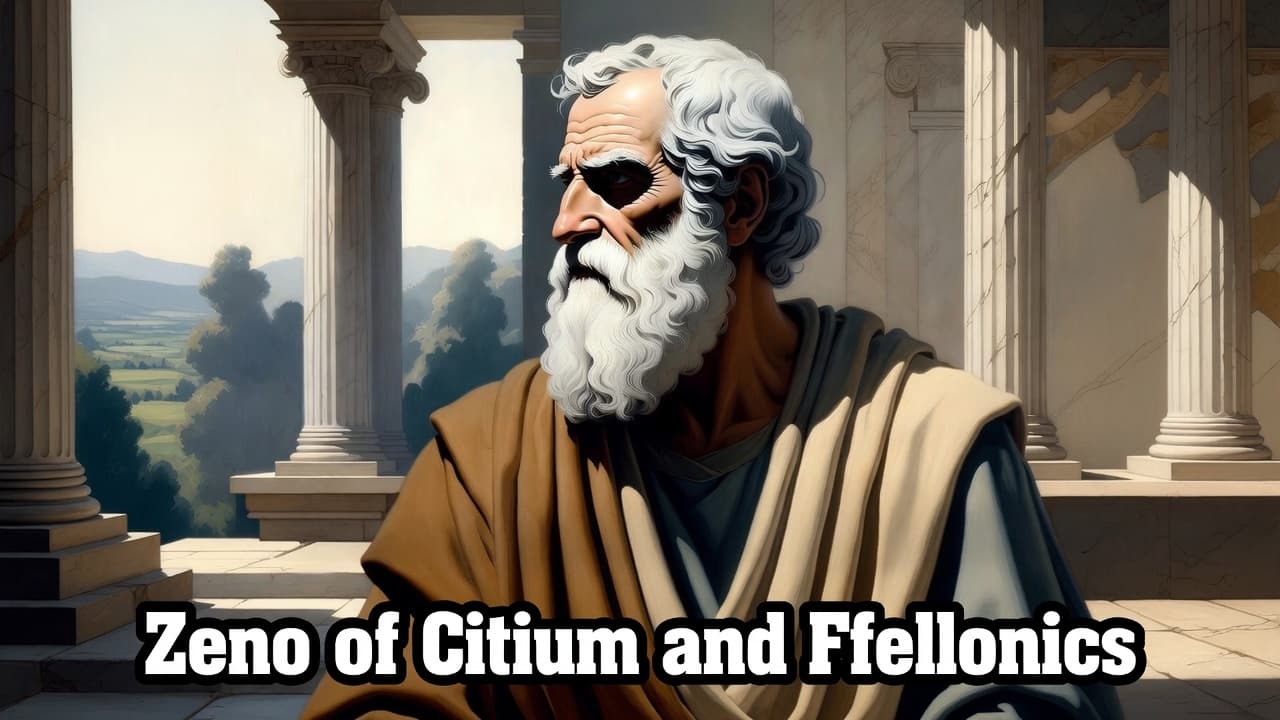
The Geometry of Becoming: Ffellonics and the Rational Cosmos of Zeno of Citium
The Geometry of Becoming: Ffellonics and the Rational Cosmos of Zeno of Citium
Zeno of Citium (c. 334–262 BCE), the Phoenician merchant-turned-philosopher who founded Stoicism in the colonnades of Athens, bequeathed to the world one of antiquity’s most enduring visions of ordered reality. At the heart of his system lies the Logos—the divine, rational principle that permeates the cosmos, governing its every motion with inexorable law. More than two millennia later, a contemporary geometric-thermodynamic framework known as Ffellonics has emerged, offering a strikingly modern, visual, and physical counterpart to Zeno’s ancient intuition. Though Ffellonics arises from sphere-packing, free-energy minimization, and hierarchical self-assembly rather than Hellenistic metaphysics, it functions as a precise, geometric realization of the very same idea: that simple, immanent rules, relentlessly applied, generate the harmonious, relational structures we call reality.
Zeno’s Logos: The Rational Fire of the Cosmos
Zeno taught that the universe is a single, living, rational organism. The Logos is its animating intelligence—simultaneously God, Nature, Fate, and Providence. It is material (a subtle, fiery pneuma or breath) yet fully rational. As the “seminal reason” (logos spermatikos), it seeds and unfolds all things according to perfect law. Nothing occurs by chance; every event is the necessary expression of this cosmic reason.
For Zeno and his successors, the ethical imperative followed directly: humans, endowed with a fragment of the same Logos, achieve tranquility and virtue by aligning their will with Nature’s rational order. “Live according to nature” meant living according to Logos. The cosmos is not chaotic flux (as Heraclitus had emphasized) but ordered becoming—a deterministic unfolding in which apparent opposites (fire and stability, change and law) are reconciled in a single, purposeful process.
Zeno’s surviving fragments and the later Stoic tradition present the Logos as both the cause and the pattern of reality: an immanent, generative principle that operates locally (in every part of the cosmos) yet produces global harmony.
Ffellonics: The Geometry of Relational Emergence
Ffellonics is a purely local thermodynamic rule applied to identical spheres: attach symmetrically to nearest neighbors in the position that maximises contacts (thereby minimising free energy) while preserving global symmetry. This rule is cumulative and irreversible. Starting from the first “ontological touch” (Level 1), it generates a finite 12-level relational emergence hierarchy:
• Level 2: straight line
• Level 3: triangle
• Level 3: tetrahedron (first Platonic solid)
• Level 4: octahedron
• Level 5: icosahedron
• … continuing through hexagonal tessellations, spaceframes, and culminating in the stable close-packed lattices (FCC/HCP) at Level 12.
No external designer, long-range forces, or global blueprint is required. Order emerges strictly from local, symmetry-seeking, energy-minimising decisions. The process is “thermodynamically intelligent”: at every step the system “chooses” the lowest-free-energy configuration available. The result is not fractal chaos but a precise, hierarchical, and finite geometry of becoming—the cleanest physical embodiment of how stable, harmonious structures arise in nature (crystallization, colloidal self-assembly, phase transitions).
Ffellonics explicitly positions itself as a geometric bridge between thermodynamics and ontology. It translates Spinoza’s monism and process-philosophical ideas of relational becoming into three-dimensional space, but its deeper resonance lies further back—with the pre-Socratic and Stoic tradition.
The Deep Structural Parallel: One Rule, One Cosmos
The relation between Ffellonics and Zeno’s philosophy is not historical but philosophical and structural. Both systems rest on a single, immanent imperative that is:
• Local yet universal — Ffellonics’ rule operates only between immediate neighbors; Zeno’s Logos is everywhere present in the pneuma that binds the cosmos. In both cases, local obedience produces global rationality.
• Deterministic and irreversible — Stoic fate is the inexorable expression of Logos; each Ffellonic attachment locks in the next lowest-energy state, exporting entropy and building irreversible order.
• Generative and purposeful — Zeno’s Logos is provident and rational; Ffellonics describes its rule as “thoughtful” and “purposeful” because it systematically maximises relational harmony. The ancient philosopher and the modern geometric model both portray reality as intelligent becoming rather than blind mechanism.
• Rooted in classical intuition — Ffellonics passes through the very Platonic solids that fascinated Plato and later Stoics. Its hierarchy realises, in physical form, the ordered cosmos Zeno inherited from Heraclitus and the Academy. Where Heraclitus saw Logos governing the flux of fire, Ffellonics visualizes a single rule governing the flux of attachment.
In short, Zeno gave us a philosophical account of a rational, law-governed universe. Ffellonics supplies a geometric and thermodynamic demonstration of how such a universe can self-assemble from identical elements following one minimal rule. It is as if the Stoic cosmos has been run through a modern laboratory of sphere-packing and energy landscapes—and the same rational order emerges.
Why the Relation Matters Today
In an age of complexity science, self-organisation, and emergent phenomena, Ffellonics revives Zeno’s ancient insight with unprecedented clarity and testability. It shows that the “divine reason” the Stoics revered need not remain abstract. It can be observed in the laboratory, modeled in simulation, and seen in the very crystals beneath our feet.
For the Stoic practitioner, Ffellonics offers a vivid metaphor: just as each sphere finds its place by maximising local harmony under thermodynamic necessity, so the individual finds eudaimonia by aligning with the rational order of Nature. The 12-level hierarchy becomes a visual ladder of virtue—from the first conscious “touch” of awareness to the stable, maximal coordination of a life lived in accordance with Logos.
Zeno of Citium taught that the universe is one, rational, and good. Ffellonics does not contradict him; it illustrates him. In the quiet, symmetrical attachment of sphere to sphere, we glimpse the same eternal principle that once echoed beneath the Stoa Poikile: the Logos that makes cosmos out of chaos, harmony out of multiplicity, and meaning out of becoming.
The geometry of Ffellonics is, in the end, the geometry of Stoic wisdom made visible—proof that the ancient call to “live according to Nature” finds unexpected confirmation in the most fundamental laws of self-assembly.
Comments
No comments yet. Be the first to share your thoughts.