The Relationship Between Ffellonics and DNA Self-Assembly Models
Ffellonics and DNA self-assembly models represent two powerful but philosophically distinct approaches to the same fundamental question: How can simple local rules produce complex, ordered structures without a central designer?
While they share the same overarching goal — bottom-up self-assembly — they differ sharply in mechanism, flexibility, and purpose. Together they illuminate complementary sides of nature's ability to build order from local interactions.
Core Mechanisms
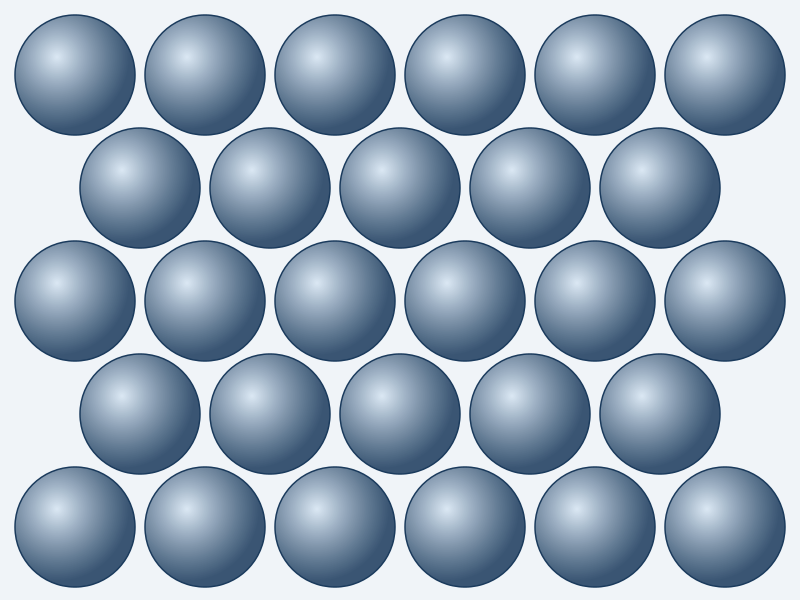
Ffellonics is a classical thermodynamic and geometric model. It uses identical spheres that follow a single local rule: symmetric nearest-neighbor attachment under continuous free-energy minimization. The process begins with the first relational contact between two spheres (Level 1) and progresses deterministically through exactly 12 Levels, reaching its thermodynamic ground state at Level 12 — the stable 12-fold FCC/HCP lattice. Symmetry is actively preserved at every step, and the entire hierarchy unfolds spontaneously, without external direction. The endpoint is not arbitrary: 12 is the three-dimensional kissing number, the proven maximum number of identical spheres that can simultaneously touch a central sphere (Schütte and van der Waerden, 1953). Ffellonics describes the lawful geometric path that terminates there.
DNA self-assembly encompasses several related but distinct models, and it is worth distinguishing the two most significant. Erik Winfree's Abstract Tile Assembly Model (aTAM) uses programmable DNA tiles with sequence-specific "sticky ends." Attachment is governed by cooperative hybridization kinetics and a temperature threshold parameter (τ). Tiles are designed to bind only when their complementary sticky ends match, enabling the system to grow into user-defined shapes or even perform algorithmic computation — aTAM has been shown to be Turing-universal. DNA origami, developed by Paul Rothemund in 2006, takes a different approach: a long single-stranded scaffold DNA is folded into a prescribed two- or three-dimensional shape by hundreds of short "staple" strands. Rather than growing from tile-like units, origami collapses a pre-existing strand into a defined form. Both exploit programmable base-pairing as their local rule, but their mechanisms, mathematical frameworks, and design constraints differ substantially.
Key Similarities
Both Ffellonics and DNA self-assembly models are local-rule, distributed systems that require no global controller. Both rely on energy minimization as the driving force: Ffellonics minimises Gibbs free energy through contact maximization and symmetry; DNA systems minimise hybridization free energy through sticky-end or staple-strand binding. Both demonstrate emergence — simple local interactions produce global order far more complex than any individual unit — and both can generate highly regular, lattice-like structures.
Key Differences
AspectFfellonicsDNA Self-Assembly (aTAM & origami)UnitsSingle identical type (spheres)Multiple distinct programmable tile or strand typesLocal RuleFixed: symmetric attachment + free-energy min.Programmable: sequence-specific bindingSymmetryStrictly enforced and maximised at every LevelUsually broken or designed; not inherently maximisedHierarchyFixed 12-Level cumulative progressionFlexible or flat; hierarchy must be explicitly programmedEnd StateUniversal ground state (12-fold lattice)Arbitrary user-defined shapes or computationsComputational PowerDeterministic, not designed as a computational systemTuring-universal (aTAM); shape-prescribed (origami)Error RobustnessPredicted high: symmetry and energy constraints leave few metastable traps — a hypothesis consistent with real sphere-packing systemsMeasurably lower; requires proofreading tiles or careful kinetic controlFlexibilityLow (always converges to the same optimal lattice)Extremely high (arbitrary patterns possible)
Complementary Strengths
Ffellonics excels at thermodynamic optimality and universality. It shows the most efficient possible geometric pathway when units are identical and symmetry is maximised. Its fixed 12-Level hierarchy with Platonic milestones and stable 12-fold ground state — grounded in the proven kissing number — represents the self-assembly trajectory under pure thermodynamic and geometric constraints. Where aTAM's theoretical ceiling is Turing-universality, Ffellonics' is the kissing number: each framework is anchored by a hard mathematical result that defines what it can, and cannot, exceed.
DNA self-assembly models excel at programmability and computational power. By designing different tile types and glue strengths, researchers can direct the system to form almost any desired structure or perform algorithmic computation during growth. DNA origami adds the ability to prescribe complex three-dimensional shapes from a single scaffold. Together these make DNA self-assembly an extraordinarily flexible practical tool for nanotechnology and molecular computing.
In practice, many real biological systems sit between the two. Viral capsids and protein complexes typically use nearly identical subunits — consistent with Ffellonics — but with slight programmed variations and environmental controls to achieve both robustness and specificity.
Theoretical and Practical Implications
Ffellonics can serve as a theoretical reference model for understanding the limits of efficient self-assembly. It reveals why certain DNA designs work as well as they do: they are approximating the symmetry-maximising, free-energy-minimising principles that Ffellonics embodies in its purest form. Conversely, DNA self-assembly research suggests productive extensions of Ffellonics — for example, exploring how small amounts of programmed specificity (introducing distinct sphere types) might be incorporated without losing core thermodynamic elegance.
Conclusion
Ffellonics and DNA self-assembly models are not competing explanations but complementary perspectives on the same phenomenon. Ffellonics provides the clean geometric and thermodynamic skeleton — grounded in the kissing number and free-energy minimization — that explains why ordered structures emerge so naturally from identical units. DNA self-assembly shows how that skeleton can be programmed and harnessed for arbitrary, information-rich constructions.
Ffellonics describes what self-assembly looks like when driven by geometry and thermodynamics alone. DNA models describe what self-assembly achieves when given programmable instructions. Studying them side by side illuminates the full spectrum between pure thermodynamic necessity and engineered possibility — and suggests that the most robust natural systems draw from both ends of it.
Comments
No comments yet. Be the first to share your thoughts.