The Significance of the Relation Between Hox Genes and Ffellonics
· 5 min read
ByDavid Fell
The Significance of the Relation Between Hox Genes and Ffellonics
The fact that virtually every human is born with four limbs and (usually) five fingers is one of biology’s most striking examples of predictability. Across hundreds of millions of years and thousands of species, the tetrapod limb plan has remained remarkably stable. Developmental biologists explain this stability through Hox gene modularity — a genetic system that creates a limited set of positional “slots” and then reliably fills them.Ffellonics, by contrast, is a purely geometric and thermodynamic model: identical spheres attach symmetrically under a single local rule, generating a fixed 12-stage hierarchy that ends in the 12-fold coordination lattice. Although the two systems operate at completely different scales and with different mechanisms, they share a deep conceptual resonance. Exploring this relation reveals a more general principle of nature: constrained relational modules reliably produce predictable hierarchical outcomes.Hox Gene Modularity: Biology’s Predictable BlueprintHox genes are master regulators arranged in chromosomal clusters. Their expression follows spatial and temporal collinearity: the physical order of the genes on DNA roughly matches the order of body segments and limb regions they control. In limb development, specific combinations of Hox proteins (especially from the HoxA and HoxD clusters) divide the distal limb bud into a series of overlapping domains.These domains function as modular slots. Each slot receives a unique combinatorial “address” based on the dose and mix of Hox proteins. The result is a pre-patterned field that reliably condenses into five digit primordia — the pentadactyl ground state. The system is highly canalized: once the Hox code and associated signaling gradients (such as Sonic hedgehog) are established, small genetic or environmental perturbations rarely alter the basic five-digit architecture. Evolution can modify, fuse, or reduce digits (as in horses or birds), but the underlying five-slot blueprint remains visible in the embryo.This modularity gives biology robustness and predictability. The limb is built from semi-independent repeating units that can be individually tweaked without collapsing the whole structure.Ffellonics: A Minimal Geometric Model of the Same LogicFfellonics begins with an isolated sphere (pure potential) and applies one local rule: symmetric nearest-neighbor attachment that maximizes contacts while minimizing free energy. From this single rule, a strict 12-stage hierarchy emerges:
- Early stages build low-coordination polyhedral modules (tetrahedron, octahedron, icosahedron).
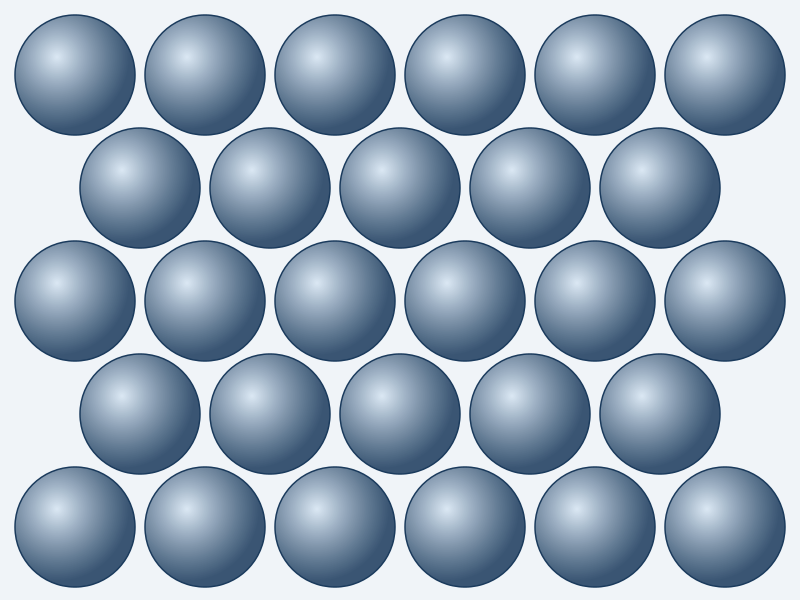
- Mid-stages form planar and directional modules (hexagonal tessellation, truss, spaceframe).
- Final stages reach the maximal 12-fold coordination lattice.
- Modularity: Both systems build complexity from repeating, semi-independent units. Hox genes create digit-field modules; Ffellonics creates coordination-level modules.
- Local Rules Generate Global Order: Hox expression boundaries and signaling gradients act locally to produce global limb pattern. Ffellonics’ attachment rule acts locally to produce global 12-fold symmetry.
- Strong Constraints Produce Predictability: Hox modularity is constrained by gene-regulatory networks and canalization. Ffellonics is constrained by the geometry of 3D space and energy minimization. In both cases, tight constraints sharply limit variation and make the final form highly repeatable.
- Canalization and Robustness: Once the rules are set, both systems are buffered against small perturbations. The 12-fold lattice in Ffellonics is a strong attractor; the pentadactyl limb plan is a deeply canalized developmental endpoint.
- Conceptual Unification
Ffellonics shows that the predictability we observe in limb development is not unique to life or genes. It is a more general feature of any constrained relational system. Hox genes are biology’s sophisticated implementation of a principle that Ffellonics models in its purest geometric form. - Bridge Between Scales
Ffellonics can act as a theoretical scaffold for developmental biology. It offers a simple way to visualize and simulate how local rules might generate the modular fields seen in limb buds, segmentation, or other patterned structures. - New Research Directions
Understanding Ffellonics could inspire experiments in synthetic biology or materials science: designing artificial modular systems that mimic Hox-like predictability for tissue engineering or self-assembling metamaterials. - Philosophical Insight
Both systems illustrate that nature often achieves reliable order not through top-down design but through constrained emergence. Predictability arises when local interactions are channeled by strong limits — whether those limits are geometric (Ffellonics) or genetic/developmental (Hox genes).
Share:
Comments
No comments yet. Be the first to share your thoughts.