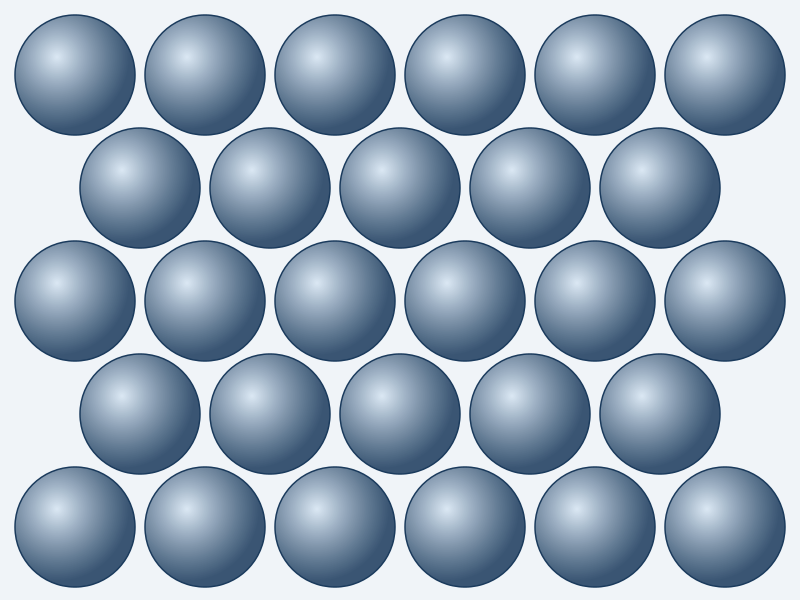
The Spheres of Ffellonic Geometry: Embodying the Five Elements of Intrinsic Nature
Introduction: Spheres as the Core of Geometric Functionality
In the realm of geometry, the sphere stands as nature's most versatile archetype—simple, isotropic, and profoundly efficient. Ffellonic geometry leverages spheres as the foundational units in its 12-level hierarchy, where they attach naturally to form structures from a line (Level 1) to a tetrahedral-octahedral honeycomb (Level 12). This framework posits that spheres embody an intrinsic nature comprising five essential elements: shape, charge/polarity, bonding sites, flexibility/rigidity, and information/code. These elements, rooted in the spheres' physical and conceptual properties, enable Ffellonic geometry to model diverse natural systems, from molecular bonds to social networks. This article delves into how each element is fulfilled by the spheres, drawing on molecular geometry, VSEPR theory, and philosophical implications, to illustrate their role in the hierarchy's progression.
Shape: The Isotropic Foundation
The sphere's defining element is its shape—a perfect, three-dimensional form with uniform curvature in all directions. In Ffellonic geometry, this isotropy ensures that spheres serve as ideal building blocks, allowing seamless attachment without directional bias. As seen in molecular geometry, spheres represent atomic nuclei in ball-and-stick models, where the central atom's shape dictates electron group arrangements . At Level 3's tetrahedron (4 spheres), the spherical shape enables tetrahedral coordination, as in methane (CH₄), where carbon's spherical symmetry minimizes steric hindrance. This shape embodies intrinsic universality, allowing the hierarchy to scale from finite Forms to infinite lattices, much like a language learner's words forming a foundational vocabulary.
Charge/Polarity: The Electrostatic Driver of Attachment
Charge and polarity endow spheres with the ability to attract or repel, mimicking electrostatic interactions in chemistry. In Ffellonic geometry, spheres embody polarity through differential "attraction potential," where opposite "poles" (e.g., positive/negative charges) facilitate bonding. VSEPR theory underscores this, where electron pair repulsion shapes molecular geometry, with polar bonds (e.g., C-H in methane) determining overall polarity . At Level 4's octahedron (6 spheres), this polarity enables octahedral coordination in compounds like NaCl, stabilizing the structure. The spheres' intrinsic polarity, encoded by the vertices' structural code, drives the hierarchy's progression, reflecting a learner's selective word attachments based on contextual "charge."
Bonding Sites: The Points of Connection
Bonding sites are the specific locations on a sphere where attachments occur, analogous to valence electrons or reactive sites in chemistry. In Ffellonic geometry, these sites are defined by the kissing number, allowing up to 12 attachments in 3D space. The tetrahedron (Level 3) has 4 bonding sites, the octahedron (Level 4) 6, and the icosahedron (Level 5) 12, mirroring molecular bonding—e.g., carbon's 4 sites in tetrahedral methane . This embodiment ensures stable linkages, with the vertices' code guiding site-specific bonds, like a language learner's "sites" (grammatical rules) enabling phrase formation.
Flexibility/Rigidity: The Balance of Adaptability and Strength
Spheres embody a duality of flexibility and rigidity: their surface is rigid (maintaining shape) yet adaptable to attachments, allowing deformation without fracture. In molecular geometry, this is seen in flexible linkages (e.g., single bonds) versus rigid ones (e.g., double bonds), influencing thermal stability and deformability . Ffellonic’s Level 7 Octet Truss (extensive line of spheres) exhibits this balance, rigid in structure yet flexible in extension, as in elastomers where geometry allows deformation without damage. The spheres’ intrinsic duality, encoded by the vertices’ structure, enables the hierarchy’s stability amid growth, akin to a language learner’s rigid grammar yielding flexible expression.
Information/Code: The Encoding of Progression
The spheres’ information or "code" is the intrinsic capacity to guide hierarchical growth, analogous to genetic or computational codes. In Ffellonic geometry, the vertices embody this as the "DNA" of the system, encoding the attraction rules and symmetry groups (e.g., I_h at Level 5). This code, like molecular information in DNA or RNA, dictates bonding patterns and progression, as in VSEPR theory’s electron pair repulsion shaping geometry . At Level 12’s honeycomb, the code manifests as a universal pattern of stability, reflecting a language learner’s internalized grammar enabling fluent communication.
Implications for Natural Systems and Philosophy
These five elements make Ffellonic geometry’s spheres versatile models for natural systems—shape for form, polarity for bonds, bonding sites for connectivity, flexibility/rigidity for adaptability, and code for progression. Philosophically, they embody Schelling’s “mastery through limitation,” with the 12-sphere cap confining yet empowering, like a learner’s structured path to mastery. Plato’s cosmic order finds expression in this holistic embodiment, while Young’s reflexive process sees the spheres as a dance of matter and mind.
Conclusion: Spheres as the Quintessence of Intrinsic Nature
Ffellonic geometry’s spheres fulfill the five elements of intrinsic nature—shape, charge/polarity, bonding sites, flexibility/rigidity, and information/code—forming a robust, adaptable framework for modeling nature’s complexity. Encoded by the vertices’ structure, they drive the 12-level hierarchy, reflecting a universal truth: the sphere, with its intrinsic balance, is nature’s quintessence, guiding growth from atomic bonds to global networks.
Comments
No comments yet. Be the first to share your thoughts.