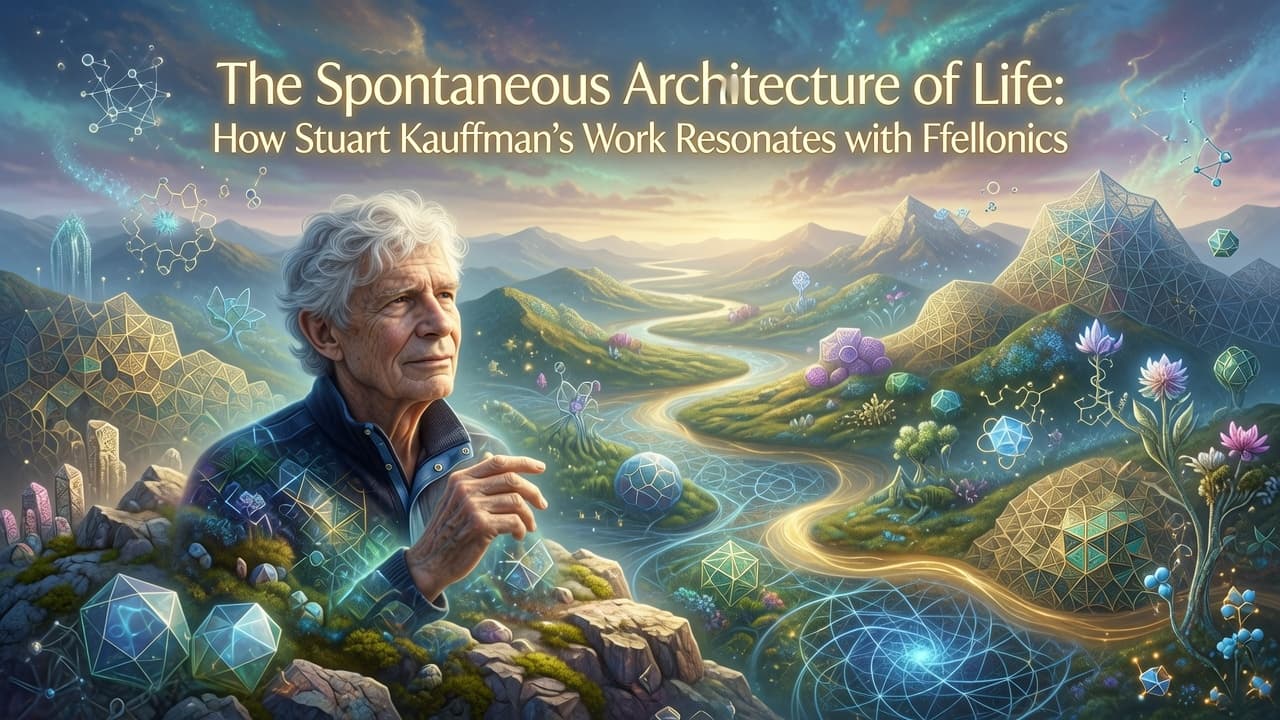
The Spontaneous Architecture of Life: The Resonance of Ffellonics with the work of Start Kauffman
Stuart Kauffman, the pioneering theoretical biologist and complex systems thinker, has long argued that order in biology emerges not solely through Darwinian selection but through powerful processes of self-organization. Decades later, the geometric framework known as Ffellonics—developed by David Fell and explored in depth at ffell.com—offers a strikingly resonant vision. It proposes that reality unfolds toward harmony through relational self-assembly governed by simple geometric rules and a Principle of Least Resistance.
While Kauffman works primarily with dynamical networks and chemical systems, and Ffellonics emphasizes topology, sphere packing, and polyhedral geometry, the two frameworks converge on profound shared themes: spontaneous order from local interactions, bottom-up emergence, thermodynamic drives toward stability, and the extension of these ideas beyond biology into consciousness and meaning.
Stuart Kauffman: Self-Organization as a Fundamental Force
Kauffman is best known for demonstrating that complex biological systems can exhibit “order for free.” In his landmark 1993 book The Origins of Order, he shows that self-organization and far-from-equilibrium dynamics play a central role alongside natural selection in generating biological complexity across population dynamics, molecular evolution, and morphogenesis.
Key pillars of his work include:
• Random Boolean networks modeling gene regulatory networks, where cell types emerge as dynamical attractors and differentiation corresponds to transitions between them.
• Autocatalytic sets — collections of molecules in which each catalyzes the production of others — providing a plausible mechanism for the origin of molecular reproduction and metabolism in prebiotic chemistry.
• The NK model of rugged fitness landscapes, illustrating how systems navigate complexity.
• The concept of the adjacent possible, describing how novelty expands the space of what can come next.
Kauffman has consistently emphasized that sufficiently complex systems of interacting components tend to self-organize into ordered, functional states. This perspective challenges purely selectionist views and opens doors to understanding life as an expected outcome of physical and chemical laws rather than an improbable accident.
Ffellonics: Geometry as the Substrate of Relational Emergence
Ffellonics is a geometric framework centered on relational emergence. It explores how order arises through topology, polyhedra, tessellation, and especially multi-level sphere-packing geometries. At its core lies the Principle of Least Resistance — the idea that nature achieves effortless flow (rivers carving paths, bamboo growing straight, quantum systems following least-action principles) in alignment with both physics and Taoist wu wei (non-action or effortless action).
According to Ffellonics, identical units (conceptualized as spheres) interact locally according to simple relational rules. Through stress dissipation, they relax into symmetrical, adaptive, and hierarchically ordered structures — typically described in a 12-level progression. This process is explicitly linked to bottom-up self-organization, DNA self-assembly, and the emergence of nanostructures from thermodynamics. It bridges “weak” emergence (rule-governed order) and “strong” emergence (involving consciousness and subjective experience), diagramming even Hegel’s dialectical unfolding of Spirit through geometric relations.
A central claim is the “Single Truth”: once relations begin, reality unfolds toward harmony as an impartial law.
Strong Resonances Between the Two Frameworks
The alignment between Kauffman’s ideas and Ffellonics is not superficial. Several deep parallels stand out:
1. Spontaneous Order from Local Interactions (“Order for Free”)
Kauffman showed that random Boolean networks with simple logical rules spontaneously organize into ordered attractors without external direction. Similarly, Ffellonics demonstrates that local geometric relations and stress dissipation in sphere-packing systems generate global symmetry and adaptive order. Both reject the notion that high-level order requires top-down design or exhaustive selection; instead, order is an intrinsic tendency of sufficiently interactive systems.
2. Relational Self-Assembly and Collective Closure
Kauffman’s autocatalytic sets are perhaps the clearest point of contact. In these sets, molecules collectively catalyze their own production, achieving a form of self-reproduction through relational catalysis rather than individual replication. Ffellonics describes an analogous process in geometric terms: units achieve coordination and minimal tension through successive relational contacts, building hierarchical order bottom-up. Both frameworks portray life-like organization as a collective, emergent property of interacting parts.
3. Thermodynamics, Least Action, and the Drive Toward Stability
Kauffman’s work is grounded in far-from-equilibrium thermodynamics, where systems explore possibility spaces and settle into organized states. Ffellonics makes this explicit through the Principle of Least Resistance and the descent of Gibbs free energy through its 12-level hierarchy toward stable minima. Both see ordered structures as outcomes favored by physical laws that minimize resistance or energy dissipation in relational contexts.
4. Simple Rules Generating Profound Complexity
Whether through Boolean logic in gene networks or a single local relational rule in geometric sphere packing, both approaches show how minimal generative principles can produce rich, adaptive, and seemingly purposeful structures. Ffellonics’ minimal, testable model (one rule, twelve levels, definite endpoint) echoes Kauffman’s demonstration that critical complexity in chemical or network systems reliably yields self-reproducing organization.
5. From Molecules to Form, Mind, and Meaning
Kauffman extends his ideas to morphogenesis, the adjacent possible in evolution and technology, and ultimately to questions of mind, consciousness, and the sacred (Reinventing the Sacred). Ffellonics explicitly positions geometric relational integration as a pathway to consciousness — the felt experience of increasing coherence and symmetry — while connecting to Hegel and broader philosophical traditions. Both frameworks treat biology as a gateway to understanding higher-order phenomena rather than an endpoint.
Complementary Strengths
Kauffman provides rigorous dynamical and chemical models (Boolean networks, autocatalytic closure, fitness landscapes) grounded in decades of theoretical biology and complexity science. Ffellonics supplies a concrete geometric and topological language — sphere packing, polyhedra, tessellations — that makes relational emergence visually and structurally intuitive. It also foregrounds the aesthetic and philosophical dimensions of “effortless” order.
Together, they suggest a richer picture: dynamical networks and chemical catalysis operating within geometric constraints that favor minimal resistance and maximal relational harmony.
Conclusion: Toward a Unified View of Emergent Order
Stuart Kauffman’s lifelong exploration of self-organization reveals that life is not an anomaly imposed on a chaotic universe but an expected expression of relational complexity. Ffellonics, through its geometric lens, arrives at a remarkably similar conclusion: once relations begin, ordered harmony tends to unfold according to principles of least resistance and collective self-assembly.
These resonances are not coincidental. They point to a deeper convergence in how we understand the emergence of order — whether in prebiotic chemistry, gene regulation, biological form, or even the origins of subjective experience. Kauffman’s networks and autocatalytic sets find natural counterparts in Ffellonics’ sphere-packing hierarchies and relational geometry.
As research into complexity, origins of life, and consciousness continues, frameworks like these offer fertile ground for synthesis. They remind us that the universe may be far more creative and self-organizing than classical reductionism once allowed — and that geometry, dynamics, and relation may be three faces of the same underlying generative process.
Further Reading
• Stuart Kauffman: The Origins of Order (1993), At Home in the Universe (1995), Reinventing the Sacred (2008).
• Ffellonics essays at ffell.com, particularly those on relational emergence and geometric frameworks for consciousness.
The dialogue between these perspectives is only beginning — and it promises to illuminate how order, life, and meaning arise in our universe.
Comments
No comments yet. Be the first to share your thoughts.