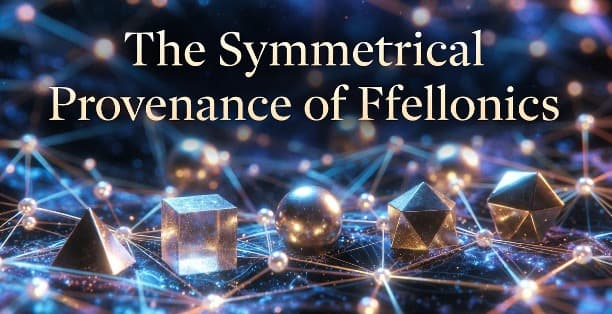
The Symmetrical Provenance of Ffellonics
Ffellonics offers a compelling evolution in geometric understanding. It takes the classical pinnacle of finite symmetry—the Platonic solids—and transforms it into a dynamic, generative framework rooted in relational self-assembly. Rather than viewing symmetry as a fixed property of closed polyhedra, Ffellonics demonstrates how symmetry emerges, deepens, and organizes through simple local interactions between identical units.
The Platonic Solids: Archetypes of Pure Symmetry
The five Platonic solids—tetrahedron, cube (hexahedron), octahedron, dodecahedron, and icosahedron—represent the highest degree of regularity possible for convex polyhedra in three-dimensional Euclidean space. In each solid, all faces are congruent regular polygons, and an identical number of faces meet at every vertex. These forms are vertex-transitive, edge-transitive, and face-transitive, possessing exceptionally rich symmetry groups (tetrahedral, octahedral, and icosahedral).tutors.com
Their mathematical completeness was rigorously established by Euclid, who proved there can be only five such solids. Philosophically, Plato linked them to the fundamental elements and cosmic order. Kepler attempted to connect them to planetary orbits. Over centuries, mathematicians and scientists have explored their dualities, symmetry groups, and extensions within polyhedral geometry, including Archimedean solids, Johnson solids, uniform tilings, and higher-dimensional polytopes.
What distinguishes Platonic symmetry is its purity and minimality under strict constraints: flat faces, straight edges, and topological closure. These solids embody balance, equality, and harmony in their most concentrated geometric form.
Extending the Foundation: The Core of Ffellonics
Ffellonics, pioneered by David Fell, builds directly on this Platonic heritage while generalizing its principles. The key innovation is modeling geometric structures through identical spherical units that follow one minimal local rule: symmetric nearest-neighbor attachment that maximizes coordination (number of contacts) while minimizing local stress or free energy.
This approach removes the classical restriction to rigid polyhedra with flat faces. Instead, symmetry criteria are applied to more general relational assemblies of spheres. The outcome is a broader series of structures—often described as the twelve Ffellonic Forms—rather than being limited to the original five Platonic solids.
Symmetry in Ffellonics is not presupposed or imposed from outside. It is actively generated through a deterministic process of self-organization. Isolated spheres possess no inherent relational structure. The first contact (“the first ontological touch”) initiates a lawful progression. Each subsequent attachment may temporarily create asymmetry, but the local rule consistently drives the system toward configurations that restore and enhance overall symmetry and stability.
Sphere Packing and the Generative Power of Local Rules
Ffellonics draws heavily on the mathematics of sphere packing. In three dimensions, the maximum number of equal spheres that can simultaneously touch a central sphere—the kissing number—is twelve. This 12-fold coordination represents both a geometric limit and the thermodynamic ground state for dense, symmetric packing (realized in face-centered cubic or hexagonal close-packed lattices).
The framework treats symmetry as an emergent property built level by level. The single local rule favors lower-energy states, which correlate strongly with higher symmetry. Transient disturbances caused by new attachments are resolved by rearrangements that increase global coordination and harmony. This creates a self-reinforcing cycle: symmetry begets greater stability, which enables further ordered growth.Platonic solids appear naturally as stable intermediates within this process, particularly at coordination levels where tetrahedral, octahedral, or icosahedral arrangements provide the most symmetric configurations achievable at that stage.
The 12-Level Hierarchical Progression
Ffellonics unfolds as a clear, deterministic 12-level hierarchy of relational self-assembly:
Early levels begin with basic contacts (straight-line pairs) and planar arrangements (triangles).
Mid-levels feature the emergence of Platonic solids: tetrahedral, octahedral, and icosahedral polyhedra.
Subsequent levels progress through tessellations, trusses, spaceframes, and more complex polyhedral or honeycomb structures.
The sequence culminates in dense, space-filling arrangements (such as truncated octahedral or cuboctahedral honeycombs) and ultimately the fully coordinated 12-fold lattice, where every unit achieves maximum symmetric neighbors.
This hierarchy is not arbitrary. It reflects the progressive realization of symmetry under consistent local rules, with Platonic forms serving as elegant milestones along the path.
Broader Implications: Symmetry as a Generative Principle
By framing symmetry as something built rather than merely classified, Ffellonics bridges classical geometry with modern concepts of emergence and self-organization. It aligns with thermodynamic principles (energy minimization), biological self-assembly (e.g., DNA nanostructures or colloidal systems), and philosophical ideas of relational development.
The model offers a minimalist yet powerful account of how ordered complexity arises: one impartial local rule, identical units, and repeated application leading to a definite endpoint of maximal symmetry. It resonates with thinkers from Plato to Hegel and contemporary systems theorists, suggesting that relational harmony is a fundamental driver of structure in both physical and conceptual realms.
Conclusion: Honoring and Extending a Classical Legacy
The symmetrical provenance of Ffellonics is both rooted and expansive. It begins with the Platonic solids as the purest finite expressions of geometric harmony and regularity. It then extends those principles logically by shifting focus from static polyhedra to dynamic, rule-governed assemblies of spheres. The result is a generative hierarchy in which symmetry is progressively constructed through local interactions, revealing deeper layers of relational order.
Ffellonics does not replace the Platonic foundation—it fulfills its potential by showing how the same drive toward symmetry and equality can operate beyond rigid boundaries, producing a richer family of structures and a clearer mechanism for emergence. In doing so, it provides a coherent bridge between ancient geometric insight and contemporary understandings of self-organization, stability, and complexity.
As exploration of Ffellonics continues through resources like ffell.com and related discussions, it stands as a testament to the enduring power of symmetry: not as a finished destination, but as a generative principle that continues to unfold new forms of order from the simplest relational beginnings.
Comments
No comments yet. Be the first to share your thoughts.