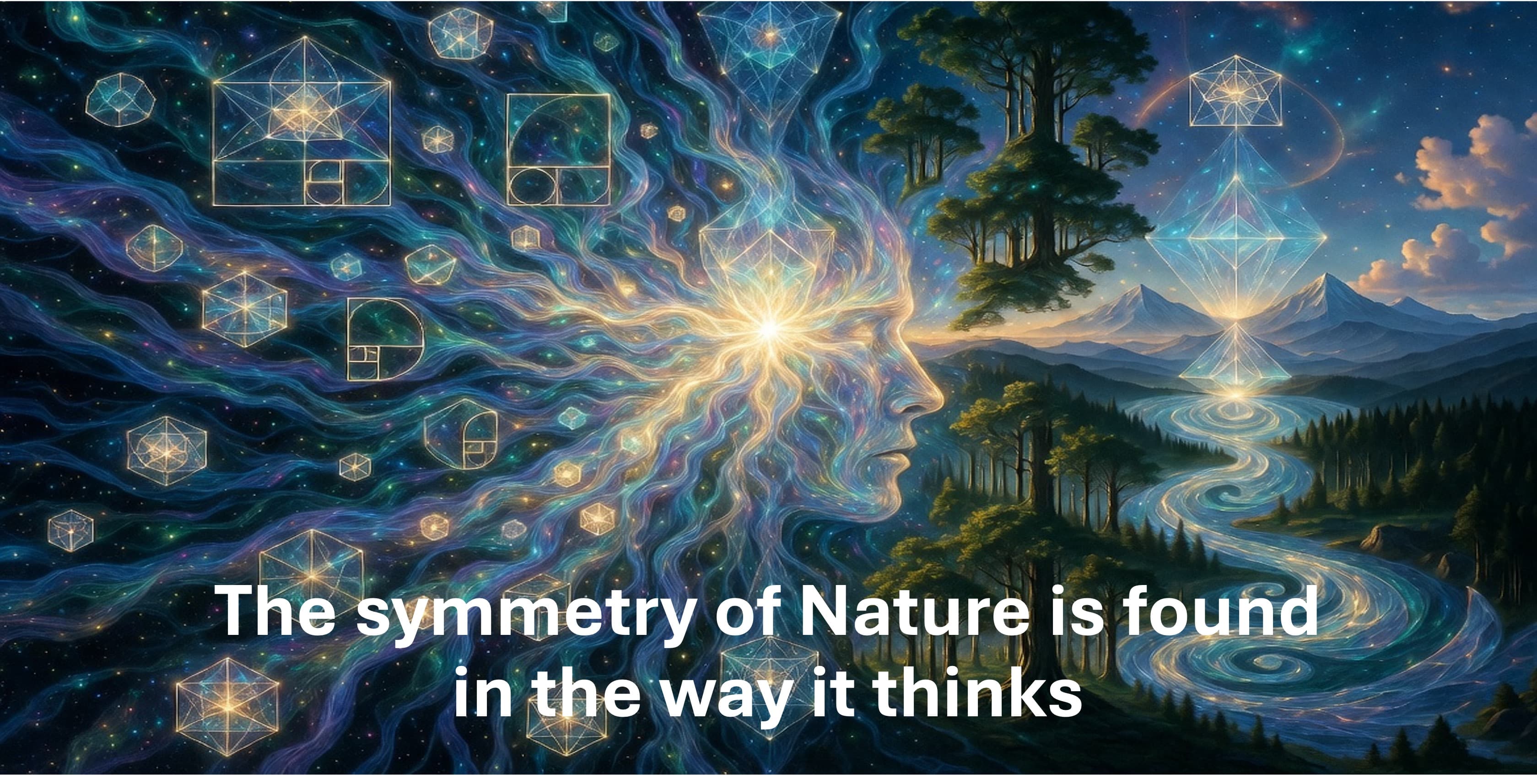
The Symmetry of Nature: Arising from Thought, Not Manifestation
· 3 min read
ByDavid Fell
Introduction
We gaze at the exquisite symmetry in nature—the hexagonal snowflake, the spiral galaxy, the icosahedral virus—and marvel at its perfection. Yet, time and again, we fixate on these visible forms, treating them as the essence of symmetry itself. But the purest symmetry does not reside in these manifestations; it arises from the way nature "thinks"—the underlying processes, principles, and relational dynamics that shape reality. This article explores that deeper truth, drawing on Ffellonic geometry as a model for how nature computes its preferences through effortless, energy-minimizing flows.
The Illusion of Manifest Symmetry
Humanity has long been captivated by symmetry's outward expressions. Plato saw the five regular solids as cosmic archetypes, embodying elemental perfection. Kepler sought them in planetary orbits. Modern science finds them in crystal lattices and molecular bonds. But this focus on the end product overlooks the genesis: symmetry is not a static property imposed on matter; it is the emergent outcome of nature's intrinsic "thought"—a computational process of optimization, relation, and minimal resistance.
Consider a snowflake: its hexagonal arms are not designed; they form because water molecules "think" through hydrogen bonding, following the path of least energy to minimize free energy in freezing conditions. The symmetry is the trace left by that thinking, not its source.
Nature's "Thought": The Principle of Minimal Effort
What does it mean for nature to "think"? Not consciousness, but a blind, elegant computation—following variational principles like least action, free-energy minimization, or entropy production. Physics reveals this everywhere:
• In classical mechanics, particles take geodesics—the shortest path in curved space.
• In quantum mechanics, Feynman path integrals sum all paths, but interference reinforces the stationary-action route.
• In thermodynamics, dissipative structures (Prigogine) export entropy to import order far from equilibrium.
This "thought" is effortless: nature doesn't struggle; it aligns with what requires the least opposition, yielding maximal harmony.
Ffellonic Geometry: A Model of Nature's Thinking
Ffellonic geometry exemplifies this process. Starting with identical spheres—ontological primitives—it unfolds through one axiom: attach to maximize contacts while preserving symmetry. This local "thinking" (energy minimization) generates a 12-level hierarchy:
• Levels 1–5: Finite clusters, including Platonic solids as milestones.
• Levels 6–12: Infinite lattices, culminating in FCC/HCP packing (k=12, maximal 3D symmetry).
The visible symmetries (Platonic forms, lattices) are not the origin—they are the output of nature's computation: relational events accumulating into order. Ffellonic shows symmetry arises from "thought" (minimal-energy paths), not as pre-given ideals.
Manifestations as Echoes, Not Essence
People fixate on symmetrical outcomes—snowflakes, galaxies—without seeing the thinking behind them. But purest symmetry lies in the process: the way nature computes preferences for efficiency, as in Levin's natural induction (relaxation under stress) or colloidal crystallization (Gasser 2001). Ffellonic reveals this genericity: billions of systems follow the same low-energy ladder.
Conclusion
The symmetry of nature is not in its shapes, but in how it thinks—shaping manifestations through effortless computation. Ffellonic geometry mirrors this: from minimal relation to maximal harmony, without force. By shifting focus from end to process, we glimpse nature's deepest elegance: symmetry as the trace of thought, not its source.
As Heisenberg noted, particles are defined by symmetry; Ffellonic shows symmetry is defined by relational becoming. The purest symmetry is the thinking itself.
Share:
Comments
No comments yet. Be the first to share your thoughts.