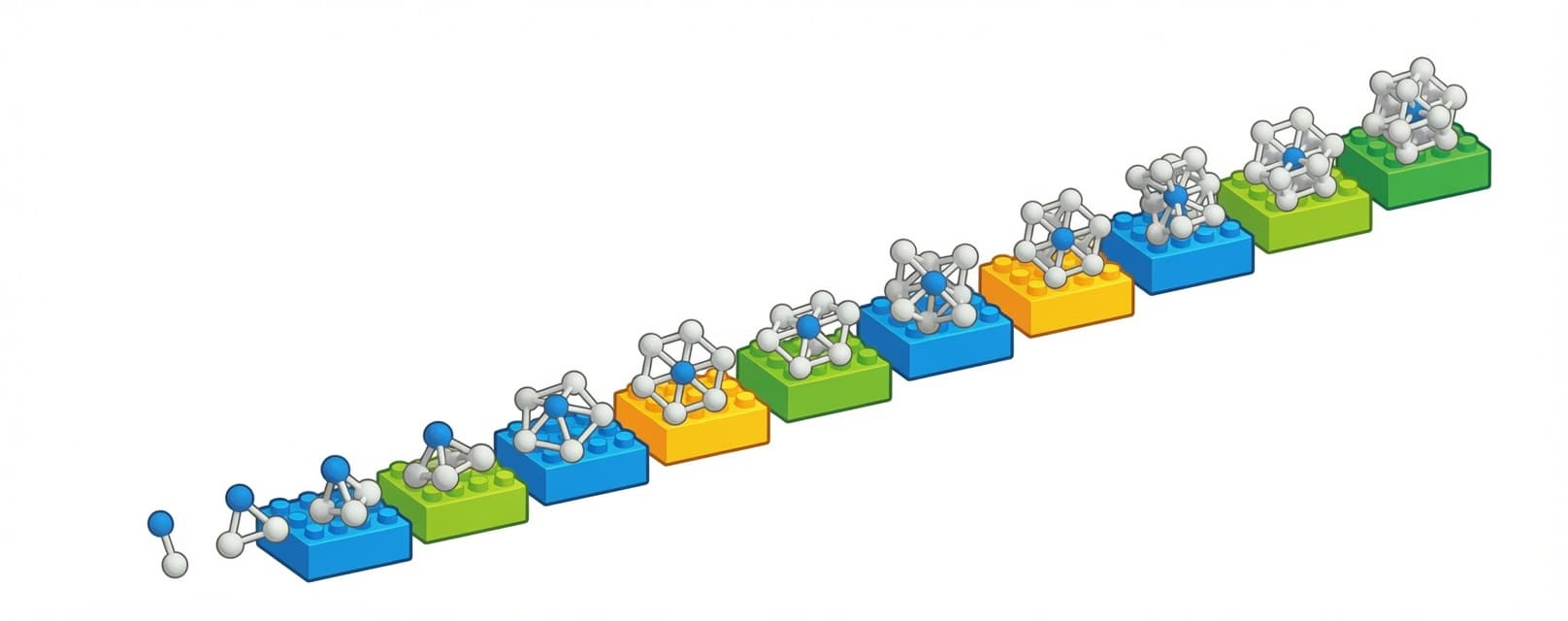
What Thermodynamics Has Always Needed: A Developmental Ladder
For more than a century, thermodynamics has explained with precision why ordered structures emerge from disorder. Systems spontaneously move toward lower free energy — ΔG = ΔH − TΔS — while exporting entropy to their surroundings. The direction of the process is clear. The driving force is well understood. What thermodynamics has consistently struggled to provide is an account of how this happens in a concrete, step-by-step, geometrically visible way.
Classical thermodynamics gives us tendencies and inequalities. Non-equilibrium thermodynamics — Prigogine's dissipative structures — gives us a framework for understanding self-organisation far from equilibrium. But both remain largely abstract. They describe the arrow of time and the drive toward stability without specifying what geometric forms a system will pass through on the way, or how to recognise when it has arrived at its optimal configuration.
This absence of a clear developmental ladder has been a persistent gap. Scientists can predict that a system will minimise free energy. They cannot easily say what sequence of structural stages it will follow, or what the final configuration will look like when it gets there.
Ffellonics Supplies the Missing Ladder
Ffellonics is a minimal geometric reference model built on one local rule:
Symmetric nearest-neighbour attachment under Gibbs free-energy minimisation.
From the first contact between two isolated spheres at Level 1, the system begins an irreversible, cumulative 12-level progression. Each new attachment lowers ΔG, preserves global symmetry, and increases the number of nearest-neighbour contacts. The process is dissipative — entropy is exported to the environment — self-reinforcing, and strictly hierarchical.
The developmental ladder is precise and visible:
Levels 1–2 — Simple pairs and small clusters form. The first contact produces the steepest drop in free energy in the entire hierarchy. The process becomes thermodynamically irreversible from this point.
Levels 3–5 — The Platonic solids appear as natural local energy minima: the tetrahedron at Level 3, the octahedron at Level 4, the icosahedron at Level 5. These are the first stable, symmetric coordination shells — not imposed forms, but inevitable stopping points in the energy landscape.
Levels 6–11 — Higher coordination shells build cumulatively. Each step further reduces free energy while maintaining global symmetry. The marginal energy gain per attachment decreases steadily, signalling approach to the ground state.
Level 12 — The thermodynamic ground state: the 12-fold FCC/HCP lattice. Every sphere has exactly twelve nearest neighbours. Global free energy reaches its absolute minimum for the given constraints. The hierarchy is complete. The system does not need to climb further — it extends laterally in perfect order, achieving finite hierarchical depth and unbounded, stable extension.
The Ground State as a Complete Thermodynamic System
Level 12 is not merely a geometric endpoint. It is thermodynamically complete. The 12-fold lattice at the ground state is governed by a closed, interdependent set of physical state variables — position, momentum, energy, force, power, velocity, acceleration, jerk, angular momentum, torque, moment of inertia, and entropy production rate — twelve in total, one for each coordination contact.
These variables function as a fully coupled network. When all are simultaneously optimised within the constraints of the local rule, the system achieves maximum relational coordination and minimum internal tension. This is the thermodynamic endpoint that classical theory has long implied but never been able to specify concretely. Ffellonics makes it explicit.
Why the Ladder Matters
Ffellonics does not replace thermodynamics. It completes a part of it that has remained unfinished. By translating the abstract drive of free-energy minimisation into a concrete, predictable, geometrically visible pathway, it gives thermodynamics three things it has lacked:
A clear sequence of stages with recognisable geometric milestones, so the progression of a self-organising system can be tracked and anticipated rather than merely inferred after the fact.
A definite, reachable ground state — not a vague steady state or an asymptotic approach to equilibrium, but a specific, stable configuration that can be identified and described.
A universal reference pattern that appears across physics, chemistry, biology, and more complex systems — a common structural logic underlying self-assembly at different scales and in different materials.
The model reveals that spontaneous self-organisation is not mysterious or arbitrary. Under the right local rule — symmetry combined with energy minimisation — it follows a lawful, finite developmental pathway that terminates in maximal coordination and stability.
Conclusion
Thermodynamics tells us why systems move toward order. It does not tell us what order looks like at each stage of the journey, or what the destination is. Ffellonics supplies both. The developmental ladder it provides — twelve levels, one local rule, a definite ground state — makes the abstract drive of free-energy minimisation concrete and visible.
Once the ladder is in view, it becomes recognisable across domains: in crystal growth, molecular self-assembly, biological morphogenesis, and the staged development of complex systems at many scales. The same progression, the same milestones, the same terminal configuration. The gap in thermodynamic theory that has persisted for over a century is not a fundamental one. It is a gap in geometric specificity — and Ffellonics closes it.
Comments
No comments yet. Be the first to share your thoughts.