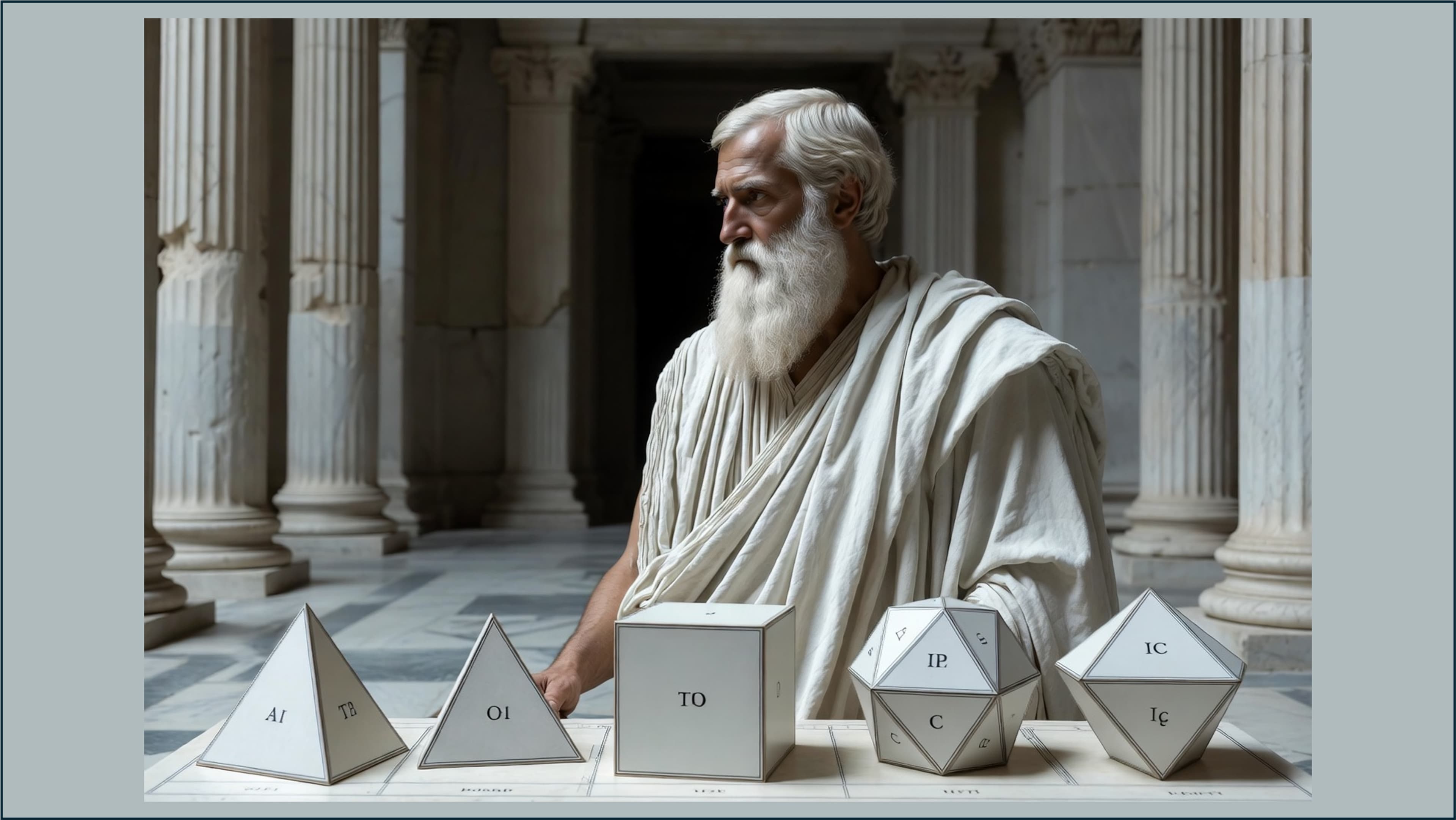
Why Euclid's Proof of Only Five Platonic Solids Is Less Significant Than Their Intrinsic Nature
For over two thousand years, Euclid's proof in Book XIII of the Elements has been celebrated as one of geometry's great achievements: there are exactly five regular convex polyhedra whose vertices all lie on a single sphere. The argument is clean, combinatorial, and logically complete. Yet when we ask what makes the Platonic solids truly significant — not as a mathematical curiosity, but as structures that appear repeatedly in nature — the proof begins to feel surprisingly limited.
What Euclid Actually Proved
Euclid's demonstration rests on integer constraints: the number of sides per face (3, 4, or 5); the number of faces meeting at each vertex; and the requirement that the angle defect at each vertex be positive but less than 360°. Only five combinations satisfy these conditions without collapsing into a plane or becoming non-convex. The proof is a triumph of enumeration — count the possibilities, rule out the rest, done.
But the reason the Platonic solids recur in crystals, viruses, foams, and biological assemblies has almost nothing to do with these integer tallies. Their real significance lies elsewhere entirely.
Their Intrinsic Nature: Four Principles
1. They are the natural consequence of identical spheres touching a central sphere.
The vertices of every Platonic solid are simply the positions where equal spheres touch a central one with maximum symmetry. The tetrahedron (four spheres), octahedron (six), icosahedron (twelve) are not primary forms — they are emergent patterns produced by local attachment rules. Euclid uses the sphere as a bounding container but never treats it as the origin. By focusing on faces and vertices, he captures the shadow rather than the substance.
2. They are energy-favourable intermediates in a longer process.
In physical systems, the configurations we call Platonic arise because they are local energy minima under pairwise attraction. A tetrahedron minimises local strain for four identical units; an icosahedron does the same for twelve. These are not isolated ideals — they are transient stages in a continuous relaxation pathway that extends well beyond them. Euclid's proof ends the story at five finite solids; nature keeps adding spheres, proceeding through further coordination shells toward the global energy minimum for regular packing.
3. Their significance is processual, not enumerative.
The intrinsic nature of the Platonic solids is connectivity — coordination number — and emergence from simple local rules, not the final integer counts of faces or angles. The tetrahedron, octahedron, and icosahedron represent three coordination steps in an energy-favourable progression driven by one rule: spheres attach by touching. They are milestones, not endpoints. Euclid's proof, by stopping at enumeration, misses the generative process that causes these forms to appear in nature again and again.
4. Nature does not enumerate — it relaxes.
When identical units minimise free energy through local interactions, they do not select from a list of five solids. They follow the steepest descent through the energy landscape, passing through tetrahedral, octahedral, and icosahedral configurations on the way to denser lattices. The proof that there are only five finite regular polyhedra on a single sphere answers the question "how many can fit on a sphere at once?" — but nature is asking a different question entirely: what pathway do spheres follow when they keep attaching?
What Ffellonic Geometry Restores
Ffellonic geometry reframes the Platonic solids as Levels 3, 4, and 5 in a 12-level hierarchy generated by one simple rule — symmetric nearest-neighbour attachment under free-energy minimisation. This reveals their intrinsic nature as relational events in an ongoing, low-energy progression. They are not static ideals; they are early stations on a dissipative pathway that continues through further coordination structures all the way to the 12-fold FCC/HCP lattice — the thermodynamic ground state of regular sphere packing.
Euclid's proof tells us there are five. Ffellonic geometry tells us what they are doing there, why they appear in nature, and where the process goes next.
Conclusion
Euclid's proof remains a jewel of deductive reasoning. But when we ask what makes the Platonic solids significant — why they recur across scales in crystals, viruses, foams, and biological assemblies — the answer lies not in the integer constraints he enumerated, but in the deeper, processual principles he never pursued.
The five solids are not the conclusion of a geometric story. They are its opening movement. The full progression — from first contact at Level 1 to the thermodynamic ground state at Level 12 — is the geometry that nature has been tracing all along. Euclid described five beautiful forms. Ffellonic geometry explains why they exist, and what comes after them.
Comments
No comments yet. Be the first to share your thoughts.