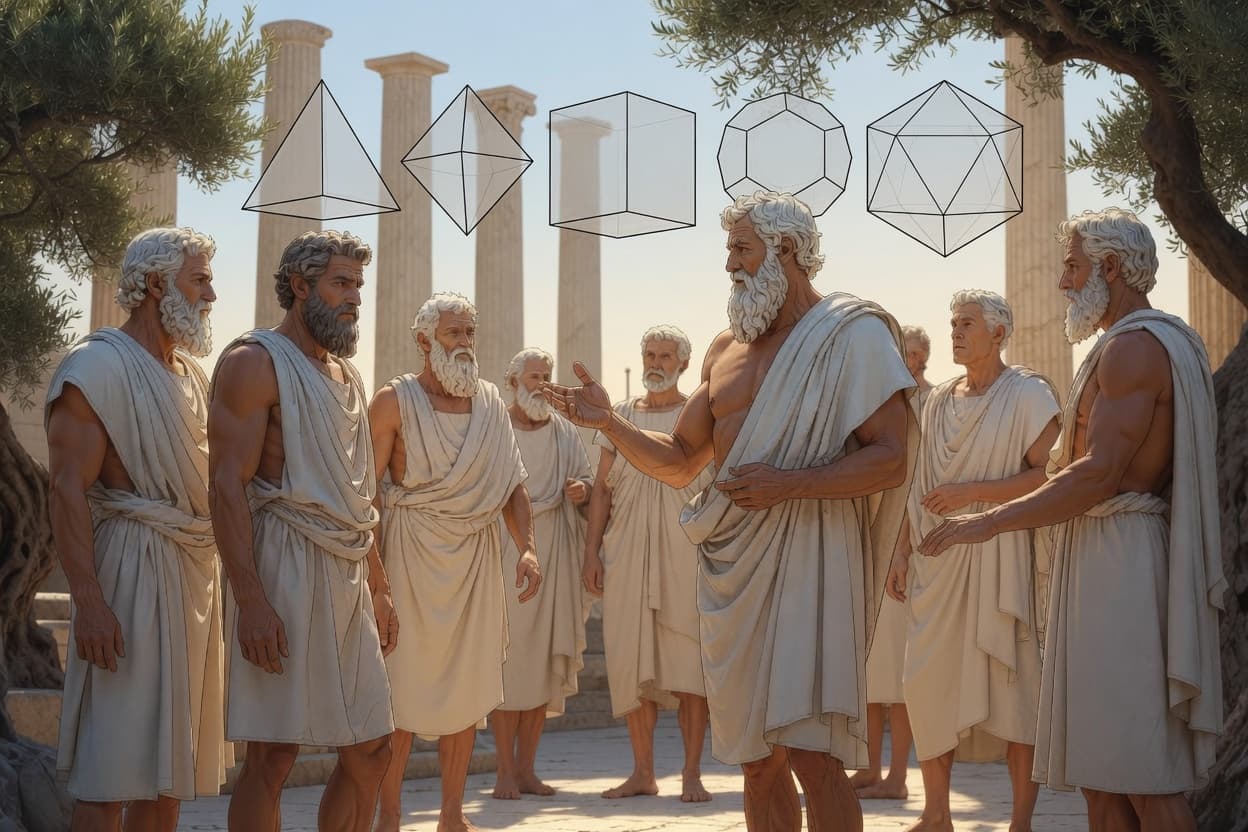
Why the Platonic Solids Were Revered by the Ancient Greeks
The five regular polyhedra — tetrahedron, cube, octahedron, dodecahedron, and icosahedron — held a unique place in ancient Greek thought. They were not merely interesting geometric objects. They were understood as evidence that the universe is rationally structured, that mathematics and physical reality are not separate domains, and that pure reason can penetrate to the deepest truths about existence.
Mathematical Perfection and Uniqueness
For the ancient Greeks, geometry was not a practical tool — it was the highest form of knowledge. The Platonic solids stood apart from all other three-dimensional forms because they satisfy a precise and demanding set of conditions simultaneously: every face is an identical regular polygon; the same number of faces meet at every vertex; and all vertices lie on a single sphere. No other convex polyhedra meet all three criteria.
Euclid recognised this significance. Book XIII of the Elements — his great systematic treatise on geometry — culminates in the construction of all five solids and the proof that no others of this kind can exist. That a finite, complete, and provably exhaustive set of such forms was achievable through pure deductive reasoning made the solids, for the Greeks, symbols of mathematical completeness itself.
The historical origins of their discovery are partly obscure. Tradition credits Pythagoras or his followers with knowledge of at least the tetrahedron, cube, and dodecahedron. Theaetetus, a contemporary of Plato, is thought to have contributed the systematic treatment of the octahedron and icosahedron.
Plato's Cosmology: Geometry as the Fabric of Nature
It was Plato (c. 428–348 BCE) who gave the solids their most ambitious role. In his dialogue Timaeus (c. 360 BCE), he proposed that the physical world is built from microscopic particles whose shapes correspond to the five solids, each linked to one of the classical elements:
Tetrahedron → Fire. Its sharp points and faces suggested the piercing, cutting quality of flame.
Cube → Earth. Its stable, stackable structure evoked solidity and permanence.
Octahedron → Air. Light and smooth, it suggested mobility and flow.
Icosahedron → Water. Its many faces gave it a near-spherical form, making it the most fluid of the solids.
Dodecahedron → The cosmos. Its twelve pentagonal faces, the most sphere-like of the group, led Plato to associate it with the heavens — used, he suggested, by the creator to organise the constellations.
This was not mere metaphor. Plato was proposing a genuine physical theory: that matter at its most fundamental level has geometric form, and that the structure of the universe reflects the same rational order that mathematics reveals. The solids connected abstract geometry to cosmology, physics, and metaphysics in a single unified vision.
Why They Mattered
The significance of the Platonic solids in Greek thought rested on several converging ideas.
Their uniqueness — the fact that exactly five exist and no more — suggested that nature itself is constrained by mathematical necessity. The universe could not be otherwise structured. Their perfect symmetry placed them beyond the imperfect, changeable objects of ordinary experience, aligning them with Plato's broader philosophy of eternal ideal Forms that underlie the sensory world.
Their influence extended well beyond antiquity. Kepler, two thousand years later, attempted to embed the solids within a model of planetary orbits, still convinced that the cosmos was geometrically ordered in their terms. They recur throughout the history of science and philosophy as a touchstone for the idea that reality has a rational, geometric foundation accessible to the human mind.
Conclusion
For the ancient Greeks, the Platonic solids were not random curiosities of geometry. They were the point at which mathematics and the physical world converged — proof that the universe is not chaotic but ordered, not arbitrary but necessary, and not opaque to reason but legible through it. That five such perfect forms exist, and exactly five, seemed to the Greeks less like a mathematical accident than a profound disclosure about the nature of reality itself.
Comments
No comments yet. Be the first to share your thoughts.