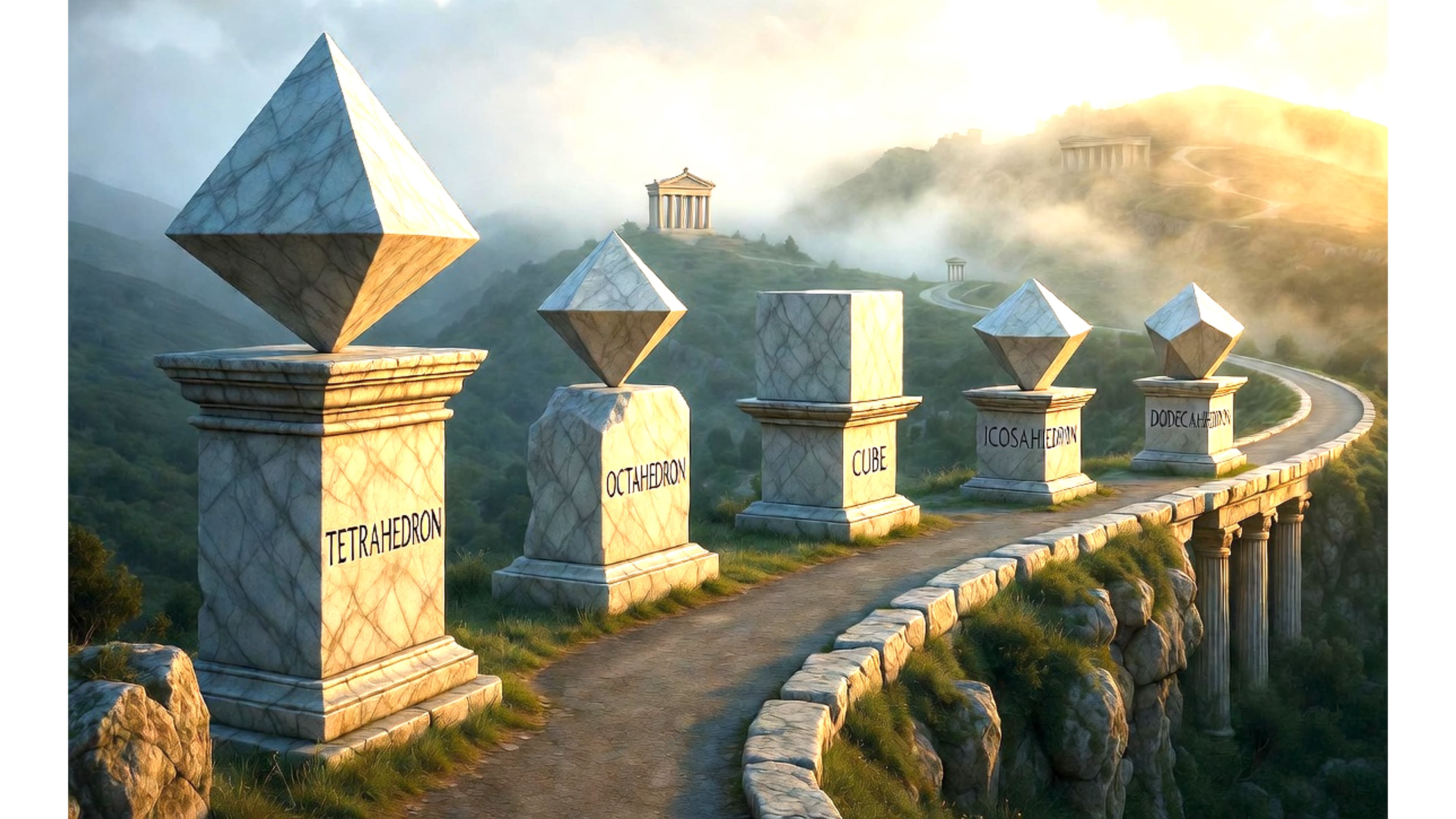
Why We Have Spent Too Long Treating Platonic Solids as Reality
For more than two thousand years, the Platonic solids have occupied a privileged position in our understanding of symmetry and structure. Plato assigned them to the classical elements in the Timaeus — tetrahedron to fire, octahedron to air, icosahedron to water, cube to earth, dodecahedron to the cosmos itself. Kepler built his entire model of planetary orbits around them. Even into the twentieth century, they were regularly invoked as the deep archetypes of natural order, as though the universe somehow selects these five shapes because they are intrinsically fundamental.
But what if this has it backwards? What if the Platonic solids are not the origin of symmetry, but milestones along a deeper, more primary process — one that both precedes and continues beyond them?
The Ffellonic Starting Point
Ffellonic geometry begins not with polyhedra but with the simplest possible ontological unit: the identical sphere, and one generative rule:
Spheres attach when their surfaces touch, each new sphere settling into the position that maximises contacts while preserving symmetry.
From that single axiom, a 12-level hierarchy unfolds:
Level 1 — Dyad (k = 1)
Level 2 — Equilateral triangle (k = 2)
Level 3 — Regular tetrahedron (k = 3) — first Platonic solid
Level 4 — Regular octahedron (k = 4) — second Platonic solid
Level 5 — Regular icosahedron (k = 5) — third Platonic solid
Level 6 — Two-dimensional triangular lattice (k = 6)
Levels 7–11 — Progressive coordination shells
Level 12 — Face-centred cubic / hexagonal close packing (k = 12): the densest regular packing in three-dimensional space, proven by Hales in 2005
The Platonic solids appear within this hierarchy as transient, finite clusters — not eternal archetypes, but consequences of sphere-packing dynamics. They are way-stations, not starting points or endpoints.
The true attractor of the system is not the icosahedron or the dodecahedron. It is the close-packed lattice at Level 12, where every sphere is surrounded by the maximum possible number of identical neighbours — the global minimum of the free-energy landscape for identical spheres under symmetric attachment.
Why This Inversion Matters
The traditional view looks at the Platonic solids and concludes: these are the ideal forms; structure conforms to them. Ffellonic geometry reverses the direction of explanation: these are patterns that emerge when identical units seek relational harmony through local energy minimisation. The deeper reality is not the solid — it is the sphere and the process of attachment.
This is a shift from top-down imposition to bottom-up emergence; from static being to dynamic becoming; from Platonic idealism to a process-oriented ontology. It aligns with several well-established frameworks:
Prigogine's dissipative structures — order arising through entropy export rather than external design.
Modern packing theory — sphere packing, not polyhedral form, as the organising principle of dense matter.
Biological self-assembly — most spherical viruses adopt icosahedral symmetry not because Plato was right, but because it minimises free energy under subunit constraints. Bone trabeculae and certain foams approach octet-truss and Kelvin-cell geometries for the same reason: emergent efficiency, not imposed form.
In each case, the Platonic solid appears because the physics demands it at that coordination level — not because it was selected from a catalogue of ideal forms.
The Deeper Lesson
We have spent too long revering the Platonic solids as reality itself, when they are better understood as elegant intermediate patterns — necessary stages in a more primary relational process, but stages nonetheless.
Ffellonic geometry refocuses attention on the sphere — isotropic, relational, without privileged orientation — and on the single generative rule that drives the entire hierarchy. In doing so, it offers a unified geometric account of nature's preferred symmetry ladder, from minimal contact at Level 1 to maximal coordination at Level 12. The Platonic solids are part of that story. They are not its origin.
Comments
No comments yet. Be the first to share your thoughts.