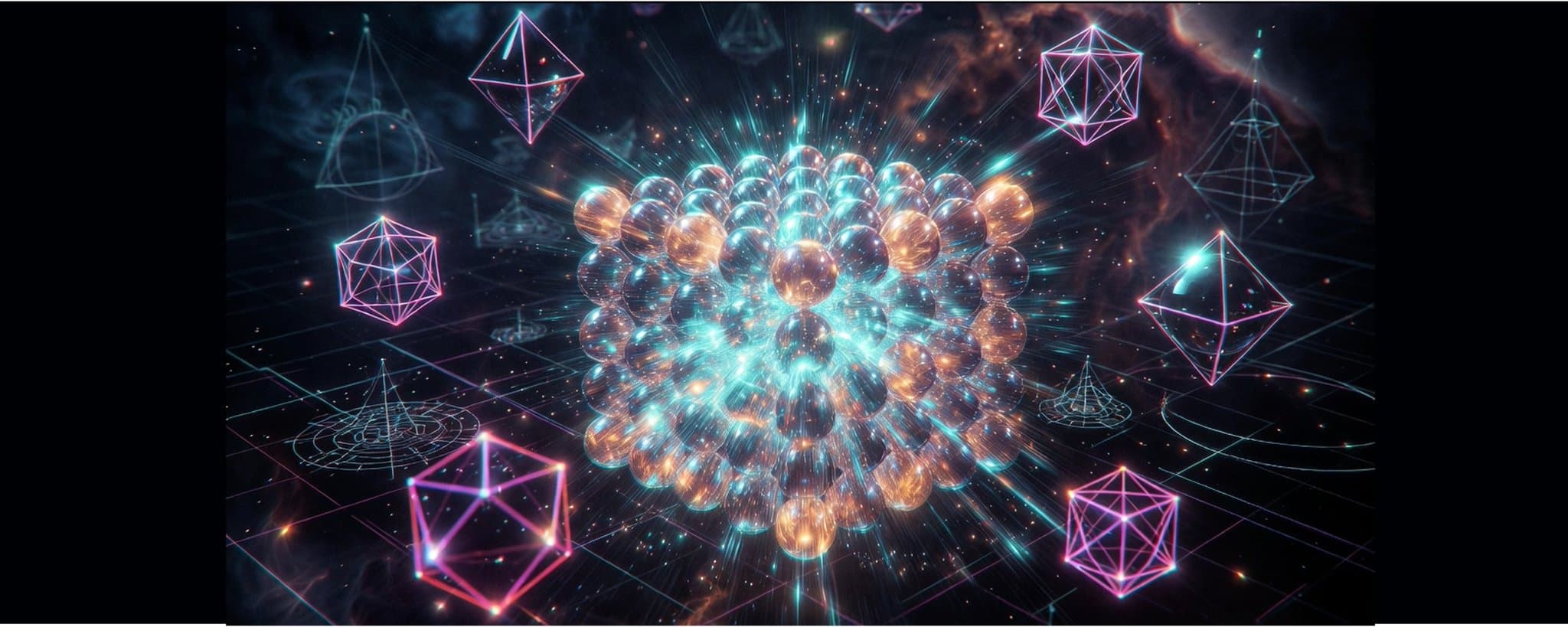
Ffellonics and Discrete Geometry: From Classification to Generation
Discrete geometry is the study of finite or countable geometric objects — points, spheres, polyhedra, lattices, and packings — where combinatorial rules and symmetry, rather than continuous curves or smooth manifolds, govern structure. It is traditionally a classificatory science: given a set of constraints, what configurations satisfy them, and how many such configurations exist?
Ffellonics relates to this field in a specific way. It takes objects that discrete geometry has long studied — the kissing number, the Platonic solids, close-packed lattices — and embeds them within a generative process: a sequence in which these configurations appear, in a fixed order, as the necessary outputs of one local rule applied repeatedly. Where discrete geometry classifies what configurations are possible, Ffellonics describes a specific pathway through which certain configurations arise in sequence.
The Discrete Geometry Foundations
Several established results in discrete geometry are directly relevant to the Ffellonic hierarchy. The kissing number problem asks how many equal spheres can simultaneously touch a central sphere in a given number of dimensions; in three dimensions, the answer is twelve, proven by Schütte and van der Waerden in 1953. Sphere packing theorems address the densest possible arrangements of identical spheres in space, culminating in the Kepler conjecture — that face-centred cubic and hexagonal close packing are the densest possible arrangements in three dimensions — proven by Hales. The Platonic and Archimedean solids represent the most symmetric finite arrangements of points on a sphere, classified completely since antiquity.
Ffellonics generates each of these as a stage in its hierarchy. Level 1 is the dyad — two spheres in contact. Level 2 is the equilateral triangle. Level 3 is the tetrahedron, the first Platonic solid to appear. Level 4 is the octahedron. Higher levels build successive symmetric coordination shells, and Level 12 is the FCC/HCP lattice — the configuration in which every sphere has exactly twelve equidistant neighbours, realising the kissing number and the densest packing simultaneously. Each of these configurations is, individually, a standard object of discrete geometry: a discrete, rigid, symmetric structure governed by combinatorial adjacency and coordination number.
From Static Classification to Generative Sequence
What Ffellonics adds to this picture is not new objects but a specific ordering and mechanism connecting them. Traditional discrete geometry asks questions like "how many ways can twelve spheres touch a central one?" — questions about a fixed configuration considered in isolation. Ffellonics asks a different kind of question: starting from isolated spheres, and applying one local rule — symmetric attachment that maximises contacts while minimising free energy — what sequence of configurations results, and in what order?
The answer, according to the Ffellonic model, is the twelve-level sequence described above. The local rule enforces symmetry at each step — new attachments must preserve the rotational and reflectional symmetry of the existing structure — and free-energy minimisation determines which of the symmetry-preserving options is selected. The configurations do not vary continuously between levels; the system occupies one discrete stable configuration, then transitions to the next as a new attachment is added. This is consistent with how rigid frameworks and energy-minimising point sets behave more generally in discrete geometry: stable configurations are discrete and well-separated, not continuously variable.
The 12-Fold Lattice in Context
The ground state at Level 12 — the FCC/HCP lattice — is one of the most thoroughly studied objects in discrete geometry, as the solution to both the kissing number problem and the sphere-packing problem in three dimensions. In Ffellonics, it represents the configuration of maximum coordination: every unit retains its individual identity while participating in the maximum possible number of symmetric contacts.
This connects to several established areas of discrete geometry. Rigidity theory studies how local constraints on a framework can force global rigidity — a question directly relevant to why each Ffellonic level is a stable configuration rather than a flexible one. Graph theory applied to polyhedral skeletons describes the combinatorial structure of each level's coordination graph. And crystallography studies the periodic structures that the FCC and HCP lattices instantiate at the level of real materials. Ffellonics connects these areas by proposing that the same combinatorial rules that describe these structures statically also describe a specific process by which such structures could be reached from an initial condition of isolated units.
Broader Connections
The combination of discrete geometric constraints with a thermodynamic selection rule has several potential implications, though these vary considerably in how well-established they are.
The connection to physical self-assembly is the most direct: discrete geometric rules combined with free-energy minimisation describe, in outline, how colloidal crystals, viral capsids, and other supramolecular structures form — processes that are governed by local symmetry and energetic constraints rather than by chance alone. This is consistent with established research on self-assembly.
The suggestion that Ffellonics might serve as a classical scaffold relevant to quantum geometry — approaches such as loop quantum gravity or causal set theory, which also build spacetime from discrete combinatorial elements — is considerably more speculative. These frameworks operate at the Planck scale and involve dynamics entirely different from classical sphere packing; any connection would require substantial additional work to establish and should be treated as a suggestive structural analogy rather than a proposed mechanism.
Applications to materials science, where the hierarchy could inform the design of structures with specific coordination properties, are more tractable. Applications to AI architecture or consciousness studies, mentioned elsewhere in discussions of Ffellonics, remain at the level of structural analogy and have not been developed into specific testable proposals in this context.
Directions for Further Work
For discrete geometers, Ffellonics suggests several specific lines of inquiry. One is to establish formal proofs of uniqueness — for each level, is the configuration the Ffellonic hierarchy predicts genuinely the unique outcome of the symmetry-and-energy-minimisation rule, or are there alternative configurations at the same energy that the model does not currently distinguish? Another is to examine how the hierarchy generalises to higher dimensions or to non-Euclidean spaces, where the kissing number and densest packings are different and, in many cases, still open problems. A third is computational verification, using rigidity algorithms or energy-minimisation solvers to confirm that the proposed sequence is in fact what such algorithms produce when run from an initial condition of isolated spheres. A fourth is mapping the hierarchy onto real discrete physical systems — nanoparticle assemblies, metamaterials — where the sequence of intermediate structures could be observed directly.
Conclusion
Discrete geometry classifies the configurations that discrete geometric objects can take — what arrangements of points, spheres, or polyhedra are possible under given constraints. Ffellonics proposes a specific generative sequence through a subset of these configurations, governed by one local rule, and asks not only what structures are possible but in what order they arise when identical units self-organise from an initial condition of isolation.
This reframing does not change the mathematical objects themselves — the kissing number, the Platonic solids, and the close-packed lattices remain what discrete geometry has established them to be. What it adds is a specific hypothesis about process: that these objects are not merely possible configurations among many, but are the necessary stages of a particular developmental sequence, when the governing constraints are symmetry preservation and free-energy minimisation applied locally and repeatedly.
Comments
No comments yet. Be the first to share your thoughts.