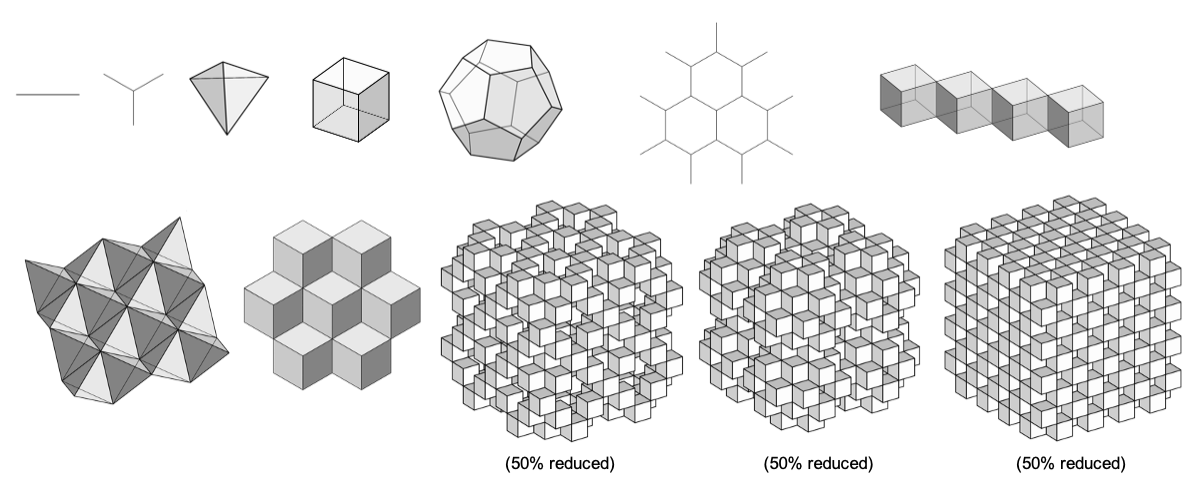
Gallery

Platonic Solids
The Platonic solids are five special three-dimensional shapes that are as perfectly balanced and symmetrical as any solid object can be. Every face is exactly the same regular polygon, every edge is the same length, and the same number of faces meet at every corner.
There are only five of them:
- the tetrahedron (a pyramid made of four equal triangles),
- the cube (six equal squares),
- the octahedron (eight equal triangles),
- the dodecahedron (twelve equal pentagons),
- the icosahedron (twenty equal triangles).
No other solid shape works this way. Each one has a matching "partner" shape (its dual) that fits together with it perfectly, and the tetrahedron is its own partner.
What makes them special is their extreme symmetry. You can rotate them in many different ways and they still look identical. No other everyday solid objects have this level of perfect balance.
The ancient philosopher Plato linked them to the basic elements of the world: the tetrahedron to fire, the cube to earth, the octahedron to air, the icosahedron to water, and the dodecahedron to the whole cosmos. Even today these shapes show up wherever nature or design needs the highest possible symmetry — inside viruses, crystals and certain carbon molecules.
In short, the Platonic solids are the purest examples of three-dimensional symmetry that exist.
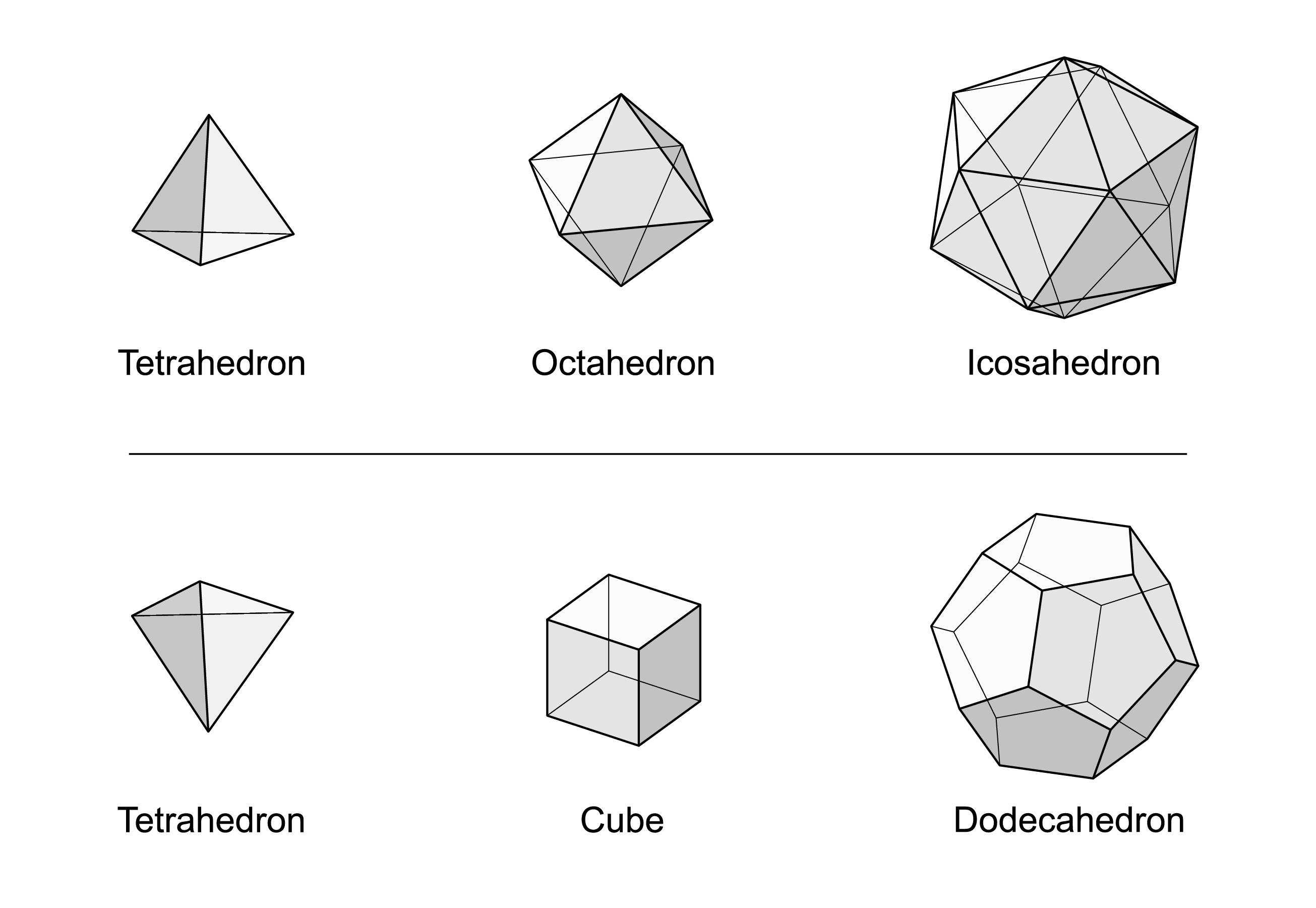
Platonic Solid Duals
To understand the full potential of the Platonic solids, you need to see that they are not simply five separate shapes. They form two linked series of three duals each.
One series is the tetrahedron, the octahedron and the icosahedron. The other is the tetrahedron (which is dual to itself), the cube and the dodecahedron.

Ffellonic Forms
Ffellonic Forms