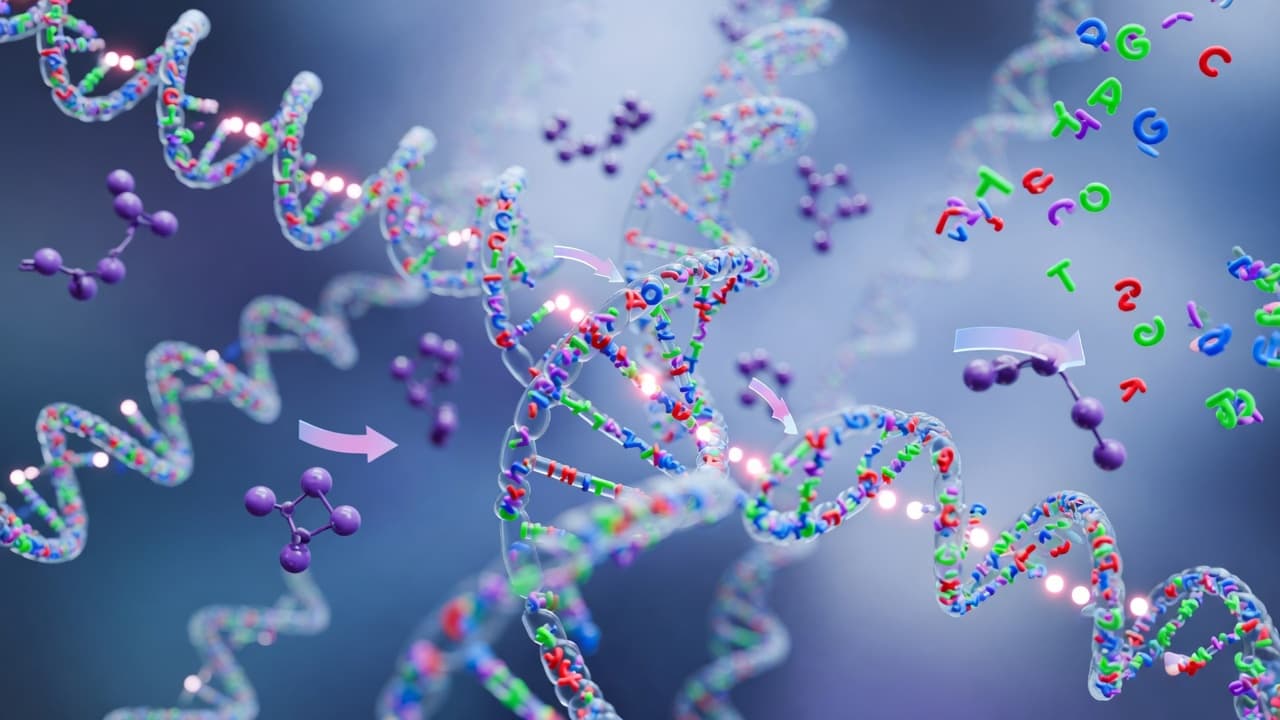
Ffellonics and DNA Self-Assembly: Complementary Models of Bottom-Up Order
Ffellonics and DNA self-assembly both address the same core question: how can simple local rules generate complex, ordered structures without any central designer? Both rely on bottom-up self-assembly, yet they approach the challenge from distinct philosophical and mechanistic angles. Together, they illuminate different facets of nature’s ability to create global order through local interactions.
Core Mechanisms
Ffellonics is a purely thermodynamic and geometric model. It starts with identical spheres that follow one local rule: symmetric nearest-neighbor attachment driven by continuous free-energy minimization. From the initial contact at Level 1, the system evolves deterministically through exactly twelve hierarchical levels, culminating in its thermodynamic ground state at Level 12 — a stable 12-fold FCC/HCP lattice. Symmetry is maintained at every stage, producing a gradual, natural unfolding of structure.
DNA self-assembly models, exemplified by Erik Winfree’s Abstract Tile Assembly Model (aTAM) and DNA origami, operate differently. They employ programmable DNA tiles with sequence-specific “sticky ends.” Attachment is governed by cooperative hybridization kinetics and a temperature threshold (τ). Because tiles only bind when their complementary sticky ends match, researchers can engineer the system to form arbitrary shapes, patterns, or even structures that execute computation as they grow.
Key Similarities
Despite their differences, the two approaches share fundamental principles:
• Both are distributed systems governed solely by local rules, with no global controller.
• Both are driven by energy minimization — Ffellonics through geometric contacts and symmetry that reduce Gibbs free energy; DNA tiles through specific hybridization that lowers binding free energy.
• Both demonstrate genuine emergence, where simple local interactions produce global patterns far more complex than any individual unit.
• Both readily generate highly regular, lattice-like architectures.
Complementary Strengths
Their strengths lie in different domains:
Ffellonics represents thermodynamic optimality and geometric universality. With identical units and maximal symmetry, it follows the most efficient possible pathway, yielding a fixed twelve-level hierarchy punctuated by Platonic-solid intermediates and ending in a highly stable 12-fold lattice. It embodies the “ideal” case under pure physical constraints.
DNA self-assembly excels at programmability and computational versatility. By designing multiple tile types and tuning glue strengths, scientists can direct growth toward virtually any target structure or algorithmic behavior, making it a powerful platform for nanotechnology and molecular-scale computing.
Real biological systems often blend both paradigms. Viral capsids and protein assemblies use largely identical subunits (Ffellonics-like) yet incorporate subtle programmed differences and environmental cues (DNA-like) to balance robustness with functional specificity.
Theoretical and Practical Implications
Ffellonics serves as an elegant theoretical benchmark for the limits of efficient self-assembly. It explains why many successful DNA designs work so well: they implicitly harness the symmetry-maximizing, free-energy-minimizing principles that Ffellonics captures in their purest form.
Conversely, insights from DNA self-assembly can enrich Ffellonics. Introducing a limited number of distinct “sphere types” with programmed specificity could extend the model while preserving its thermodynamic elegance.
Together, the frameworks define a spectrum: Ffellonics as the thermodynamic ideal of spontaneous order, and DNA models as its information-rich, engineered counterpart.
Conclusion
Ffellonics and DNA self-assembly are not competing explanations but complementary lenses on the same phenomenon. Ffellonics provides the clean geometric and thermodynamic foundation that explains why ordered structures arise so naturally. DNA self-assembly demonstrates how that foundation can be programmed to create arbitrary, functional, and computationally powerful constructs.
Examining them side by side enriches our understanding of self-assembly — from the inevitable, symmetry-driven efficiency of Ffellonics to the flexible, information-driven power of DNA tiles. The comparison reveals a deeper truth: nature builds complexity through local rules, and these two models each highlight a vital aspect of that universal capacity. Ffellonics shows what self-assembly achieves when guided purely by thermodynamic intelligence; DNA models reveal what becomes possible when that intelligence is augmented with programmable information.
Comments
No comments yet. Be the first to share your thoughts.