Ffellonics and Entropy: How Geometric Order Manages Disorder
The second law of thermodynamics states that the entropy of an isolated system tends to increase over time — the universe moves, on the whole, from more ordered to less ordered states. Yet nature also exhibits processes in which entropy decreases locally: crystals form from disordered solutions, biological structures self-assemble from dispersed components, and complex ordered systems arise spontaneously from simpler starting conditions. These are not violations of the second law — they are cases in which local entropy reduction is paid for by a larger entropy increase in the surroundings. Understanding the geometric and thermodynamic logic that makes such local ordering possible is one of the central questions in the study of self-organisation. Ffellonics offers a precise and minimal model of exactly this process.
The Ffellonic Hierarchy as a Pathway of Entropy Reduction
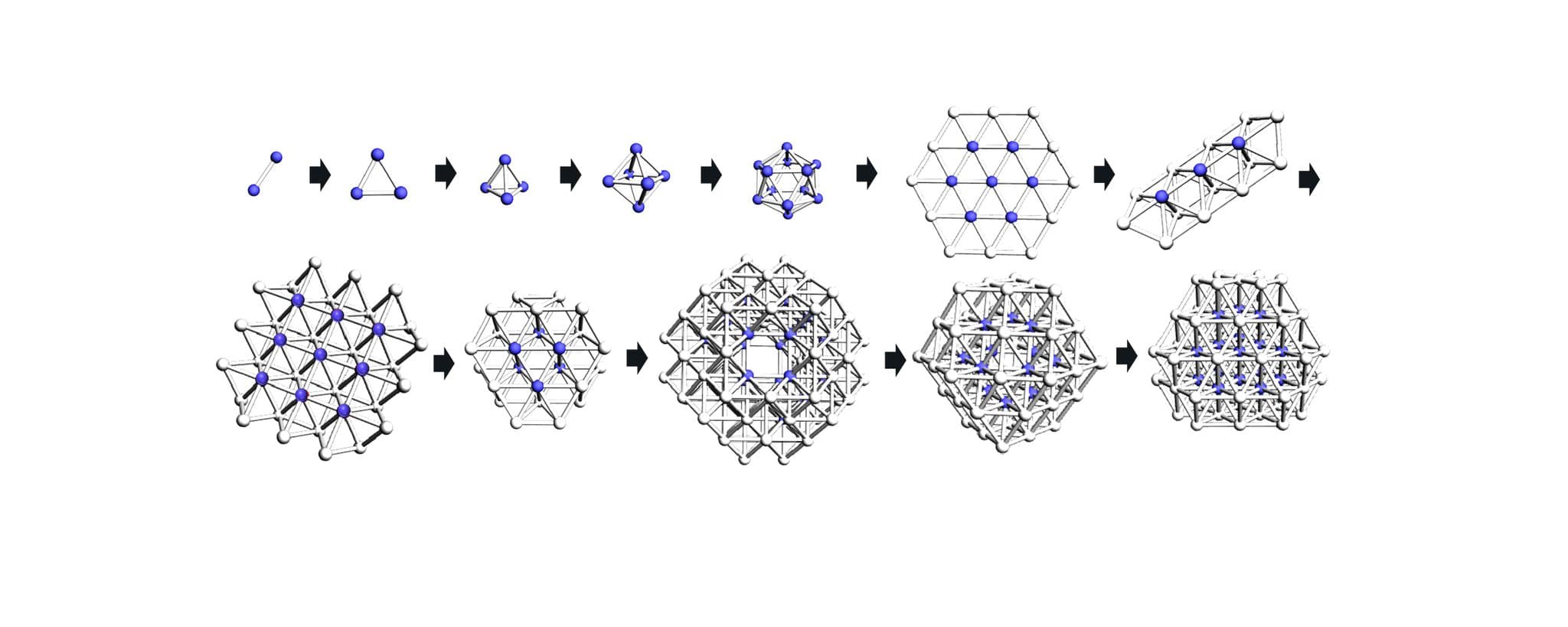
Ffellonics is a 12-level hierarchy of relational emergence in which identical spheres attach under one local rule — symmetric nearest-neighbour attachment under free-energy minimisation. Each attachment increases local coordination and symmetry while releasing energy to the environment, thereby increasing the entropy of the surroundings more than it decreases the entropy of the growing cluster. The result is a process that is globally entropy-increasing — consistent with the second law — while locally producing progressively more ordered, more symmetric, and more stable configurations.
Entropy, understood thermodynamically, quantifies the number of microstates available to a system: lower entropy corresponds to fewer available configurations, higher entropy to more. Symmetric structures have lower entropy than disordered ones because symmetry constrains the space of configurations. The Ffellonic hierarchy is therefore a progression from high-entropy starting conditions — isolated, undifferentiated spheres with no structural constraints — to low-entropy final configurations, in which each unit's position is precisely determined by its coordination geometry.
This progression is not monotonically smooth in its entropy profile at every step, but the overall trajectory is clear: the 12-fold FCC/HCP lattice at Level 12 is one of the lowest-entropy regular configurations available in three-dimensional space under symmetric attachment. Reaching it requires passing through a series of intermediate configurations, each lower in entropy than the one before.
Entropy Management Across the Hierarchy
The early levels of the hierarchy (Levels 1 to 5) produce finite, closed clusters of increasing symmetry. The tetrahedron at Level 3 — with its high degree of rotational symmetry — represents a significant reduction in configurational entropy relative to the disordered starting state, because the positions of all four spheres are precisely determined by the structure. The icosahedron at Level 5, with its higher symmetry group, reduces entropy further. These early milestones correspond to the first stable coordination shells — local minima in the free-energy landscape at which the system temporarily rests before proceeding.
The intermediate levels (Levels 6 to 8) introduce the transition from finite clusters to structures capable of indefinite extension. The hexagonal tessellation at Level 6 is the first configuration in which the local coordination logic can propagate in two dimensions without limit. This represents a qualitative change in the system's entropy profile: the structure is no longer bounded, and its entropy in the extensional directions is, in a sense, managed through periodicity — the repetition of a low-entropy unit cell — rather than through finite closure.
The advanced levels (Levels 9 to 12) build progressively denser and more coordinated structures. Level 12 — the FCC/HCP close-packed lattice — achieves the maximum coordination number possible for identical spheres in three dimensions, corresponding to the minimum configurational entropy consistent with a regular, periodic structure. Each sphere's position is fully determined by its coordination geometry, leaving essentially no configurational freedom.
Parallels in Physical and Biological Systems
The entropy management that Ffellonics models geometrically appears across a wide range of physical and biological systems, and the Ffellonic level sequence provides a useful reference for understanding why.
Crystal growth is the paradigmatic physical case: a disordered solution or melt reduces its local entropy by forming an ordered lattice, paying for this reduction through the heat released to the surroundings. The FCC lattice that metals such as gold adopt corresponds directly to Level 12 of the Ffellonic hierarchy, where entropy is minimised and coordination is maximised.
Virus capsid assembly provides a biological case. Capsid proteins self-assemble into icosahedral shells — corresponding to Level 5 in the Ffellonic hierarchy — because icosahedral symmetry minimises the free energy of assembly for identical or near-identical subunits. The assembly process manages entropy by selecting symmetric configurations at each step, in exactly the way the Ffellonic local rule specifies.
In both cases, the key feature is that the process reaches a definite, low-entropy endpoint rather than continuing indefinitely. This is the structural significance of Ffellonics' finite depth: the hierarchy terminates at Level 12 because that is the point at which no further symmetric attachment reduces free energy. The system has exhausted the available entropy reduction — it has reached the lowest-entropy configuration the rule and the geometry of three-dimensional space permit.
An Open Question: Quantifying Entropy at Each Level
A natural next step for the Ffellonic framework would be to compute the configurational entropy of each level explicitly — using the known geometric properties of each coordination structure — and verify that the sequence is monotonically decreasing from Level 1 to Level 12. This calculation is in principle tractable: each level's geometry is precisely defined, and the number of distinct microstates compatible with each structure can, at least in idealised conditions, be enumerated.
Such a calculation would also allow the entropy profile of the Ffellonic hierarchy to be compared directly with the entropy profiles observed in real self-assembly systems — crystal growth, colloidal assembly, capsid formation — providing a quantitative test of how well the Ffellonic reference model captures the thermodynamic logic of natural self-organisation. This remains an open empirical and theoretical question.
Conclusion
Ffellonics provides a geometric model of how local entropy reduction occurs in self-organising systems: through symmetric nearest-neighbour attachment under free-energy minimisation, a system progresses from a high-entropy disordered starting condition to the low-entropy 12-fold ground state, at each step paying for local order with a larger entropy increase in the surroundings.
The model is minimal enough to be fully specified and precise enough to generate testable predictions. Its value lies not in claiming to explain every instance of entropy management in nature, but in providing a clean reference case — one rule, twelve levels, a definite endpoint — within which the relationship between geometry, symmetry, and entropy reduction can be studied without the complications that real physical systems inevitably introduce.
Comments
No comments yet. Be the first to share your thoughts.