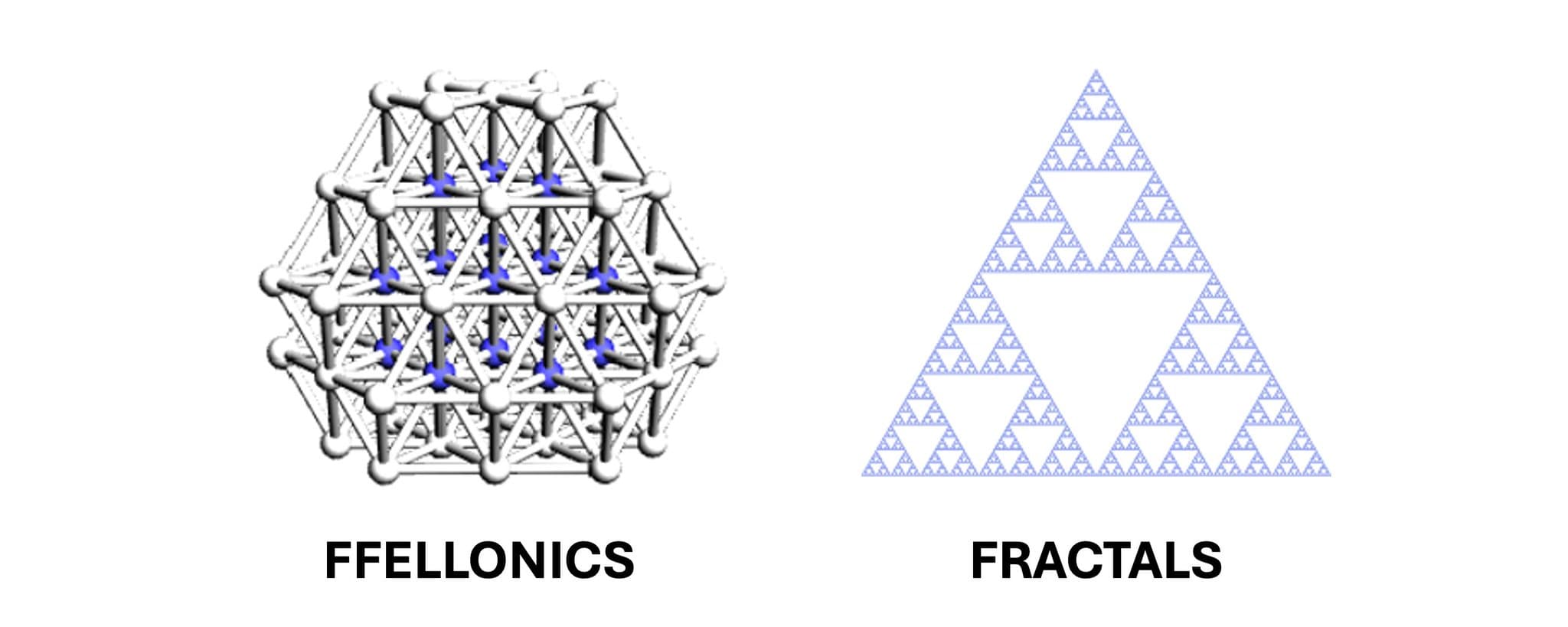
Ffellonics and Fractal Geometry: Two Different Principles of Order
Both Ffellonics and fractal geometry describe complex ordered structures arising from simple local rules. That similarity is real but superficial. Beneath it, the two frameworks represent fundamentally different organisational principles — one convergent and thermodynamically grounded, the other iterative and mathematically open-ended. Understanding the difference clarifies what each framework is actually explaining about the natural world.
The Core Distinction
Ffellonics is a finite-depth relational emergence hierarchy. Identical units attach symmetrically under free-energy minimisation, progressing through twelve defined levels from first contact to the stable 12-fold FCC/HCP ground state. The hierarchy has a clear direction, a definite endpoint, and an active selection principle: at every step, the system occupies the position that maximises contacts while minimising free energy. The progression is cumulative, irreversible, and thermodynamically driven.
Fractal geometry is infinite self-similar iteration. A simple mathematical rule is applied repeatedly — replace a line segment with a curve, subdivide a triangle, iterate a complex function — producing patterns that are self-similar across scales without limit. There is no endpoint, no selection principle, no thermodynamic driving force, and no privileged scale. Complexity emerges from mechanical repetition alone.
The difference is not merely technical. Ffellonics is directional: it moves toward a ground state and arrives there. Fractal geometry is directionless: it continues indefinitely, producing ever-finer detail without converging on anything. One framework describes how nature builds stable structure; the other describes how nature generates scale-invariant complexity.
Key Contrasts
Depth and termination: Ffellonics has exactly twelve levels and terminates at a thermodynamic ground state. Beyond Level 12, the structure extends laterally — infinitely, and in perfect order — but no new hierarchical levels are added. Fractal geometry has no termination: the self-similar pattern continues at every scale, and there is no ground state.
Driving force: Ffellonics is driven by thermodynamics — free-energy minimisation and entropy production. Each step is the most energetically favourable available move. Fractal geometry is driven by mathematical iteration alone, with no energetic or physical selection principle.
Symmetry: Ffellonics actively preserves global symmetry at every level. The Platonic solid milestones — tetrahedron at Level 3, octahedron at Level 4, icosahedron at Level 5 — are the configurations that maintain perfect global symmetry at their respective coordination numbers. Fractal geometry exhibits local or statistical self-similarity, which is a different and weaker property than global symmetry.
Optimisation: Ffellonics selects, at each step, the lowest-free-energy configuration available. It is an optimising process. Fractal iteration applies the same rule regardless of outcome — there is no selection, no comparison between alternatives, and no sense in which any configuration is preferred over another.
Complementary Roles in Nature
The two frameworks are not competitors. They describe different aspects of natural pattern formation, and real systems often exhibit features of both.
Fractal geometry excels at capturing irregular, scale-invariant complexity — coastlines, river networks, lightning, lung branching, turbulence, and the growth fronts of dendritic structures. These are systems where the governing process has no preferred scale and no terminating ground state. The fractal description captures their statistical self-similarity with precision.
Ffellonics excels at explaining ordered, hierarchical self-assembly — crystal lattices, virus capsids, protein cages, and close-packed molecular structures. These are systems where thermodynamic constraints drive the process toward a specific, stable endpoint. The Ffellonic hierarchy describes the pathway to that endpoint and the milestones along the way.
In real systems the two can appear in sequence. Early growth phases may exhibit fractal-like behaviour — dendritic exploration, branching, apparent scale-free complexity — but once symmetry and free-energy minimisation dominate, the system converges toward Ffellonics-style ordered packing. A snowflake may begin with fractal-like branching but settles into hexagonal symmetry. A virus capsid starts with fluctuating protein subunits but locks into a precise icosahedral shell. The fractal phase describes the exploration; the Ffellonic phase describes the convergence.
What the Distinction Reveals
The contrast between the two frameworks points toward a broader distinction in how natural order arises. Fractal geometry describes pattern formation in the absence of a preferred scale or a thermodynamic endpoint — the wild, open-ended complexity of boundary phenomena and scale-free growth. Ffellonics describes pattern formation when thermodynamic constraints impose a clear direction and a definite destination — the convergent, hierarchical complexity of stable self-assembly.
Both are real features of the natural world. But they operate in different regimes and serve different explanatory purposes. Fractal geometry is the right framework for systems without a ground state. Ffellonics is the right framework for systems converging toward one.
Ffellonics is not a fractal. It is the ordered, thermodynamically grounded counterpart to fractal geometry — describing the regime where nature's tendency toward symmetry and energy minimisation dominates over the open-ended iteration that produces fractal patterns.
Comments
No comments yet. Be the first to share your thoughts.