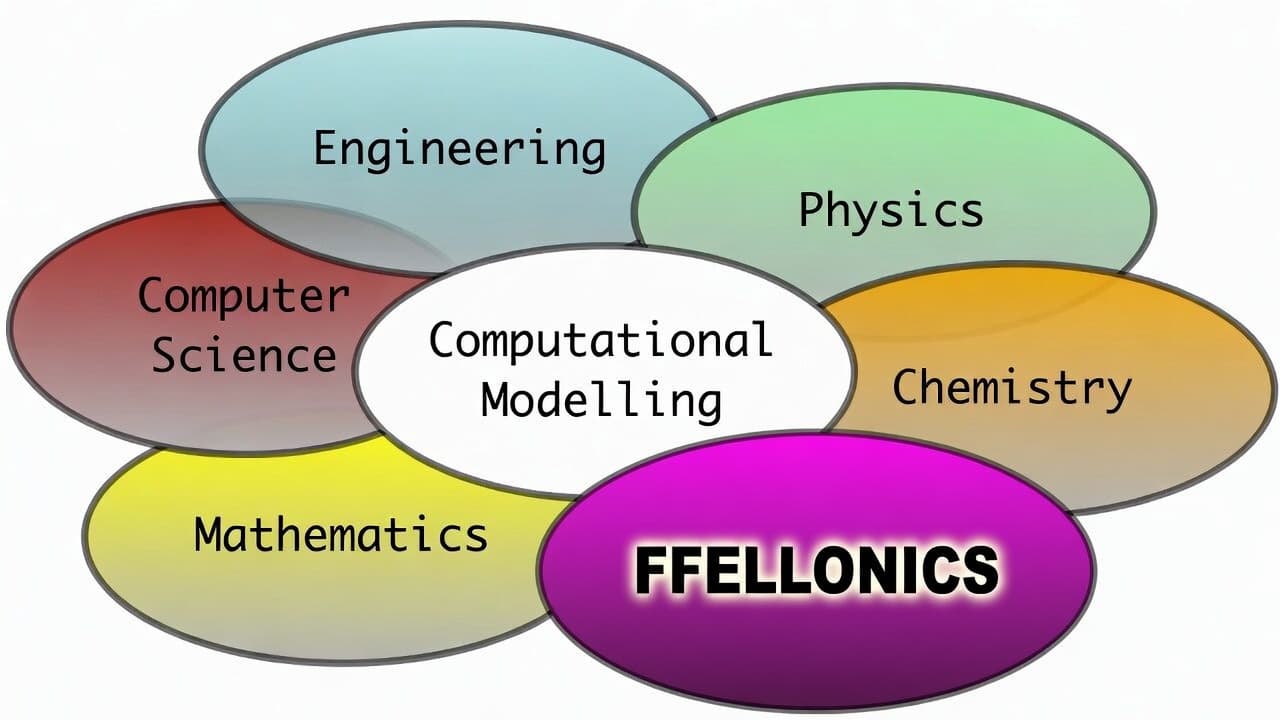
Ffellonics as a Computational Framework
Ffellonics is well-suited to computational modelling because it is rule-based, iterative, and bottom-up: it starts with identical units and applies one local rule repeatedly — symmetric nearest-neighbour attachment that maximises contacts while minimising free energy — and from that single rule, a 12-level hierarchy of increasing complexity and symmetry emerges deterministically. This makes Ffellonics not only a geometric model but a practical blueprint for simulating self-organisation and hierarchical development. The connections to computational modelling fall into several categories.
Agent-Based Modelling and Self-Assembly Simulation
Ffellonics maps naturally onto agent-based modelling. Each sphere is an autonomous agent; the attachment rule is a local decision function — choose the position that maximises contacts while preserving symmetry; and the simulation evolves step by step as new agents arrive and attach according to the rule.
This structure mirrors real self-assembly processes directly: crystal growth, colloidal nanoparticle assembly, virus capsid formation, and protein folding all involve identical or near-identical units following local energy-minimisation rules to produce ordered global structures. A computational implementation of Ffellonics therefore provides a clean testbed for studying how local rules produce global order — a controlled environment in which the rule is known exactly, unlike in physical systems where the precise interaction potentials may be uncertain or difficult to measure.
Graph Generation and Network Evolution
Each stage of the Ffellonic hierarchy can be represented as a growing graph, with spheres as nodes and attachments as edges, evolving under symmetry and energy-minimisation constraints. This framing connects Ffellonics to generative graph algorithms and the study of hierarchical network formation — specifically, the question of how local connectivity rules produce global network properties such as modularity, resilience, and symmetry.
This is potentially useful for modelling networks that exhibit high degrees of symmetry or hierarchical organisation — structures that appear in biological systems, materials, and some social networks — though it should be noted that most real-world networks of interest (the internet, citation networks, social networks) are scale-free rather than symmetric in the Ffellonic sense, and the framework's applicability to those cases would need separate justification.
Discrete Dynamical Systems
The 12-level progression can be viewed as a discrete dynamical system, in which each level is a state, the attachment rule is the update function, and the system converges toward an attractor — the 12-fold coordination lattice. This framing is useful for studying convergence behaviour, exploring the structure of the underlying energy landscape, and examining the phase transitions that occur at specific points in the hierarchy — most notably the transition from the planar tessellation at Level 6 to the three-dimensional extension at Level 7, which represents a genuine qualitative change in the system's dimensionality.
Optimisation and Generative Algorithms
Because Ffellonics is fundamentally an optimisation process — local energy minimisation under symmetry constraints — it connects naturally to gradient-based and constraint-based optimisation methods, to evolutionary or generative algorithms that evolve structures toward symmetry and efficiency, and to machine learning approaches that generate hierarchical or symmetric patterns. In each case, the Ffellonic rule provides a simple, well-understood target against which more complex or more general optimisation methods could be benchmarked.
Computational Advantages
The features that make Ffellonics distinctive as a geometric model are the same features that make it attractive computationally. It has a clearly defined starting state, a single local rule, a finite and well-defined endpoint, and deterministic progression under symmetry constraints. These properties make it suitable for fast prototyping of self-assembly simulations, for testing specific hypotheses about how local rules generate emergent order, for use as a benchmark model in complexity science — a known-answer test case against which more elaborate models can be checked — and for visualising and teaching concepts of hierarchy, symmetry, and emergence, where its determinism and finite structure make outcomes easy to verify.
Conclusion
Ffellonics offers a minimal, rule-based, generative framework for studying how local interactions produce hierarchical global order — a framework whose simplicity is what gives it value as a computational tool. One rule, a fixed endpoint at Level 12, and a fully deterministic developmental sequence make it straightforward to implement, to verify, and to use as a point of comparison for more complex models.
Its value as a computational laboratory lies precisely in this simplicity: because the rule and the outcome are both known in advance, deviations between simulation and prediction are immediately informative, and the framework provides a controlled setting in which more general questions about emergence and self-organisation can be explored before being applied to systems where the governing rules are less certain.
Comments
No comments yet. Be the first to share your thoughts.