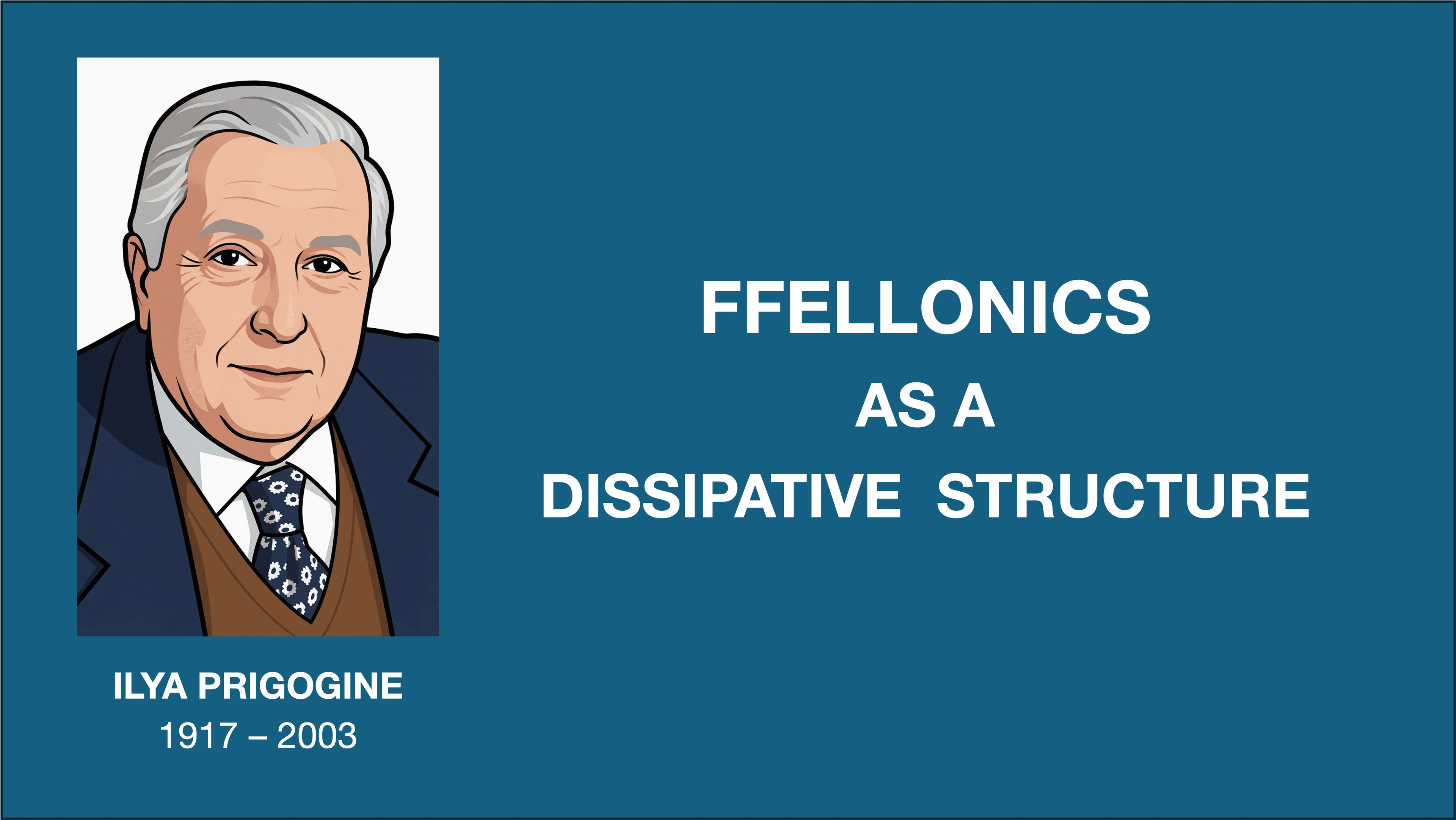
Ffellonics as a Dissipative Structure: A Prigoginian Analysis
Ilya Prigogine's theory of dissipative structures established that open systems operating far from thermodynamic equilibrium can spontaneously generate ordered patterns by dissipating energy and exporting entropy to their surroundings. This was one of the most significant developments in twentieth-century thermodynamics — a demonstration that the second law, far from precluding the emergence of complexity, is the condition under which complexity becomes possible.
Ffellonics offers a particularly clean geometric instance of this principle. Beginning with isolated relational units and governed by a single local rule — symmetric nearest-neighbour attachment under free-energy minimisation — the system progresses irreversibly through twelve cumulative levels, culminating in the stable 12-fold FCC/HCP lattice at Level 12. Examined against Prigogine's criteria, the Ffellonic hierarchy satisfies each of them precisely, suggesting that it functions not merely as a geometric packing model but as a structural archetype for dissipative self-organisation.
Prigogine's Criteria
Dissipative structures, as Prigogine characterised them, share four essential features. They are open, involving continuous exchange of energy or matter with the environment. They operate far from equilibrium, sustained by persistent gradients that prevent relaxation to a disordered steady state. They involve non-linear interactions, which allow small fluctuations to be amplified and can produce qualitative transitions — bifurcations — in the system's behaviour. And the order they generate is dissipation-driven: a local decrease in entropy, made possible only because a larger increase in entropy occurs in the surroundings.
Classic examples include Bénard convection cells, the Belousov–Zhabotinsky reaction, hurricanes, and living organisms — systems in which striking spatial or temporal order emerges precisely because energy is continuously flowing through them and being dissipated.
The Structure of the Ffellonic Hierarchy
Ffellonics is a strictly defined 12-level hierarchy generated by identical relational units attaching symmetrically to maximise coordination while minimising free energy. The progression is cumulative and irreversible. Levels 1 and 2 establish the formation of dimers and small clusters. Levels 3 through 5 produce the Platonic solids — the tetrahedron, octahedron, and icosahedron — as natural stability milestones. Levels 6 through 11 involve the progressive build-up of higher coordination shells. Level 12 represents the thermodynamic ground state: the 12-fold FCC/HCP lattice, in which every unit has exactly twelve nearest neighbours.
At each level, a dynamic equilibrium exists between two complementary structural features — Ffellonic Forms, generated by internal coordination centres, and Canalicchio Duals, generated by external radical points. This internal-external balance is maintained throughout the hierarchy and contributes to the stability of each successive configuration.
Ffellonics as a Dissipative Process
The Ffellonic hierarchy satisfies each of Prigogine's criteria at every stage.
It is open: new relational units and the energy associated with their attachment continuously enter the system, as occurs in crystal growth from solution or vapour. It operates far from equilibrium: persistent gradients — in chemical potential, surface tension, or concentration — drive the system away from disordered equilibrium states and toward the configurations the local rule favours. It involves non-linear interactions: the placement of each new unit geometrically constrains the possibilities available to subsequent units, and small changes in conditions can trigger qualitative structural transitions — such as the shift from an icosahedral cluster at Level 5 toward extended lattice structures at higher levels. And its order is dissipation-driven: each attachment lowers the local free energy of the cluster while releasing energy — as heat or other entropy — to the environment, and this entropy export is precisely what permits the local increase in coordination and symmetry.
The full sequence from Level 1 to Level 12 therefore operates as a chain of dissipative attractors, each more ordered and lower in free energy than the one before it — and each made possible by the entropy exported at every preceding step.
Manifestations Across Scales
The Ffellonic dissipative pattern appears across a wide range of physical and biological systems. In physics and chemistry, it describes crystal growth and atomic lattice formation, particularly the FCC and HCP structures that correspond to Level 12. In biology, it describes the assembly of viral capsids — icosahedral symmetry at Level 5 — and aspects of cellular self-organisation. In materials science, it describes the self-assembly of nanoparticles, foams, and emulsions into ordered superstructures.
In each of these cases, the same underlying logic applies: an open system, far from equilibrium, dissipating energy as it builds increasingly coordinated structure.
Broader Implications
The Prigoginian reading of Ffellonics has a philosophical dimension worth noting. It reframes dissipation — often associated with waste, decay, or the loss of useful energy — as the mechanism that makes ordered complexity possible in the first place. Without dissipation, the Ffellonic hierarchy could not progress beyond its first stable configuration. With it, the hierarchy is driven, stage by stage, toward its global minimum.
This connects to several broader intellectual traditions. It resonates with process philosophy's emphasis on becoming over static being — the Ffellonic hierarchy is, at every stage, a process rather than a finished object. It also connects to Aristotelian teleology in a specific and limited sense: the hierarchy moves toward a definite end state — the maximal form compatible with three-dimensional space — though this end state is reached through thermodynamic necessity rather than purposive design.
Conclusion
Ffellonics is more than a geometric packing hierarchy. Examined through Prigogine's framework, it is a dissipative process that traces a specific, well-defined pathway from relational isolation to maximal ordered coordination — and it satisfies each of the criteria that define dissipative structures at every stage of that pathway.
This positions Ffellonics as a geometric archetype of dissipative self-organisation, with manifestations across physical, chemical, and biological domains. In a universe governed by the second law, the Ffellonic hierarchy demonstrates with particular clarity that dissipation is not an obstacle to order. It is the mechanism through which order of this kind arises at all.
Comments
No comments yet. Be the first to share your thoughts.