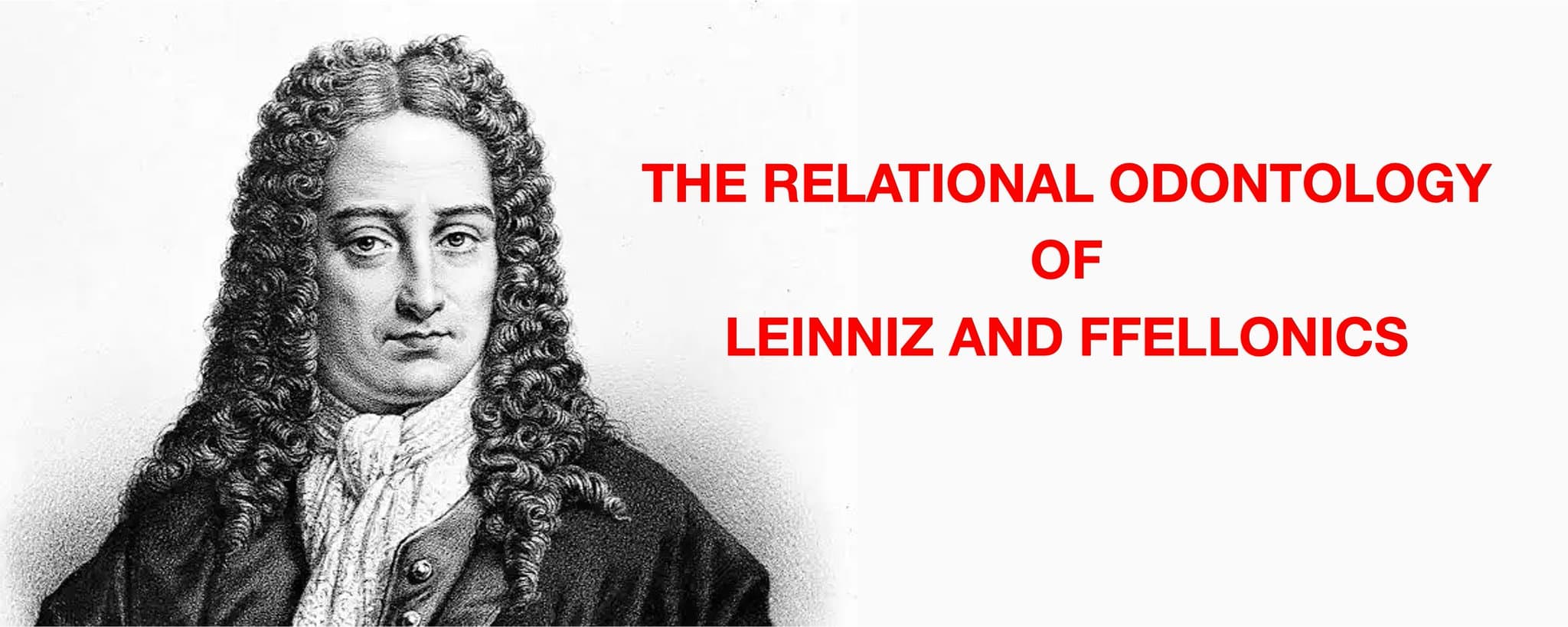
From One Touch Comes Everything: Ffellonics and Leibniz's Relational Ontology
In Leibniz's Monadology (1714), reality is composed of an infinite number of simple, indivisible substances — monads — each a unique perspective on the entire universe, with no direct causal interaction between them. A monad's identity is constituted entirely by its internal representation of every other monad; in isolation, a monad would have no content at all. Three centuries later, Ffellonics — David Fell's geometric and thermodynamic model of relational emergence — develops a structurally similar inversion: identical spheres that have no determinate structure in isolation, and which acquire all their geometric properties through relation.
The parallel is worth examining in detail, not because Ffellonics was derived from Leibniz, but because both frameworks independently arrive at the same foundational move: relations are ontologically prior to the entities they relate.
Ffellonics: Spheres as Ontological Primitives
Ffellonics begins with the simplest possible primitive: identical, isotropic spheres. An isolated sphere is pure potential — undifferentiated, without orientation, structure, or measurable identity. The generative rule is minimal: spheres attach symmetrically to nearest neighbours in a way that maximises contacts while minimising free energy.
The first event — two spheres forming a dyad at Level 1 — is the origin of differentiation. This first relation creates the first distinction: a shared axis, an inside and outside relative to the bond, and the beginning of geometry itself. From this single relational act, a deterministic 12-level hierarchy unfolds: the dyad at Level 1, the triangle at Level 2, the tetrahedron at Level 3, the octahedron at Level 4, the icosahedron at Level 5, through hexagonal tessellations and spaceframes, to the face-centred cubic and hexagonal close-packed lattices at the higher levels, where every sphere reaches the geometric maximum of twelve neighbours.
The resulting complexity is not arbitrary. It is the thermodynamically necessary outcome of symmetric relation, applicable — at least as a structural analogy — to crystal growth, colloidal self-assembly, virus capsid formation, and other systems of interacting units. The principle can be summarised concisely: relations precede and define being.
Leibniz's Monadology: A Universe of Relational Perspectives
Leibniz's monads are indivisible, non-extended, "windowless" entities — they do not causally interact with one another directly. Each monad is a unique point of view on the entire universe, its nature constituted entirely by its internal perceptions of every other monad. Two principles govern the system: the Principle of Sufficient Reason, that nothing occurs without a reason for its being so rather than otherwise, and the Principle of the Identity of Indiscernibles, that no two things can be exactly alike.
Monads form a graded hierarchy of perceptual clarity — from bare monads with confused perceptions, through animal souls capable of memory, to rational spirits capable of self-consciousness, with God as the supreme monad. Because monads cannot directly interact, the appearance of causal order in the physical world results from a pre-established harmony: each monad's internal states are synchronised with every other's at creation, producing what Leibniz called the best of all possible worlds — a universe of maximal variety, order, and harmony. Space and time, on this account, are not absolute containers but ideal orders of coexistence among monads. Physical bodies are well-founded phenomena — aggregates organised around dominant monads, rather than fundamental substances in their own right.
The Structural Parallels
The resonance between the two frameworks operates at several levels.
Relational primacy. In both systems, isolated units lack content. A monad without its relational perceptions of the rest of the universe would have no identity; a sphere without contact has no orientation, axis, or measurable structure. Both frameworks reject the idea that entities have intrinsic properties prior to and independent of their relations — substance-first metaphysics is replaced, in both cases, by a view in which relation is foundational.
Harmony from simple rules, without external intervention at the level of individual events. Leibniz's pre-established harmony ensures global coordination without direct causal interaction between monads — though the harmony itself is established by God at creation. Ffellonics replaces this with thermodynamic necessity: one local rule of symmetric energy minimisation drives the entire hierarchy toward maximal coordination. In both cases, local relational structure produces global order without requiring a blueprint that specifies the global structure directly. The disanalogy is also worth noting: Leibniz's harmony requires a divine act of synchronisation at the outset, whereas the Ffellonic rule requires no analogous foundational act beyond the first contact itself.
Graded hierarchy. Leibniz's monads form a hierarchy of perceptual clarity, from confused to fully self-conscious. Ffellonics has a strict 12-level hierarchy of coordination numbers and symmetry, each level representing increased relational integration. The structural shape — a graded progression of increasing relational depth — is shared, even though what is said to deepen (perceptual clarity versus geometric coordination) differs substantially between the two frameworks.
Geometry as relational, not primitive. For Leibniz, space is an order of relations among monads rather than an independent container. In Ffellonics, geometry literally emerges from contact: the first dyad generates the first line; subsequent attachments generate planes and volumes. Extension, in both cases, is a consequence of relation rather than a precondition for it.
Where the Frameworks Diverge
The differences between the two systems are substantial and worth stating clearly. Ffellonics is naturalistic: its spheres model physical self-assembly processes governed by measurable energy landscapes, and its claims are in principle testable. Leibniz's Monadology is an idealist metaphysics: monads are mind-like entities, and the harmony that coordinates them is divinely instituted. Leibniz's system requires God as the ground of synchronisation and creation; Ffellonics requires only the single local rule and a starting condition.
These differences mean the two frameworks are not interchangeable, and Ffellonics should not be read as a "proof" or "vindication" of Leibniz's metaphysics. What can be said is narrower: both frameworks independently converge on the same structural move — relations as ontologically prior to the relata — and Ffellonics provides a concrete, geometrically precise, and testable instance of what that move looks like when applied to physical self-assembly.
Why the Connection Is Useful
In an intellectual environment increasingly concerned with relational physics — quantum entanglement, information-theoretic approaches to ontology, network science — the convergence between Ffellonics and Leibniz's much older relational ontology is a useful reminder that the idea of relations as fundamental is not a recent innovation. Leibniz arrived at a version of this idea through metaphysical reasoning in the early eighteenth century. Ffellonics arrives at a structurally similar idea through geometric and thermodynamic reasoning in the twenty-first.
The value of the comparison is interpretive rather than evidential. Leibniz's framework offers a rich vocabulary — perspectives, perceptual clarity, well-founded phenomena — for thinking about what Ffellonics' geometric hierarchy might mean if extended, by analogy, beyond physical self-assembly to domains such as social or cognitive systems. Ffellonics, in turn, offers a concrete and visualisable case of a relational ontology in operation, which can make Leibniz's more abstract claims easier to grasp. Neither framework validates the other, but each can illuminate what the other is claiming.
Conclusion
Both Ffellonics and Leibniz's Monadology reject the picture of a universe composed of isolated things with intrinsic properties, replacing it with a picture in which relation is foundational and structure emerges from relational interaction according to a small number of governing principles. The two frameworks differ profoundly in their domains, their methods, and their metaphysical commitments — one is a physical model, the other an idealist metaphysics requiring a divine ground.
What they share is a structural commitment: that the simplest possible beginning — a single relational act — can be the origin of everything that follows, not through chance or external design, but through the consistent operation of whatever principle governs relation in that domain. That shared commitment, expressed in two entirely different vocabularies three centuries apart, is what makes the comparison worth making.
Comments
No comments yet. Be the first to share your thoughts.