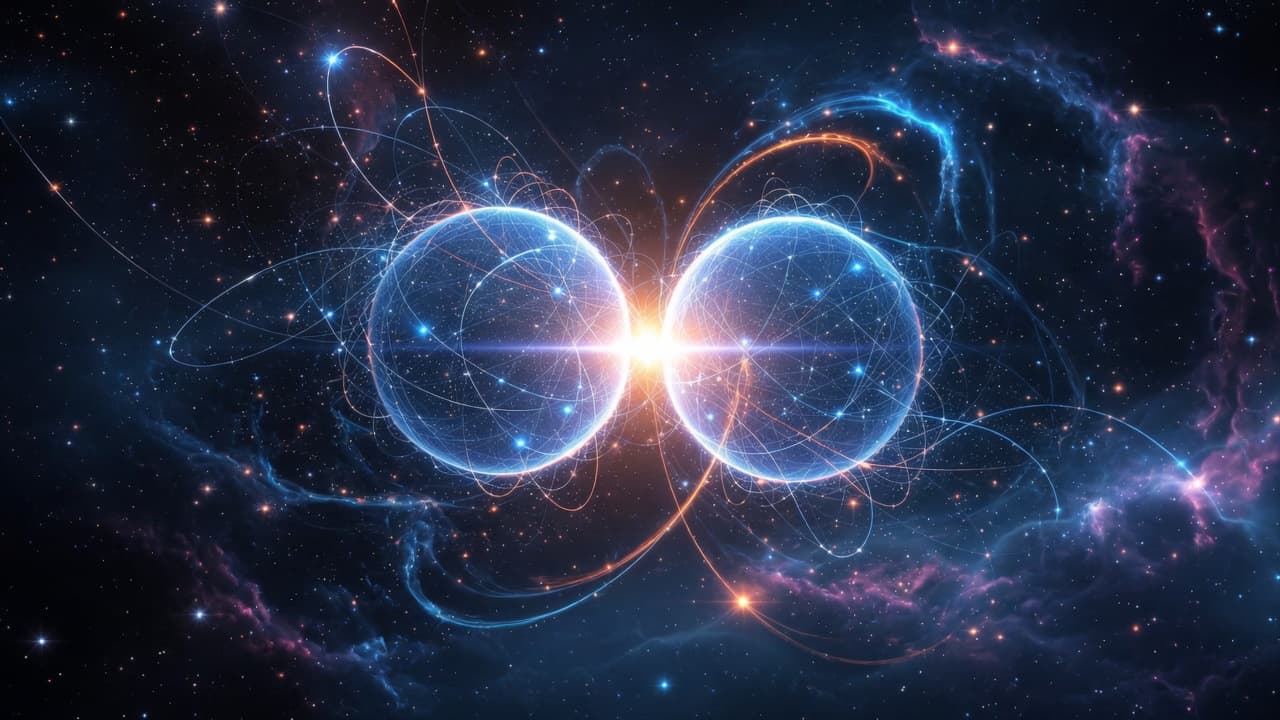
Quantum Entanglement and Ffellonics: Relation Across the Quantum-Classical Divide
Quantum entanglement is one of the most striking features of physical reality. When two or more particles become entangled, measurements on one are correlated with measurements on the other in ways that cannot be explained by any classical signal travelling between them — what Einstein called "spooky action at a distance." Entanglement demonstrates that, at the quantum level, relation can be more fundamental than the independent existence of the entities involved: once entangled, two particles cannot be fully described except as a single system.
Ffellonics operates in an entirely different regime — classical, deterministic, post-decoherence — but shares a structural starting point with entanglement that is worth examining carefully, while being precise about where the parallel ends.
The Shared Starting Point: Relation as Prior to Individuality
In both frameworks, the relevant transition is from independence to inseparability.
In quantum mechanics, two particles that interact can become entangled: before the interaction, their states are independent and can be described separately; afterward, they form a single system whose joint state cannot be factored into individual descriptions. The relation is not an additional fact about two independent things — it is what makes the joint system what it is.
In Ffellonics, the relevant transition occurs at Level 1 — the first contact between two relational units. Before contact, each unit exists in a state of pre-relational isolation: pure potential, without structure or actual relation to anything else. The moment of contact establishes the first relational fact, and from that point the local rule — symmetric nearest-neighbour attachment under free-energy minimisation — governs how the system develops.
In both cases, what exists prior to the relevant transition is, in an important sense, incomplete. Individual description gives way to relational description. This is a genuine structural parallel: both frameworks treat relation as constitutive rather than incidental.
What the Parallel Does Not Establish
It is important to be precise about the limits of this comparison. Quantum entanglement and Ffellonic attachment are not the same phenomenon operating at different scales, and Ffellonics should not be understood as describing what entangled particles "become" after decoherence in any literal physical sense.
Decoherence is the process by which interaction with the environment suppresses quantum superposition and entanglement, selecting stable classical states — pointer states — that no longer exhibit quantum correlations. What happens to a specific pair of entangled particles after decoherence is a question for quantum measurement theory, and the answer does not involve those particles subsequently following a Ffellonic attachment sequence. Ffellonics describes how classical relational units — already decohered, already definite — organise themselves through subsequent local interactions. It does not describe the fate of any particular entangled pair.
The genuine connection is at the level of structure, not mechanism: both frameworks reject the picture of reality as composed of fundamentally independent objects, and both treat the move from independence to relation as ontologically significant. But the entanglement of two particles and the attachment of two spheres in the Ffellonic hierarchy are governed by entirely different physics, operate in different regimes, and should not be conflated.
Two Regimes, One Broader Theme
Read this way, quantum entanglement and Ffellonics can be understood as addressing the same broad theme — the priority of relation over independent existence — in two different regimes that are not directly continuous with each other.
At the quantum level, entanglement reveals that correlations between systems can exist that have no classical explanation, and that the relation between entangled systems is not reducible to facts about either system in isolation. At the classical level, post-decoherence, Ffellonics describes how relational units — now governed by classical local rules — build increasingly coordinated structures through a deterministic 12-level hierarchy, terminating in the 12-fold FCC/HCP lattice.
Both are instances of a broader pattern in which relational structure is treated as fundamental rather than derivative. But they are instances of that pattern in different domains, governed by different physics, and the relationship between them is best described as thematic resonance rather than continuity or succession.
Why the Distinction Matters
This distinction matters because the strength of Ffellonics as a framework lies in its precision within the classical, post-decoherence domain — a domain where it makes specific, geometrically grounded claims about how systems develop. Overextending the framework to claim continuity with quantum entanglement risks obscuring that precision, by suggesting a mechanistic link between two phenomena that are governed by different physical laws.
The more defensible claim is narrower but still significant: both quantum mechanics and Ffellonics challenge the classical intuition that reality is fundamentally composed of separate, independent objects with relations as secondary additions. Quantum entanglement makes this challenge at the most fundamental level physics currently describes. Ffellonics makes a structurally similar challenge within the classical domain, using a model precise enough to be simulated and tested.
Conclusion
Quantum entanglement and Ffellonics share a starting point — both treat relation as prior to and constitutive of the entities involved, rather than as something that happens to pre-existing independent entities. This is a genuine and significant similarity in how the two frameworks are structured.
What they do not share is a mechanism, a regime, or a direct continuity. Ffellonics is not what entanglement "becomes" after decoherence. It is a separate, classical account of relational self-organisation that happens to share, with quantum entanglement, the deeper philosophical commitment that relation is not secondary to the things it relates.
Comments
No comments yet. Be the first to share your thoughts.