Spatial Hierarchy Models and Ffellonics: A Deep Structural Resonance
Spatial hierarchy models and Ffellonics appear at first glance to belong to entirely different domains — one rooted in human geography and economic organisation, the other in pure geometric self-organisation and thermodynamics. A closer examination reveals that they are addressing the same underlying question from different directions: why do efficient systems, whether composed of human settlements or identical physical units, naturally organise themselves into ranked, symmetric, nested hierarchies?
Spatial Hierarchy Models: The Economic Case
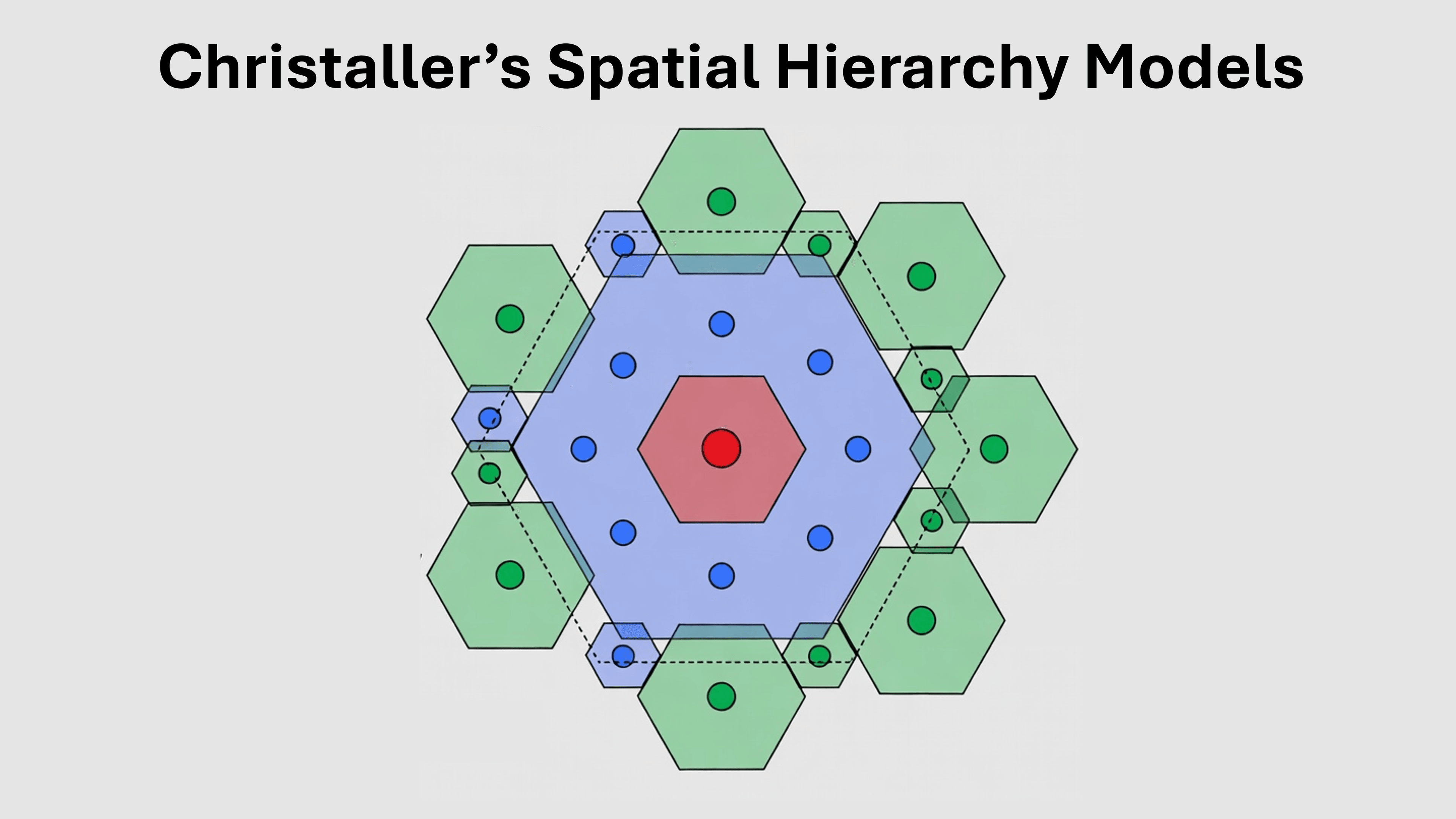
Walter Christaller's Central Place Theory (1933) began with a deceptively simple observation: towns and cities are not distributed randomly. They are spaced and sized in ways that reflect an underlying logic of efficiency. Christaller's answer was that settlements organise into a nested, ranked system to provide goods and services with minimal waste — higher-order centres supplying specialised services to wide hinterlands, lower-order centres serving everyday needs over smaller areas. To minimise travel distance and avoid gaps or overlaps in coverage, the optimal spatial pattern turns out to be a regular hexagonal lattice. Christaller identified three organising principles — the marketing principle (K=3), the transport principle (K=4), and the administrative principle (K=7) — each producing a slightly different but still hexagonally structured hierarchy.
August Lösch refined and extended this framework in The Economics of Location (1940). Rather than beginning with the largest centres and working downward, Lösch started with the smallest units and allowed market areas to overlap, producing a more flexible and realistic account of economic landscapes that nonetheless retained the same underlying hierarchical and geometric logic. Subsequent work by Brian Berry, William Garrison, and others formalised these ideas mathematically and tested them empirically. Contemporary spatial hierarchy models incorporate GIS, agent-based simulation, and network theory, but the central insight has remained stable across nine decades: efficient spatial organisation naturally produces ranked, nested, symmetric patterns.
Ffellonics: The Thermodynamic Case
Ffellonics is not an economic model. It is a pure relational emergence hierarchy — a minimal, deterministic account of how identical units self-organise under one local rule: symmetric nearest-neighbour attachment under free-energy minimisation.
From the first contact at Level 1, the system progresses cumulatively through twelve levels. The Platonic solids appear as natural milestones — the tetrahedron at Level 3, the octahedron at Level 4, the icosahedron at Level 5 — because they represent the lowest-free-energy, symmetry-maximising configurations at those coordination numbers. The hierarchy reaches its thermodynamic ground state at Level 12: the stable 12-fold FCC/HCP coordination lattice. Once Level 12 is achieved, the structure has finite hierarchical depth but extends indefinitely in space without adding new levels or sacrificing coordination efficiency.
At every level, each unit is automatically positioned in its most efficient relational configuration. The progression is dissipative and irreversible — entropy is exported to the environment at each step — making the process self-reinforcing. The result is maximal relational coordination achieved with minimal waste: the geometric expression of thermodynamic efficiency.
The Resonance
The structural parallels between the two frameworks are precise.
Both rely on hierarchy as the primary organising tool. In spatial hierarchy models, centres are ranked by service level and hinterland size. In Ffellonics, units are ranked by coordination number. Both employ symmetric geometry to achieve optimal coverage with minimal waste: Christaller's hexagonal lattice in two dimensions and Ffellonics' 12-fold coordination lattice — whose horizontal layers are themselves hexagonal — in three dimensions.
Both produce stable end-states in which the system can extend outward without restructuring. In central place theory, this is the stable regional network of centres and hinterlands; in Ffellonics, it is the infinite lateral extension of the ground-state lattice. And both arrive at their characteristic hierarchical structures not through top-down design but through the consistent application of local optimisation rules under constraints of symmetry and efficiency.
This last point is the most significant. Both frameworks demonstrate the same underlying principle: when entities follow local optimisation rules under symmetry and efficiency constraints, ordered hierarchical structures emerge spontaneously. The human-economic case and the thermodynamic case are independent instances of the same logic. Spatial hierarchy models show it operating in the complex, contingent world of human settlement; Ffellonics reveals it in its purest geometric and thermodynamic form.
What Ffellonics Adds to Spatial Hierarchy Theory
Spatial hierarchy models have always been idealisations. Christaller and Lösch both acknowledged that real settlement patterns depart from perfect hexagonal lattices due to topography, historical accident, political boundaries, and the uneven distribution of resources. The hierarchical instinct remains strong in the data, but the clean geometry is always approximate.
Ffellonics offers a rigorous physical and mathematical foundation for why hierarchical and hexagonal patterns feel natural in the first place. They are not merely convenient economic arrangements arrived at by trial and error. They are the human-scale expression of a deeper geometric and thermodynamic principle — free-energy minimisation under symmetric attachment — that operates across physical, biological, and social systems alike.
The same logic that produces Christaller's hexagonal lattice of market areas produces the hexagonal layers of the FCC/HCP ground state in Ffellonics. The same logic that ranks settlements by service level ranks coordination shells by contact number. The convergence is not coincidental. It reflects the fact that efficient organisation, at any scale and in any domain, tends toward the same family of ranked, symmetric, nested structures — because those structures minimise waste and maximise coverage under the relevant constraints.
Conclusion
Spatial hierarchy models and Ffellonics are not competing frameworks. They address the same structural question at different scales and in different domains. Christaller and Lösch showed, from the economics of human settlement, that efficient organisation naturally produces ranked hexagonal hierarchies. Ffellonics shows, from the thermodynamics of physical self-organisation, why that tendency is not peculiar to human economics but universal.
In this light, the hexagonal hierarchies of central place theory are human-scale instances of a deeper organising principle — the same principle that drives identical spheres to self-assemble into the 12-fold ground state, that governs the icosahedral symmetry of virus capsids, and that underlies the lattice structure of crystals. Ffellonics does not replace spatial hierarchy models. It provides the thermodynamic and geometric foundation from which their persistent patterns can be understood.
Comments
No comments yet. Be the first to share your thoughts.