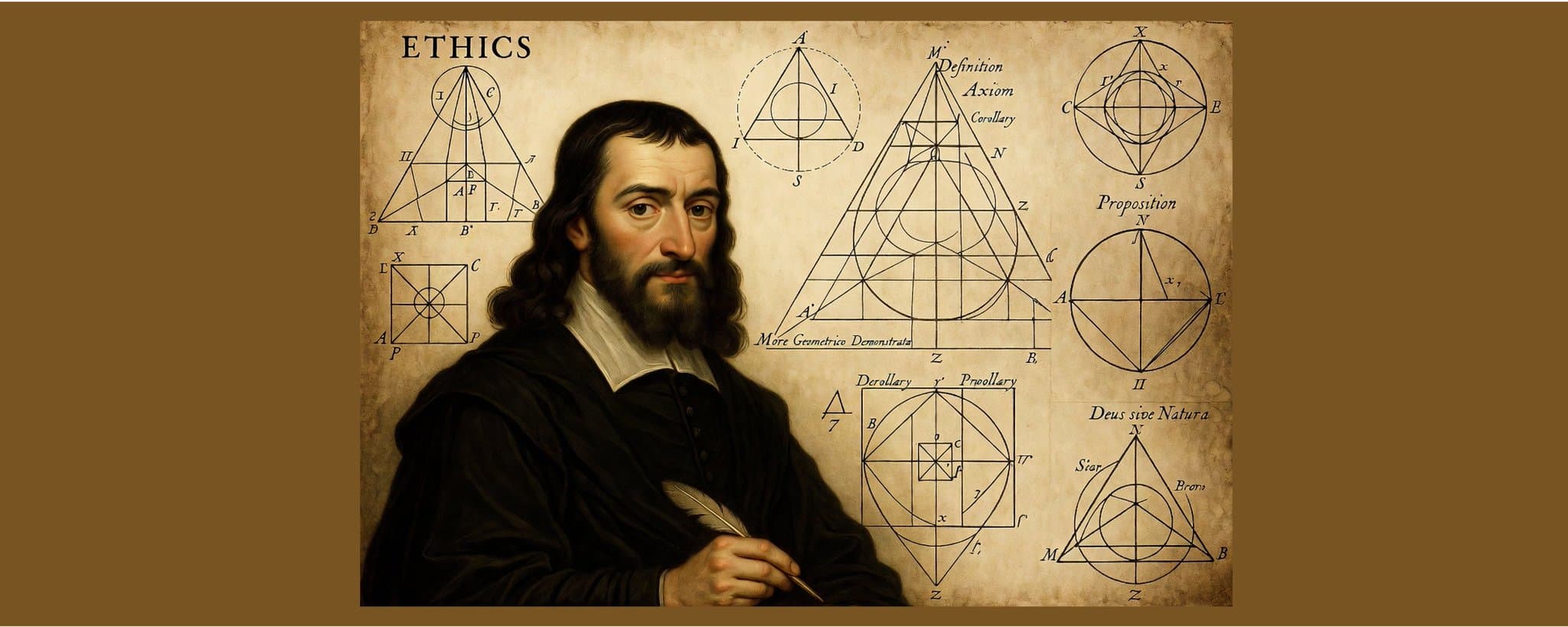
Spinoza and Ffellonics: From Geometric Necessity to Dynamic Becoming
In the 17th century, Baruch Spinoza constructed one of philosophy's most systematic and radical visions in his Ethics — a work written in the axiomatic style of Euclid, demonstrating that reality is a single infinite substance, which he called God-or-Nature, unfolding with absolute necessity through its internal relational modes. Nothing exists independently; everything is a modification of the one substance, determined by its nature from within.
Ffellonics, developed by David Fell as a minimal geometric model of relational self-organisation, was explicitly framed by its creator as an update to Spinoza's vision — preserving the core insights while replacing static substance with dynamic process. The parallels are precise enough to be worth examining in detail.
The Geometric Method: Necessity Made Visible
Spinoza's Ethics proceeds axiomatically. Definitions, propositions, and corollaries unfold with Euclidean necessity — nothing is arbitrary, everything follows deductively from the nature of the one substance. The geometric form is not merely stylistic. For Spinoza, it reflects the structure of reality itself: things are as they are because they could not be otherwise.
Ffellonics embodies the same principle, but makes it physically visible. The entire model rests on one local thermodynamic rule — symmetric nearest-neighbour attachment under free-energy minimisation — applied repeatedly in three-dimensional space. The resulting 12-level hierarchy is not invented or imposed. It is the inevitable geometric record of identical units relaxing toward minimal free energy. Every level emerges necessarily from the one before it: the tetrahedron at Level 3, the octahedron at Level 4, the icosahedron at Level 5, and the 12-fold FCC/HCP lattice at Level 12. No external designer is required. The geometry itself constitutes the necessity.
Where Spinoza demonstrated necessity through deductive proof, Ffellonics demonstrates it through physical process. The two methods are formally analogous: both show that what exists follows with strict necessity from a small number of foundational principles.
Monism and Relational Unity
At the heart of Spinoza's philosophy is monism: there is only one substance, and all particular things are modes or modifications of it. Relations are internal to the one substance — nothing exists in isolation from it, and nothing is truly independent.
Ffellonics embodies this monism in a precise physical form. There is one type of entity — the sphere — and one generative process — symmetric attachment under energy minimisation. All complexity arises from internal relations. No external forces, separate substances, or additional rules are required. The spheres themselves are not the fundamental reality; what matters are the connecting relations between them. The lines of connection, not the nodes, chart the natural formations.
This is a direct physical expression of Spinoza's relational unity. The one substance, in Ffellonics, is not a metaphysical postulate but a geometric fact: one rule, one entity type, one continuous process of becoming.
Determinism and the Recognition of Necessity
Spinoza rejected free will as an illusion arising from ignorance of causes. Everything follows with strict necessity from the divine nature. What we call freedom is not the absence of determination but the understanding and affirmation of it — the condition of acting from one's own nature rather than being driven by external forces one does not understand.
Ffellonics provides a geometric and thermodynamic demonstration of this idea. The 12-level hierarchy is strictly deterministic: any deviation from maximal symmetric contact immediately raises free energy and is thermodynamically disfavoured. The system does not wander or explore — it follows the path of steepest descent through the free-energy landscape because that is the only path the local rule makes available.
Yet within this necessity, ordered complexity of considerable richness emerges. The Platonic solids, the coordination lattices, the stable ground state — none of these are imposed from outside. They are what necessity produces when applied consistently. A mind achieving coherence, in Ffellonic terms, does not transcend the relational geometry — it embodies it more fully. This echoes Spinoza precisely: freedom is not escape from the rule but deeper alignment with it.
Conatus as Thermodynamic Striving
Spinoza's doctrine of conatus holds that every finite thing strives to persevere in its being. This striving is not an added property — it is the essence of each mode, the internal drive by which each thing maintains itself.
In Ffellonics, the thermodynamic imperative performs an equivalent role. Each sphere attaches in the way that maximises contacts and minimises free energy — not because it is directed to do so from outside, but because that is what the local rule prescribes. Each attachment is dissipative and irreversible, driving the system forward along the low-energy pathway. The progressive development of the hierarchy — from dyad to Platonic solid to coordination lattice — is the visible record of this striving: ever-greater relational density and structural persistence emerging from purely local interactions.
Conatus, in Ffellonics, is not a metaphysical postulate. It is the thermodynamic drive toward the ground state, made geometric and visible.
The Key Modernisation: Process Over Substance
This is where Ffellonics most significantly updates Spinoza. Spinoza's substance is eternal, static, and foundational — an unchanging ground that simply is, from which modes are derived but which is not itself a process. Ffellonics retains the geometric necessity and monistic unity but makes process more fundamental than substance. There is no static ground. There is only the first contact and the developmental arc that follows from it.
The 12-level hierarchy is finite in depth yet infinite in extension — a precise visualisation of becoming rather than being. It begins with the first ontological touch and arrives at the stable 12-fold lattice, yet that lattice continues harmoniously and indefinitely. Order is not a pre-existing state that the system recovers — it is the cumulative outcome of relational becoming.
In this respect, Ffellonics functions as a bridge between Spinoza's rationalist monism and Alfred North Whitehead's process philosophy. From Spinoza it takes geometric necessity, monistic unity, and the rejection of external design. From Whitehead it takes the primacy of process and the understanding that what is fundamental is not substance but the event of becoming through relation.
Why This Matters
Ffellonics does not merely echo Spinoza — it operationalises his vision in the language of contemporary physics and geometry. Where Spinoza gave us deductive clarity in prose, Ffellonics gives us a visual, predictive model that applies directly to crystal growth, colloidal self-assembly, materials science, and the emergence of biological order.
The connection matters philosophically because it demonstrates that Spinoza's deepest insights — the necessity of natural order, the primacy of internal relations, the identity of freedom with the recognition of necessity — are not merely metaphysical positions. They are structural features of how physical systems actually behave when governed by simple local rules under thermodynamic constraints.
The geometry of becoming that Spinoza intuited can now be seen, simulated, and studied in three-dimensional space. That is not a small advance.
Comments
No comments yet. Be the first to share your thoughts.