The Physical Mechanism That Sustains Ffellonics
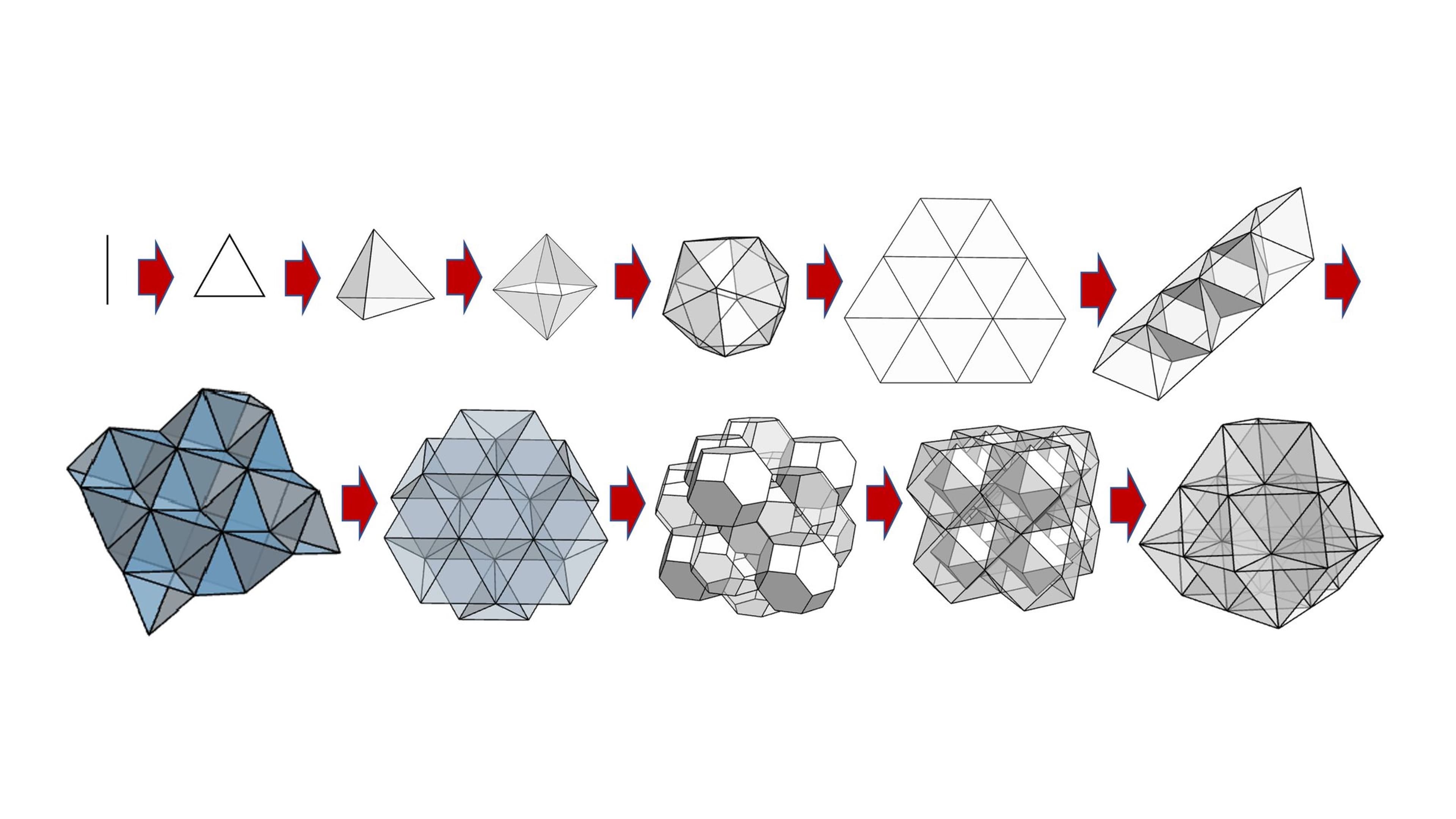
Ffellonics is a thermodynamic self-assembly process. It begins with identical spheres and unfolds through symmetric nearest-neighbour attachments that minimise free energy at every step, producing a 12-level hierarchy that terminates in the densest possible regular packing in three-dimensional space.
What prevents this process from stalling at the dyad or the triangle — what allows it to proceed all the way to the twelve-fold lattice — is a specific physical mechanism grounded in the second law of thermodynamics. The mechanism has three interlocking components: openness, dissipation, and a persistent free-energy gradient.
Openness: A Continuous Supply of New Units
Ffellonics is an open system. It requires a steady influx of new spheres from its environment. Without this supply, the process would reach a local energy minimum and stop — the structure would be stable but incomplete, unable to progress further.
This is the same condition that sustains crystal growth, virus capsid assembly, and colloidal self-assembly. New units arrive via diffusion, concentration gradients, or active transport, and each arrival brings fresh potential energy into the system. This resets the local free-energy landscape and makes the next attachment possible. Without openness, the process is a closed system relaxing toward whatever local minimum it happens to be near — not a developmental hierarchy.
Dissipation: Energy Release at Every Attachment
Every attachment event dissipates energy. An approaching sphere carries kinetic energy; upon bonding, that energy is released as heat, vibrational modes, or electromagnetic radiation. This is not incidental to the process — it is the thermodynamic price of local order.
The energy released into the surroundings increases their entropy by more than the local entropy decrease within the growing cluster. This is the defining signature of a dissipative structure, in Prigogine's sense: the second law is satisfied globally even as the local system becomes more ordered, more coordinated, and more symmetric.
Dissipation is also what makes the process irreversible. Without it, attachments would remain reversible — the system could as easily disassemble as assemble, and no directional hierarchy would emerge. Dissipation is what converts a reversible interaction into a one-way step in a developmental sequence.
The Persistent Free-Energy Gradient
At every stage of the hierarchy, the current configuration is not the global free-energy minimum. A dyad has substantial exposed surface energy. A tetrahedron is more stable but still has unsatisfied bonding sites. Even the hexagonal tessellation at Level 6 — a genuine local minimum in two dimensions — remains energetically incomplete, because extension into the third dimension offers further reductions in free energy.
This persistent gradient — the thermodynamic difference between the current configuration and the global minimum at coordination number 12 — acts as a continuous driving force. Each attachment reduces the free energy of the cluster, but because the system remains open and dissipative, the gradient is never fully eliminated until the global minimum is reached. In thermodynamic terms: each step is spontaneous, with ΔG negative, driven by the minimisation of free energy under the prevailing constraints.
The Self-Reinforcing Loop
Together, these three components form a self-reinforcing cycle. New units arrive; attachment occurs; energy is dissipated; local order increases; the free-energy gradient persists, because the system has not yet reached its global minimum; the system is ready for the next attachment.
This loop is what allows the hierarchy to proceed from the fragile dyad to the robust 12-fold lattice without external direction or fine-tuning. It is the same thermodynamic engine that drives crystal growth, virus assembly, colloidal superlattice formation, and many biological self-assembly processes. The mechanism is general — what differs across these systems is the identity of the units and the specific geometry of their interactions, not the underlying thermodynamic logic.
Manifestations in Real Systems
In crystal growth, atoms or molecules attach to a seed lattice, releasing heat as the crystal extends layer by layer toward macroscopic order. In virus capsid assembly, protein subunits diffuse to the growing shell, bind with energy release, and progressively form the icosahedral structure characteristic of Level 5 in the Ffellonic hierarchy. In colloidal self-assembly, nanoparticles in suspension follow energy-minimising paths, dissipating energy as they form ordered superlattices.
In each case, the second law is not an obstacle to the formation of order. It is the mechanism that makes increasing order thermodynamically favourable, provided the system remains open and dissipative.
Conclusion
The mechanism that sustains the Ffellonic hierarchy is the interplay of three conditions, each individually necessary and jointly sufficient: an open system that continuously receives new units, a dissipative process that releases energy at every attachment and thereby makes each step irreversible, and a persistent free-energy gradient that provides a continuous driving force until the global minimum is reached.
Ffellonics does not defy entropy. It is a direct expression of it. Every attachment increases the entropy of the universe while simultaneously increasing the local order and symmetry of the cluster. This is why the hierarchy does not terminate at the first bond, or the second, or the sixth — it is thermodynamically compelled to continue until it reaches the twelve-fold configuration that represents the global minimum for symmetric attachment in three-dimensional space. The second law, in this account, is not a constraint that complexity must overcome. It is the condition under which complexity of this kind becomes possible at all.
Comments
No comments yet. Be the first to share your thoughts.