The Self-Assembly of the Ffellonic Hierarchy and Its Support from Colloidal Research
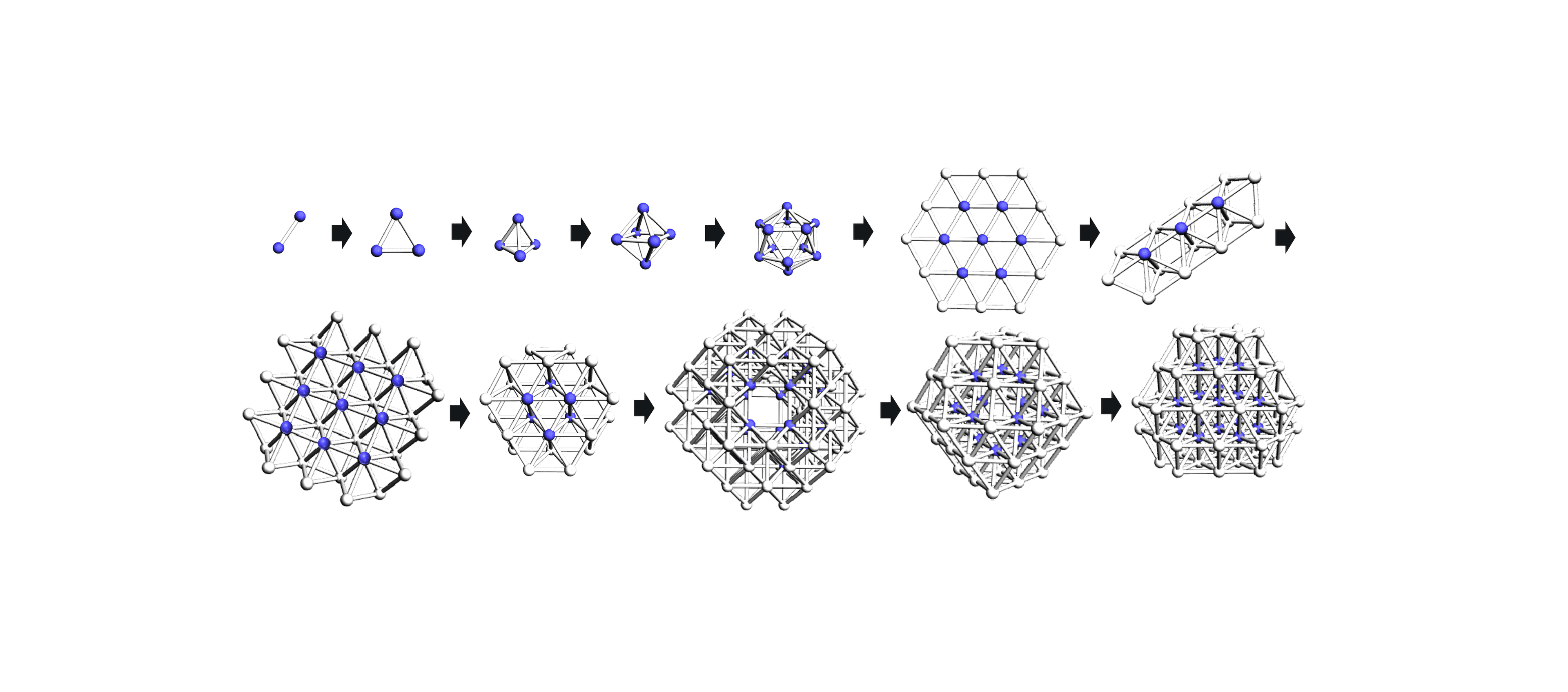
Ffellonic geometry is a hierarchical model of three-dimensional order that arises when identical spheres attach according to a single local rule: each new sphere settles into the position that maximizes the number of nearest-neighbor contacts while preserving local symmetry and structural integrity. This bottom-up process generates a discrete 12-level progression indexed by coordination number (the average number of contacts per sphere). It begins at Level 1 with the minimal dyad (coordination number k=1) and culminates at Level 12 with the densest regular packings permitted in Euclidean 3-space—the face-centered cubic (FCC) and hexagonal close-packed (HCP) lattices (k=12). Intermediate milestones include finite, highly symmetric clusters corresponding to the Platonic solids (tetrahedron, octahedron, and icosahedron) before the system transitions into extended crystalline domains.
Within the model the pathway is thermodynamically driven. Attachment that increases the number of contacts locally reduces excluded volume and therefore lowers free energy. Finite clusters occupy metastable basins on the configurational free-energy landscape; continued addition of particles and mild agitation allow the system to escape these basins and relax toward the global minimum of maximum density and symmetry at Level 12.
Experimental Support from Colloidal Research
Although the precise 12-level discretization is a geometric idealization unique to the Ffellonic framework, decades of colloidal experiments and simulations have documented closely related hierarchical sequences: small symmetric clusters appear first, persist as transient intermediates, and subsequently rearrange or merge into extended close-packed lattices. These observations supply empirical analogues for the model’s proposed stages.
Early finite clusters (Levels 3–5).
Real-space confocal microscopy of hard-sphere colloidal suspensions has repeatedly revealed that the earliest dense, liquid-like aggregates frequently display tetrahedral and icosahedral local order. Gasser et al. (2001) imaged nucleation in three dimensions and showed that critical nuclei, while ultimately adopting random hexagonal close-packed symmetry, form within a surrounding fluid rich in five-fold and icosahedral fragments. Subsequent analyses of supercooled colloidal fluids confirmed that the prevalence of icosahedral motifs increases with volume fraction near the glass transition. More recent confined systems (emulsion droplets) spontaneously produce large, well-defined icosahedral clusters containing thousands of particles, driven purely by entropy maximization under spherical boundary conditions.
Transition from finite clusters to extended lattices (Level 5 → Level 12).
Icosahedral and other Platonic-like precursors are transient. As particle number grows or mild agitation is applied, the clusters rearrange, coalesce, and develop hexagonal layers characteristic of FCC/HCP packing. Studies of colloidal crystallization pathways demonstrate that the system does not jump discontinuously to the bulk crystal; instead it progresses through staged intermediate states whose local geometry matches the early Ffellonic levels before relaxing into the dense lattice.
Hierarchical pathways with patchy particles.
Designer colloidal particles with anisotropic (patchy) interactions provide controlled realizations of hierarchical assembly. Rao, Shaw, Neophytou, Chakrabarti and coworkers (2020) showed that triblock patchy particles first form discrete tetrahedral clusters; these secondary building blocks then pack into ordered tetrastack or related open crystals. Analogous routes have been demonstrated for octahedral and other polyhedral clusters, confirming that finite, highly symmetric intermediates can serve as reliable stepping-stones to extended lattices—mirroring the Ffellonic sequence of finite symmetric forms followed by infinite close packing.
Vibrational annealing and granular experiments.
Classic ball-bearing and granular packing studies (Bernal & Mason, 1960) established that disordered sphere assemblies (packing fraction ≈ 0.64) contain a broad distribution of local coordinations and, under prolonged gentle vibration or annealing, evolve toward crystalline close packing (packing fraction ≈ 0.74). Modern theoretical and computational work by Torquato and collaborators has refined the description of these jammed states and the pathways that connect maximally random jammed configurations to ordered FCC/HCP crystals, again illustrating escape from metastable disordered basins toward the densest regular lattices.
Conclusion
Across more than six decades of colloidal, granular, and simulation research, systems of identical (or near-identical) particles that minimize free energy through local contacts consistently exhibit a hierarchical progression: minimal contacts give rise to finite, Platonic-like clusters that subsequently rearrange into extended close-packed lattices. Ffellonic geometry abstracts this empirical sequence into a clean, 12-level geometric model whose intermediate stages correspond to the transient ordered clusters observed in the laboratory. In this view the Platonic solids are not external ideals imposed from above; they emerge as real, observable, and temporary waypoints on the path to maximal three-dimensional symmetry and density.
References
1 Bernal, J. D. & Mason, J. Packing of spheres: Co-ordination of randomly packed spheres. Nature 188, 910–911 (1960).
2 Gasser, U., Weeks, E. R., Schofield, A., Pusey, P. N. & Weitz, D. A. Real-space imaging of nucleation and growth in colloidal crystallization. Science 292, 258–262 (2001).
3 Gasser, U., Schofield, A. & Weitz, D. A. Local order in a supercooled colloidal fluid observed by confocal microscopy. J. Phys.: Condens. Matter 15, S375 (2003).
4 de Nijs, B. et al. Entropy-driven formation of large icosahedral colloidal clusters by spherical confinement. Nature Materials 14, 56–60 (2015).
5 Wang, J. et al. Magic number colloidal clusters as minimum free energy structures. Nature Communications 9, 5259 (2018).
6 Rao, A. B. et al. Leveraging hierarchical self-assembly pathways for realizing colloidal photonic crystals. ACS Nano 14, 5348–5359 (2020).
7 Torquato, S. & Stillinger, F. H. Jammed hard-particle packings: From Kepler to Bernal and beyond. Reviews of Modern Physics 82, 2633–2672 (2010).
8 Torquato, S. Physics of sphere packings. Nature Reviews Physics 8, 261–275 (2026).
9 Additional supporting literature on patchy-particle hierarchical assembly and confined colloidal clusters appears in the ACS Nano and Soft Matter series (2016–2025) and in recent reviews of colloidal self-assembly strategies.
Comments
No comments yet. Be the first to share your thoughts.