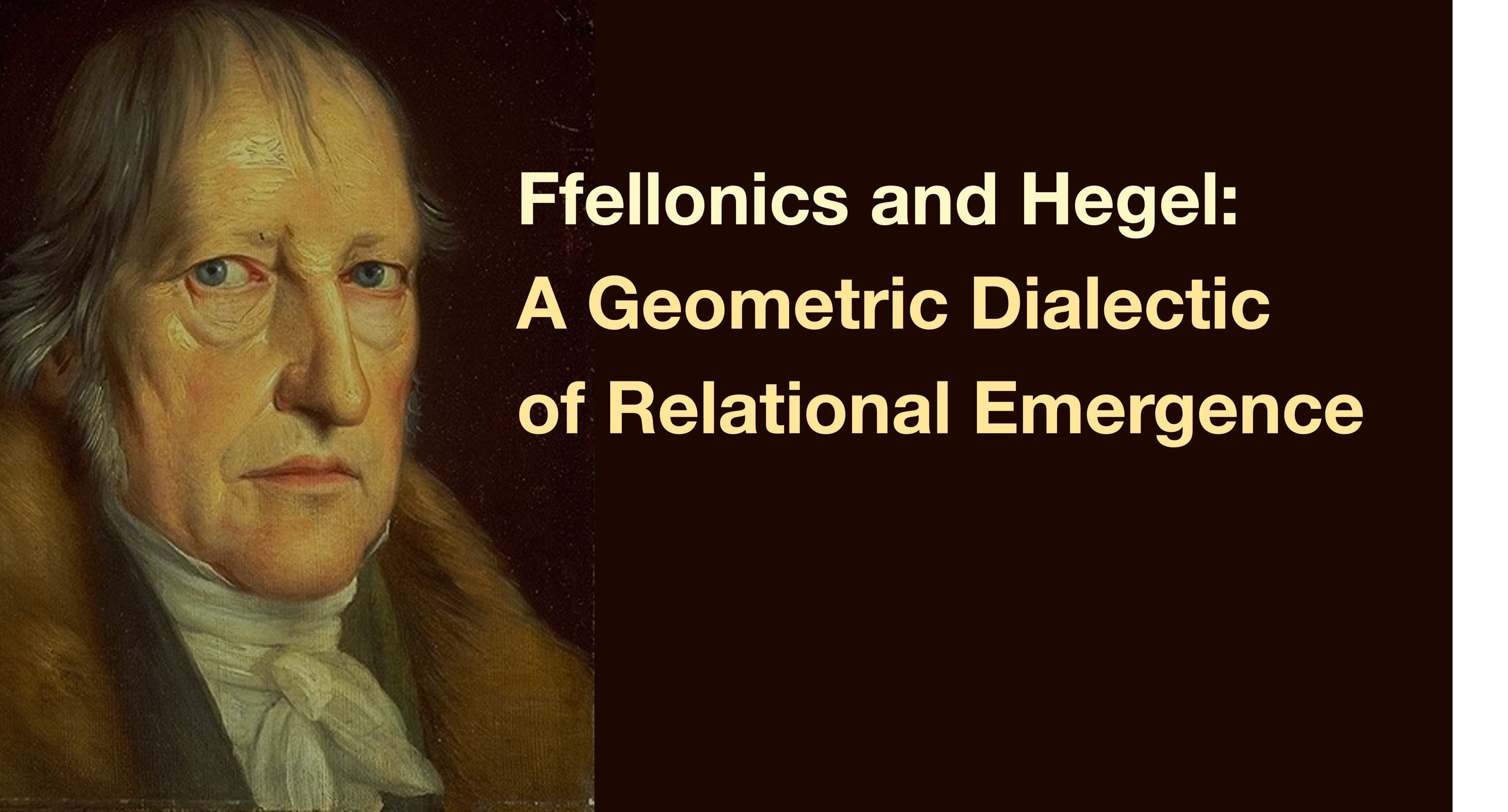
Ffellonics and Hegel: A Geometric Dialectic of Relational Emergence
Ffellonics and Hegel: A Geometric Dialectic of Relational Emergence
In the landscape of contemporary philosophy and systems thinking, few frameworks capture the spirit of relational development as elegantly as Ffellonics — a geometric model of self-assembly in which identical units (conceived as spheres) follow one minimal local rule to generate ordered, increasingly complex structures. At the same time, the 19th-century German philosopher G.W.F. Hegel developed one of the most influential accounts of how reality, consciousness, and history unfold through relational processes and necessary stages.
Although Ffellonics is a relatively new framework centred on discrete geometry, sphere packing, and thermodynamics, it resonates profoundly with core Hegelian themes. The creators of Ffellonics have themselves explicitly engaged with Hegel, describing their model as a “dialectical unfolding” and positioning it as a geometric diagram of the very processes Hegel explored conceptually. This article explores the deep parallels between the two.
Core Ideas of Ffellonics
Ffellonics proposes that ordered reality and even consciousness emerge through relational self-assembly. Isolated spheres possess no inherent identity or structure. Upon “the first ontological touch,” they attach according to a single local rule: symmetric attachment that maximizes contacts while minimizing free energy.
This rule generates a fixed 12-level hierarchy:
• Early stages produce simple clusters (dyad, triangle, tetrahedron).
• Intermediate stages build successive coordination shells.
• The process culminates in the densest three-dimensional packing (face-centred cubic or hexagonal close-packed lattice), where every sphere has exactly 12 equidistant neighbours — the theoretical maximum coordination number in 3D space.
Consciousness, in this view, is not an added property but the felt experience of increasing relational coordination — greater symmetry, integration, and coherence within the system.
Hegelian Resonances
Hegel’s philosophy, particularly in the Phenomenology of Spirit and the Science of Logic, centres on dialectical development, relational identity, and the immanent unfolding of Geist (Spirit or Mind). Several key Hegelian concepts find striking structural parallels in Ffellonics.
1. Relational Ontology: Identity Through the Other
Hegel argued that self-consciousness arises only through recognition by another consciousness. An isolated self remains incomplete; true identity is mediated and relational.
Ffellonics makes this principle geometric and minimal:
“Isolated units have no meaningful structure, perspective, or identity. Relation is primary.”
Spheres acquire structure and “perspective” only through attachment. The first contact initiates the entire hierarchy, echoing Hegel’s insight that relation is ontologically prior to isolated being.
2. Dialectical Progression and Necessary Stages
Hegel viewed reality as developing through stages in which each form necessarily gives rise to the next through internal contradiction and resolution (Aufhebung — sublation). He famously described nature as “a system of stages, in which one stage necessarily arises from the other.”
Ffellonics operationalizes this idea with striking precision. The 12-level hierarchy is not arbitrary; each configuration lawfully enables the next through the symmetry-and-energy rule. As the Ffellonics account notes, this constitutes “the dialectical unfolding” of geometric order. Early low-coordination clusters (tetrahedron with coordination number 3) give way to higher shells until the system reaches the stable ground state of maximum coordination (12 neighbours).
3. Immanent Self-Development
Hegel rejected external designers or transcendent forces. Spirit develops itself from within through its own rational necessity.
Ffellonics embodies the same principle:
There is no blueprint or external agent. A single local rule, applied repeatedly, generates global order. The framework explicitly contrasts this with imposed metaphysics, aligning with Hegel’s move beyond Kant toward an immanent, self-organizing rationality.
In one formulation from the Ffellonics community:
Hegel discovers “the self-organizing rule within thought.” The “first ontological touch” (self-reflexive or relational contact) initiates the hierarchy, which then builds lawfully toward a stable lattice — the geometric analogue of Hegel’s Absolute realized through process rather than posited in advance.
4. Stages of Consciousness
Hegel’s Phenomenology of Spirit traces the experiential development of consciousness through successive forms — from immediate sense-certainty to self-consciousness, reason, and finally absolute knowing.
Ffellonics offers a geometric phenomenology of the same movement:
• Levels 1–3: Rudimentary responsiveness and minimal awareness.
• Levels 4–6: Emergence of self-awareness through dynamic equilibrium.
• Levels 7–10: Increasing integrative capacity.
• Levels 11–12: Mature consciousness in a stable, maximally coordinated lattice — “maximum relational coordination, minimum tension.”
Awareness scales with relational depth, much as Hegel’s forms of consciousness deepen through mediation and recognition.
5. Resolution of Tension into Higher Coherence
Hegelian dialectics resolves contradictions into richer syntheses that preserve what was valuable while transcending limitation.
In Ffellonics, each new attachment reduces free energy and internal tension while increasing symmetry and overall coherence. The progression from isolated or loosely connected spheres to the fully coordinated lattice mirrors the movement from fragmented immediacy to reconciled wholeness.
The Framework’s Explicit Engagement with Hegel
Far from being an external interpretation, the resonance is acknowledged within Ffellonics itself. Discussions from the framework describe:
• Pre-Kantian metaphysics as attempting to impose perfect symmetry from the void (lacking “sphere-packing contact points”).
• Kant as revealing the limits of pure reason without experiential contact.
• Hegel as supplying the self-organizing engine: reason knows itself through relational contact, and the hierarchy unfolds from that first alignment.
One formulation captures the relationship succinctly:
“Hegel supplied the engine. Ffellonics simply diagrams the resulting lattice.”
In Hegelian terms, Ffellonic geometry is presented as “the dialectical unfolding without claiming to be the Absolute.”
Complementary Differences
While the resonances are profound, the two approaches differ in emphasis:
• Hegel works primarily in conceptual and historical terms, tracing the development of Geist through human culture, religion, and philosophy.
• Ffellonics is deliberately minimal and geometric, seeking a universal local rule applicable across scales (from physical self-assembly to models of consciousness).
Hegel offers depth and historical richness; Ffellonics offers visualizability, mathematical precision, and a testable generative mechanism. Together they suggest a powerful synthesis: Hegelian dialectics rendered in geometric and thermodynamic terms.
Conclusion
Ffellonics does not merely echo Hegel — it provides a contemporary geometric and processual lens through which Hegelian ideas of relational emergence, dialectical necessity, and the stages of consciousness can be visualized and extended. Where Hegel described the unfolding of Spirit through conceptual mediation, Ffellonics models the same movement through symmetric attachments that build ever-greater coordination and coherence.
Both frameworks ultimately affirm that order and self-awareness are not imposed from outside but arise immanently through relation. In an age increasingly interested in emergence, complexity, and the foundations of mind, the dialogue between Hegel’s dialectical idealism and Ffellonics’ geometric self-assembly offers a fertile ground for new insight — one in which the oldest questions of philosophy meet the simplest rules of form.
The lattice, it turns out, may have been there all along, waiting for us to recognize the pattern.
Comments
No comments yet. Be the first to share your thoughts.