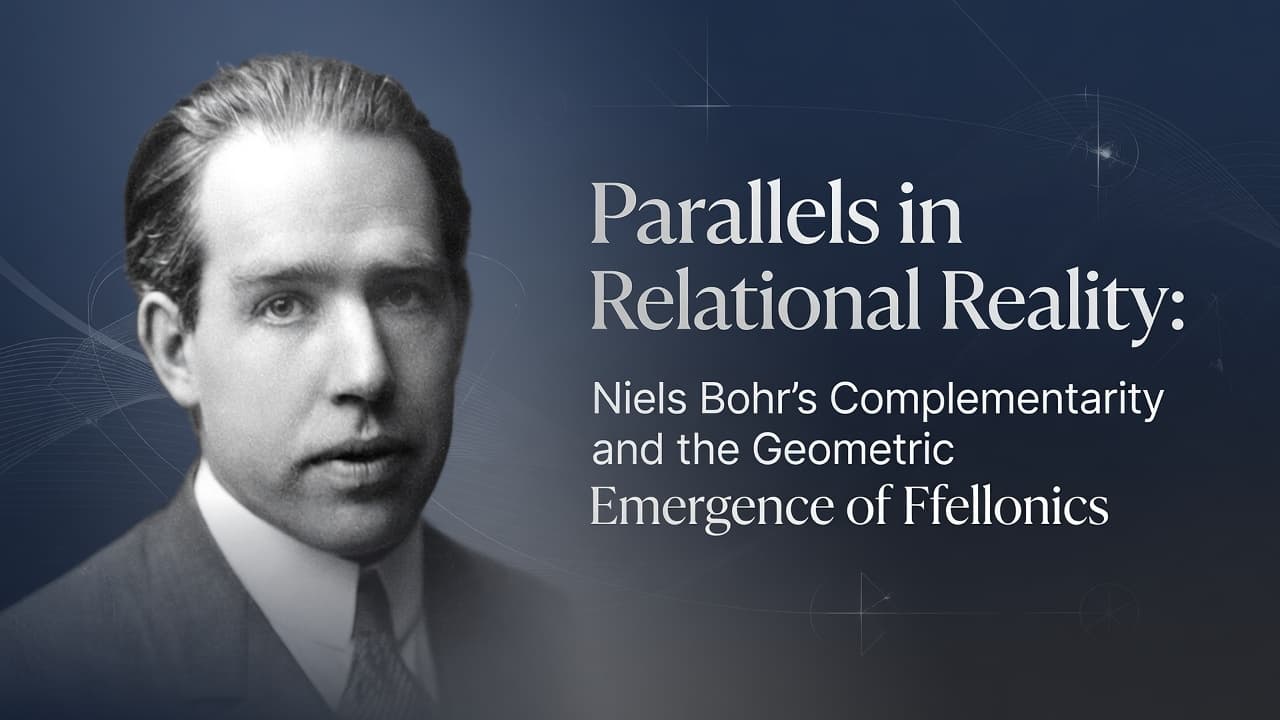
Parallels in Relational Reality: Niels Bohr’s Complementarity and the Geometric Emergence of Ffellonics
Niels Bohr revolutionized our understanding of the physical world in the early 20th century by revealing its quantum foundations. Nearly a century later, a new geometric framework called Ffellonics proposes that reality and even consciousness arise through relational self-assembly of basic units. Although separated by time, methodology, and explicit goals, the two share profound similarities in how they conceive of nature: as fundamentally discrete, relational, resistant to naïve classical pictures, and oriented toward the emergence of ordered, harmonious structures.
Bohr’s Vision: Complementarity and the Limits of Description
Bohr’s most enduring contributions lie not only in his 1913 atomic model—with electrons restricted to discrete, quantized orbits around the nucleus—but in the philosophical implications he drew from quantum mechanics. He developed the principle of complementarity, which holds that certain pairs of descriptions (wave and particle, position and momentum) are mutually exclusive yet jointly necessary for a complete account of quantum phenomena. No single classical picture can capture reality at the atomic scale.
Equally important was Bohr’s epistemological stance. He argued that the task of physics is not to unveil an objective “how nature is” independent of observation, but rather to articulate what we can unambiguously say about nature given the experimental context. The quantum postulate introduces an element of discontinuity and individuality into atomic processes, rendering classical determinism and continuous trajectories inadequate. Properties at the quantum level are defined relationally—through interaction with the measuring apparatus—rather than as intrinsic attributes of isolated objects.
In Bohr’s view, nature at its foundations demands a revision of our descriptive tools. Classical concepts remain indispensable for communicating results, yet they apply only in complementary, context-dependent ways.
Ffellonics: Relational Self-Assembly and Geometric Order
Ffellonics, articulated in a series of essays on ffell.com beginning in mid-2026, offers a geometric ontology of emergence. It models reality as arising from identical basic units—conceptually spheres in a state of pure potential—that interact according to a single local rule. Through repeated application of this rule (emphasizing symmetry preservation and stress or free-energy minimization), the units self-organize into a strict 12-level hierarchy.
• Early levels involve rudimentary contacts and responsiveness.
• Intermediate levels generate self-awareness-like coordination.
• Higher levels culminate in a stable “ground state” of maximum coordination (twelve neighbors) and minimal tension, corresponding to highly symmetric structures such as close-packed lattices and polyhedra.
chaturvedimayank.wordpress.com
Ffellonics explicitly positions itself as a post-decoherence reference model: it describes the stable, classical, harmonious order that emerges once quantum superpositions have decohered. It frames consciousness not as an add-on or fundamental property of particles, but as the experiential correlate of deepening relational integration and structural coherence. The framework draws on discrete geometry, thermodynamics, and process philosophy, treating relation itself as ontologically primary—isolated units possess no inherent structure or identity until they interact.
Striking Similarities
Despite their different starting points—one rooted in quantum physics and epistemology, the other in discrete geometry and emergence—several deep parallels stand out.
1. The Primacy of Relation
Bohr emphasized that quantum phenomena are defined through their relation to the experimental arrangement; there is no sharp separation between observer and observed at the fundamental level. Ffellonics radicalizes this idea: relation is not merely epistemic but constitutive. Isolated units have no properties worth speaking of; structure, order, and even subjectivity arise only through relational self-assembly. Both frameworks reject atomistic isolation in favor of relational ontology.
2. Discreteness and Hierarchical Structure
Bohr introduced quantization—discrete energy levels and jumps—to resolve the instabilities of classical atomic models. Ffellonics builds its entire edifice on discrete geometric steps: a fixed sequence of stable configurations (dyad → tetrahedron → higher coordination polyhedra → FCC/HCP lattice at level 12). Both replace continuous classical change with stepwise, rule-governed transitions that produce stable, observable order.
3. Emergence of Harmony from Simple Principles
Bohr’s quantized orbits produced the stable, predictable spectra of atoms. Ffellonics’ single local rule generates progressive coordination, symmetry, and a thermodynamic-like ground state of maximal harmony. In both cases, complexity and stability are not imposed from above but emerge bottom-up from basic constraints (quantization for Bohr; symmetry and energy minimization for Ffellonics).
4. Limits of Classical Picturing and the Need for Complementary Perspectives
Bohr demonstrated that classical concepts fail to provide a unified picture of quantum reality; complementary descriptions are required. Ffellonics complements the quantum view by supplying a generative geometric model of the post-quantum classical world. It offers what Bohr’s framework predicts must exist—stable, harmonious macroscopic and mesoscopic order—while acknowledging its own status as a classical scaffold relevant (speculatively) to discrete quantum geometry approaches such as causal sets or loop quantum gravity.
5. Epistemological Humility About “How Nature Is”
Bohr insisted physics concerns what we can say about nature. Ffellonics provides a concrete generative narrative for how ordered reality and subjective experience can arise from minimal relational premises. Together they suggest a two-sided approach: Bohr clarifies the boundaries of classical description at quantum scales; Ffellonics illuminates the constructive pathway by which relational discreteness yields the classical world we inhabit and experience.
Conclusion: Complementary Lenses on Reality
Niels Bohr and Ffellonics, though separated by nearly a century and operating in different idioms, converge on a vision of nature that is discrete, relational, and emergent rather than continuous, isolated, and fully picturable in classical terms. Bohr exposed the inadequacy of pre-quantum intuitions and the necessity of complementarity. Ffellonics offers a geometric mechanism by which the ordered, coherent structures—and potentially the felt quality of experience—can arise once quantum effects have decohered.
These parallels are not claims of direct influence (Ffellonics is a very recent development), but they reveal a recurring pattern in serious attempts to understand reality: when we look deeply, whether at the quantum atom or at the self-organization of geometric units, we encounter the same themes of relation, discreteness, and the generative power of simple rules operating under constraints.
In an era exploring quantum foundations, consciousness, and the emergence of classicality, Bohr’s hard-won insights and Ffellonics’ geometric program may prove mutually illuminating—two complementary descriptions of how nature organizes itself into the structured, relational world we know.
Comments
No comments yet. Be the first to share your thoughts.