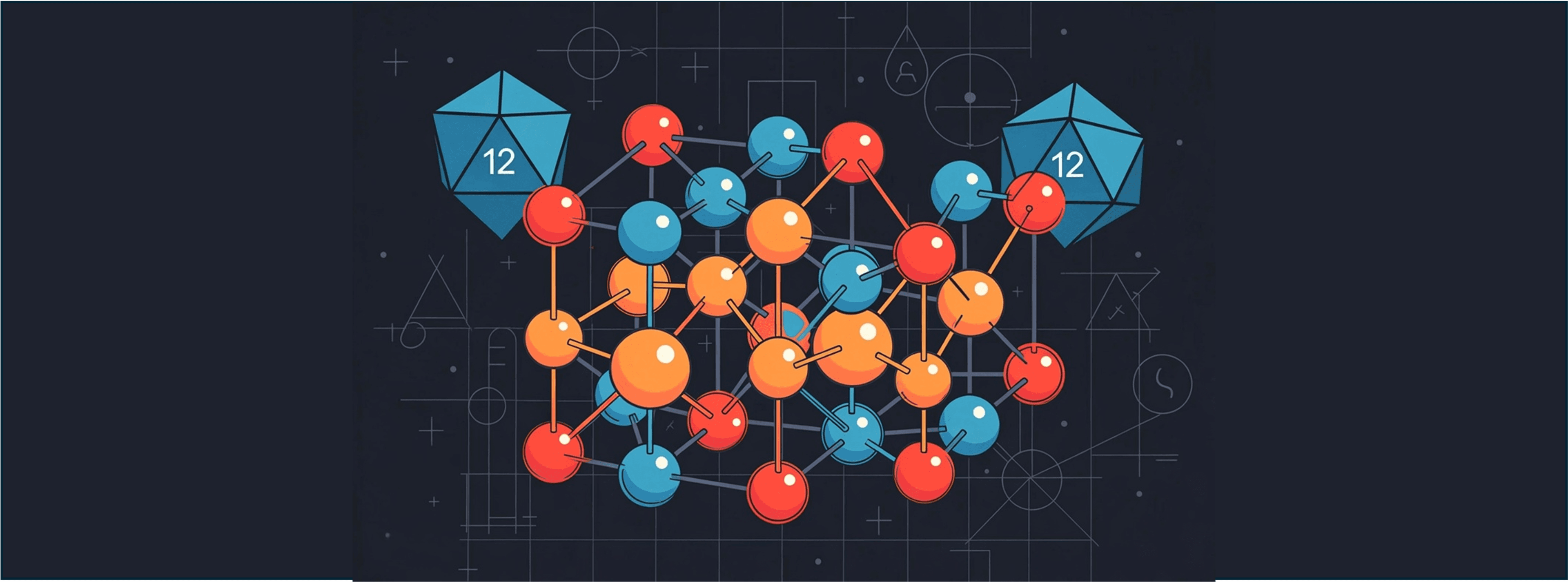
Completing Emergence: How Ffellonics Supplies the Missing Geometry of Boolean Networks
There is a subtle but consequential gap at the heart of emergence theory. On one side sit powerful mathematical tools—Stuart Kauffman’s Boolean networks, NK fitness landscapes, and autocatalytic sets—that precisely map state transitions, attractors, and the phase structure of complexity. On the other lies the intuition that emergence is not merely a jump between abstract states but a physical process that unfolds, builds spatial structure, and takes concrete form in three-dimensional reality. The dynamics are rich. The geometry of the actual process has been largely absent.
Ffellonics—the geometric framework developed by David Fell—addresses this absence. It does not replace Boolean network modeling. It completes it. Together, they offer a theory of emergence that is both dynamically rigorous and geometrically grounded.
What Boolean Networks Get Right
Kauffman’s Boolean networks are elegantly minimal: N nodes, each in a binary state (on/off), each receiving K inputs and updating according to a simple logical function. From this setup, networks spontaneously organize into stable recurring patterns—attractors—without external direction. Kauffman proposed that cell types correspond to attractors in gene regulatory networks, with differentiation as transitions between attractor basins. The scaling of cell types with gene number (roughly the square root) matched observations for networks with connectivity around K=2.
Equally significant is the edge of chaos. At low connectivity (K<2), networks freeze into rigid order. At high connectivity (*K*>2), they become chaotic. At K=2, they sit at a critical point—short attractor cycles, sensitivity to inputs, and high capacity for complex behavior. This is where adaptive biology thrives.Boolean networks thus deliver precise dynamics: where ordered states lie in configuration space, how stable they are, and what governs transitions. While the classic hypercube is abstract, Boolean-style models can be spatially embedded (e.g., on lattices or with physical contact rules), making them compatible with geometric approaches.
The Geometric Absence
The Boolean state-space is an N-dimensional hypercube—every configuration a vertex, every transition an edge. Attractors are cycles or fixed points; basins are the sets of states that flow into them. This is a map of logical possibility, not of physical process. It tells us which states exist and how they connect logically, but not what is happening in three-dimensional space as molecules bind, proteins fold, or crystals grow. Emergence in the real world has shape, volume, and energetic constraints.
What emergence theory has lacked is a model of process geometry—a description of what the system is actually building in space as order emerges from local relations.
What Ffellonics Provides
Ffellonics starts with identical spheres following one local rule: symmetric nearest-neighbor attachment that maximizes contacts while minimizing free energy. No blueprint. No designer.
From this, a deterministic 12-level hierarchy unfolds:
• Level 1: Dyad — the first relation.
• Level 2: Triangle.
• Level 3: Tetrahedron — the first Platonic solid.
• Successive levels progress through higher symmetries.
• Level 12: The thermodynamic ground state—face-centered cubic or hexagonal close-packed lattice, with maximum 12-fold coordination.
Each stage is the next configuration made inevitable by geometry and thermodynamics. Order is drawn out from within by relational logic and the drive toward minimal tension. Ffellonics describes the concrete spatial unfolding—the process geometry—that Boolean state-space abstracts away.
Real systems echo this. Colloidal nanoparticles and polyhedral particles self-assemble into ordered clusters and supercrystals through local rules. Molecular networks in chemistry often proceed through symmetric intermediates toward stable structures. Biological assemblies, from viral capsids to cytoskeletal elements, frequently display Platonic-like symmetries.
A Simple Hybrid Model
The frameworks combine naturally. Consider a hybrid where spheres carry position, binary state (0/1 for relaxed/stressed), and energy. Contacts form the evolving graph. At each step:
Compute majority neighbor state (Boolean logic).
2. Adjust the node’s state toward the majority if it reduces local energy.
3. Add new contacts preferentially toward low-energy, high-agreement regions.
In small simulations, states synchronize while the contact graph grows and energies drop, producing coherent clusters and hierarchical modules. This hybrid grounds Boolean dynamics in Ffellonic geometry (or vice versa) and can be extended with noise, heterogeneity, or full spatial physics.
The Synthesis
Boolean networks supply the dynamics: state-space structure, attractors, phase transitions, and critical connectivity. Ffellonics supplies the process geometry: the spatial sequence of forms and energetic pathway from first relation to ground-state lattice.
In combination, each Ffellonic level can correspond to a distinct attractor basin with characteristic geometry and coordination. Transitions between levels become phase transitions across energy barriers. The edge-of-chaos regime aligns with intermediate hierarchical levels—past rigid order but before frozen stability—where adaptation is most potent.
Implications and What Follows
This synthesis opens productive directions. Agent-based simulations of self-organizing systems can be checked for geometric transitions matching the Ffellonic sequence. Colloidal and nanostructure experiments provide empirical tests. Attractors become not only dynamical cycles but geometric forms with specific relational depth. The ability to ascend the Ffellonic hierarchy in response to perturbation may itself measure adaptive capacity.
Systems biology, origins-of-life research, programmable matter, and network science all stand to benefit. Emergence is both a map of possibility and the concrete building of form in space. With both halves in view, we gain a fuller picture of how order, hierarchy, and adaptability arise from the bottom up.
Boolean network modeling gave complexity science its dynamical foundations. Ffellonics supplies the missing process geometry. Together, they complete each other.
Comments
No comments yet. Be the first to share your thoughts.