Ffellonic Levels
Introduction: How the Twelve Levels Emerge from Sphere-Packing
Every essay in this collection refers, at some point, to “the twelve-level hierarchy.” Before those essays put that hierarchy to work — using it to talk about consciousness, entropy, quantum gravity, Spinoza — it is worth pausing to see the hierarchy itself: what it is, how it is generated, and why it produces the Platonic solids as a byproduct rather than a premise.
One Rule
Ffellonics begins with a minimal setup: identical spheres in three-dimensional space, with no structure or relation between them. A single local rule then governs everything that follows —
Each sphere attaches to its neighbours in the position that maximizes the number of mutual contacts while minimizing the system’s free energy, preserving the greatest possible symmetry at every step.
There is no blueprint, no external design, and no rule beyond this one. Applied repeatedly, it drives the system through exactly twelve stages of increasing coordination — the count of neighbours each sphere touches — from the first contact between two spheres to the densest possible packing achievable in three-dimensional space. It is worth being precise about the direction of the argument here: the hierarchy is not built from the Platonic solids. The Platonic solids fall out of it, as intermediate way-stations on the route to something else — full twelve-fold coordination.
Level 1 — The First Touch
The hierarchy has a definite starting point: two isolated spheres come into contact. This is the “first ontological touch” that recurs throughout the essays that follow — the minimal relational event, coordination number k = 1.
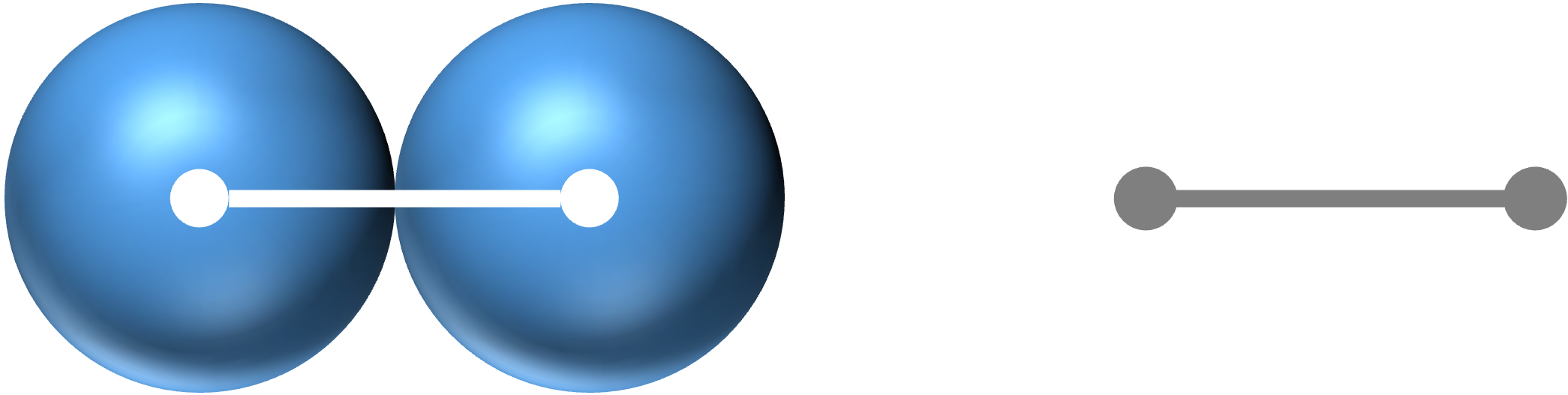
Symmetry begins at this first touch, not after it. Two identical spheres in contact already form the most symmetric configuration two bodies can share — an axis of rotational symmetry through both centres, and a mirror symmetry exchanging one sphere for the other. The geometry of Ffellonics begins here too: the line connecting the two centres is the first edge the structure produces, the same relation that later closes into the triangle, the tetrahedron’s six edges, and every subsequent shell. What the dyad does not yet carry is the more elaborate, discrete symmetry — three-fold, four-fold, the point-group symmetries of the Platonic solids — that appears only once further spheres join it.
Level 2 — The Triangle
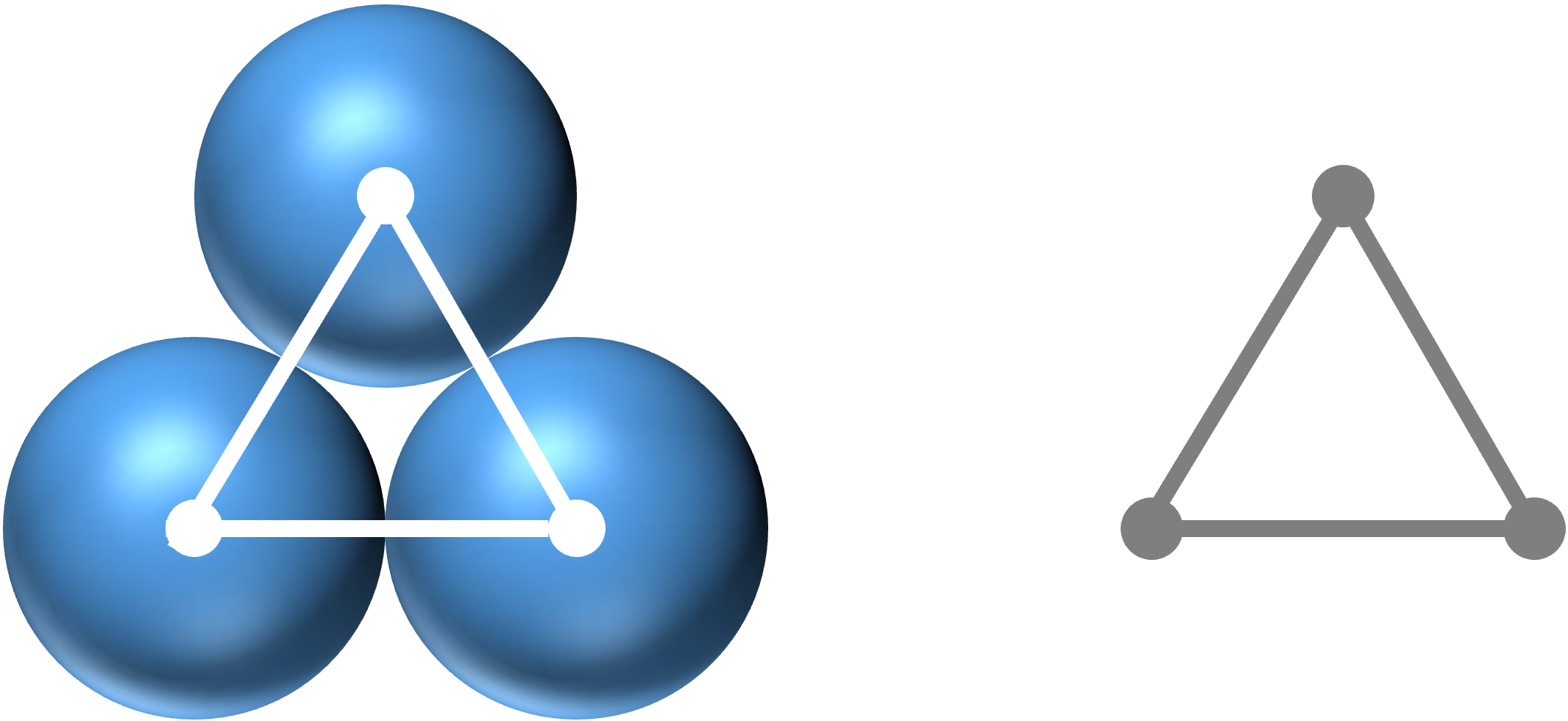
From the dyad, the same rule — maximize contacts, minimize free energy, preserve symmetry — forces the addition of a third sphere into the only position that keeps the structure symmetric. Three units in mutual symmetric contact form the first closed planar structure: the equilateral triangle. This is still a planar figure, not yet a solid, so it stands apart from what follows — the last flat step before the hierarchy lifts into three dimensions.
Levels 3–5 — The Platonic Solids as Way-Stations
From the triangle, a fourth sphere lifts the structure out of the plane, and from here the same rule produces, in turn, three of the five Platonic solids — not as a design goal, but as what maximal-contact, minimal-energy, symmetry-preserving attachment looks like once a particular number of spheres has accumulated:
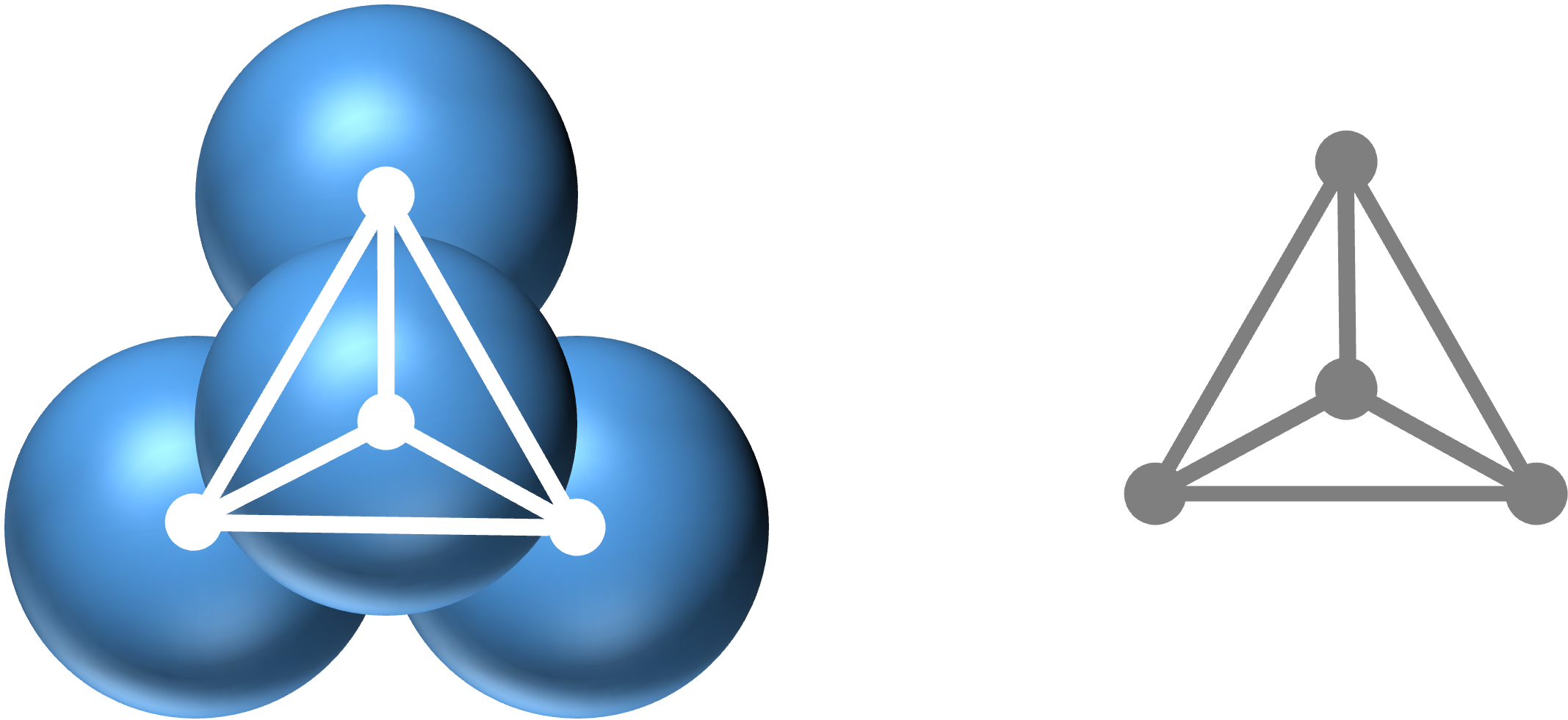
A fourth sphere lifts the triangle into three dimensions. The tetrahedron is the first closed, three-dimensional shell the process produces, and the simplest of the Platonic solids.
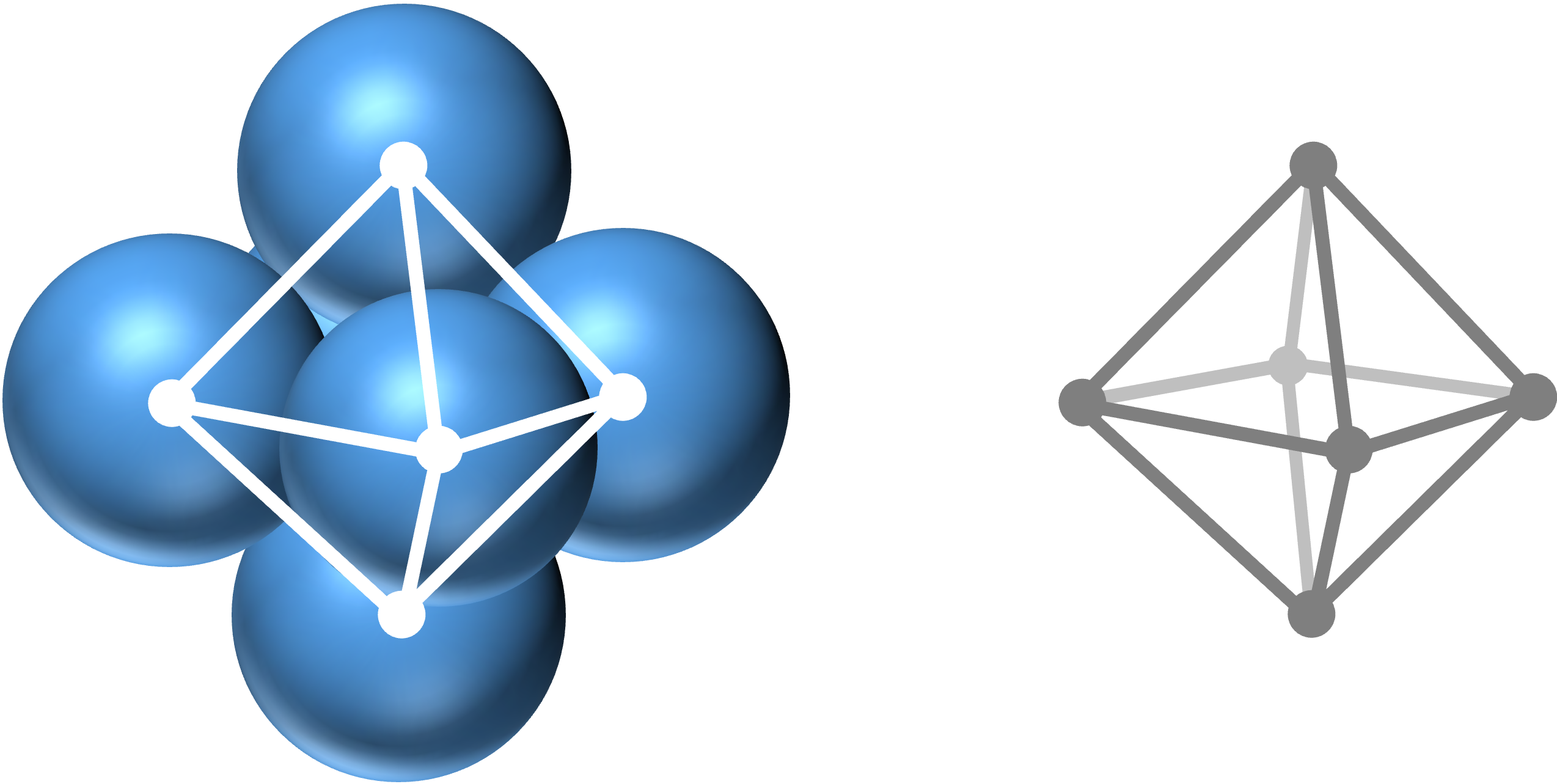
At six spheres, the structure reaches the octahedron — each sphere now touching four others.
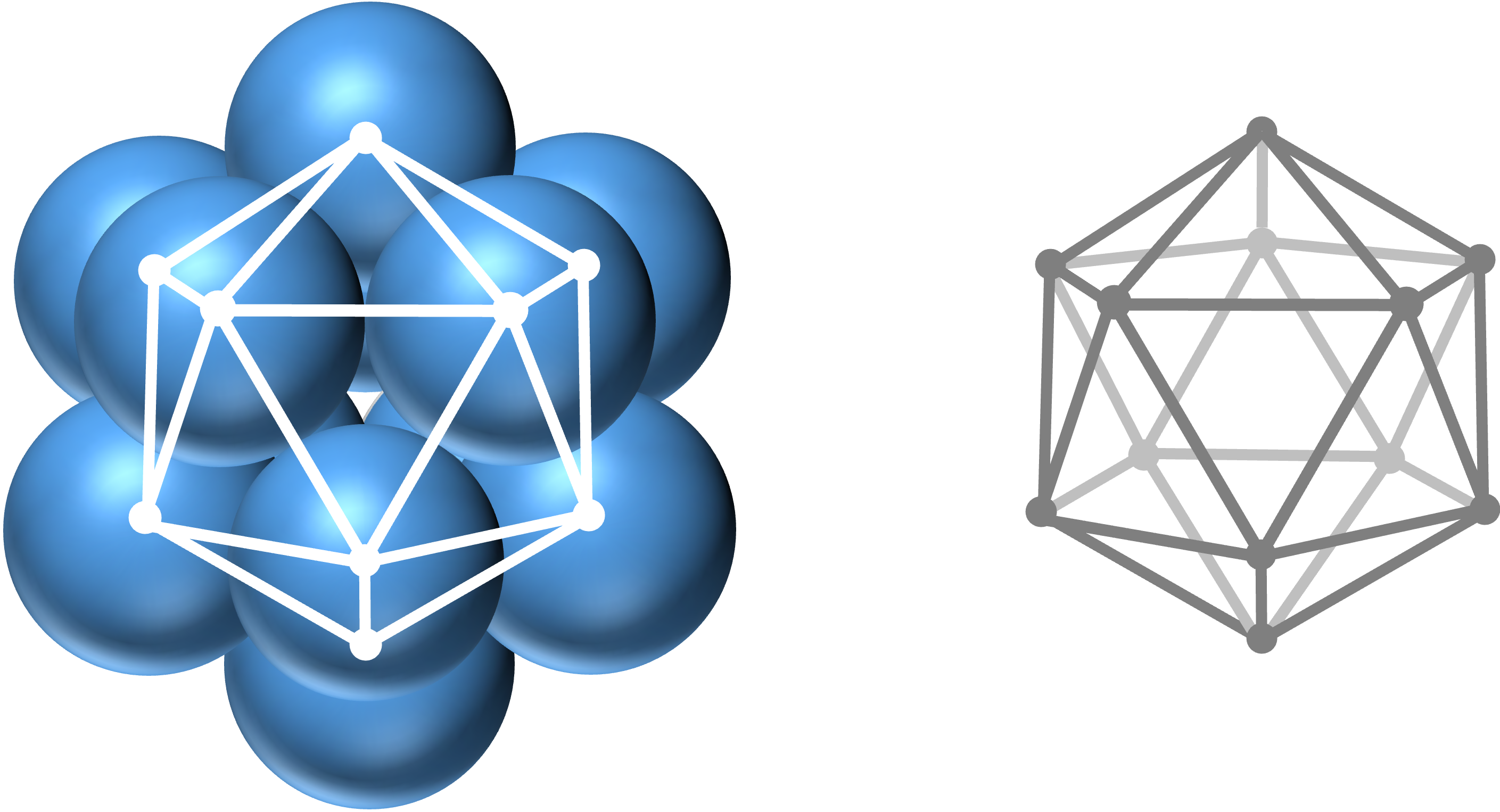
At twelve spheres arranged around a shared centre, the structure reaches the icosahedron — the most coordinated of the regular, convex, equal-sphere structures possible at this stage.
The icosahedron’s efficiency here is not just aesthetic. Closing a volume using a minimal number of identical, symmetrically repeated units is exactly the problem viruses solve with icosahedral capsids, and the same logic recurs in protein cage assemblies more generally — a single subunit, repeated under one local rule, closing into a complete shell. Ffellonics arrives at the same shape from the same underlying logic: local, identical, symmetry-preserving attachment.
The ancient reverence for these three shapes, discussed in its own right elsewhere in this collection, described their effects — pure geometric form — many centuries before anyone had a candidate mechanism for why matter should prefer them. Ffellonics proposes that mechanism.
Levels 6–11 — Beyond the Classical Solids
The whole of this process traces a single arc: from the singular simplicity of the first edge at Level 1 to the highest possible symmetrical complexity at Level 12. Levels 6 through 11 are the least individually discussed stages in the essays that follow, but that should not be mistaken for an absence of identity. Each is the exact, non-negotiable configuration at which one further mutual contact per sphere first becomes achievable — none can be skipped, reordered, or treated as interchangeable with its neighbours. Level 6 and Level 7 each merit an individual account. Levels 8 and 9 share a common character as spaceframes, and Levels 10 and 11 share a common character as spacefilling honeycombs, so each pair is treated together below.
Level Six
Level 6 of Ffellonics is the planar hexagonal tessellation: the first extended, potentially infinite lattice in the twelve-level hierarchy. It marks the shift from the closed, finite Platonic solids of Levels 3–5 to an open, repeating two-dimensional order.
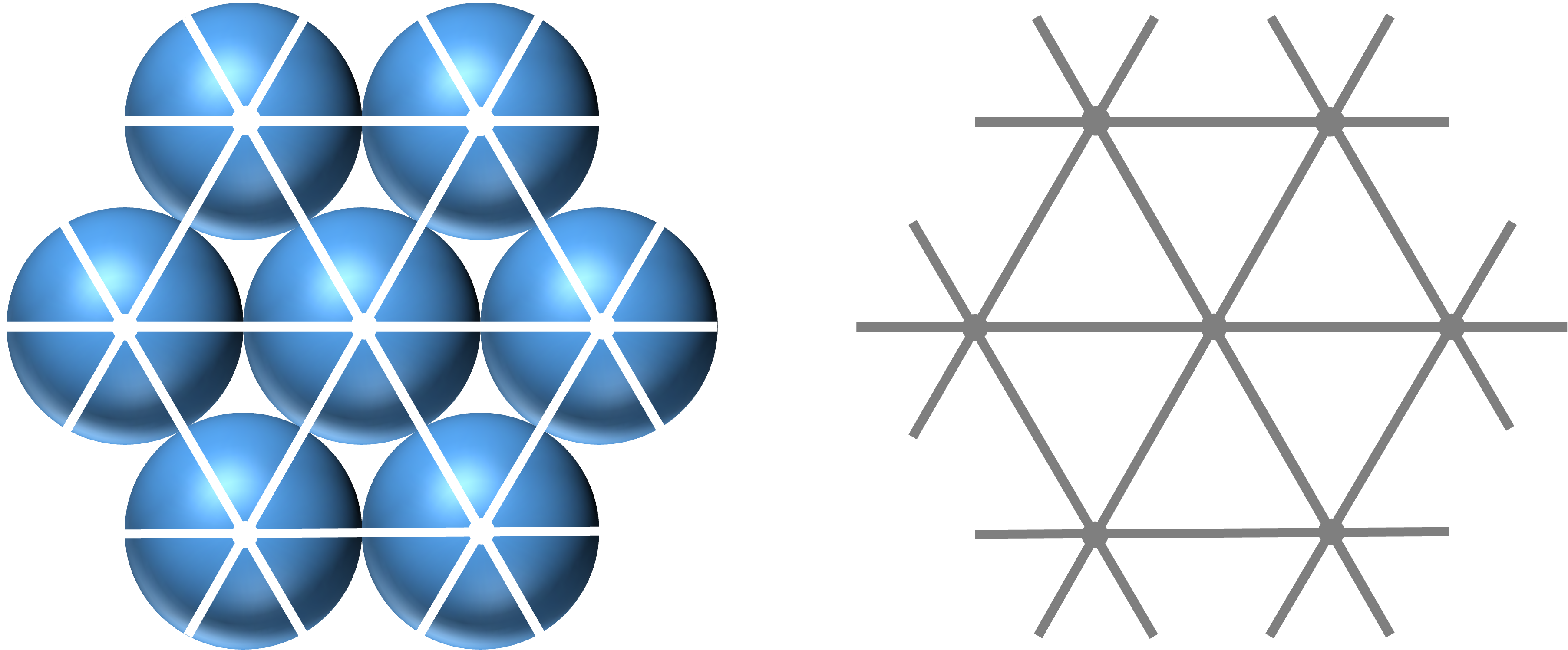
At Level Six, the spheres pack into a single plane as a regular hexagonal lattice, with each sphere touching exactly six equidistant neighbours. This is the densest possible packing of equal circles in the plane, at a density of π/(2√3), approximately 0.9069.
Unlike the closed shells that precede it, this structure can extend without bound in two dimensions. This collection calls Levels 6 through 12 the phase of infinite emergence, simply to mark that shift: the earlier levels each close into a finite form — the tetrahedron at Level 3, the octahedron at Level 4, the icosahedron at Level 5 — while Level 6 is the first configuration that is no longer a closed polyhedron, but a repeating sheet.
The same stage recurs in crystal growth as a stable two-dimensional layer — the basal planes of graphite, the hexagonal sheets of HCP metals, and many layered minerals — where it commonly appears as a low-energy intermediate before three-dimensional frameworks form.
A plane is thermodynamically favoured, but it is not the global three-dimensional ground state, so the hierarchy cannot stop here: the next attachment must leave the plane, breaking and then restoring symmetry at a higher coordination number.
In short, Level 6 is the hexagonal sheet that closes the finite-polyhedron chapter of the hierarchy and opens its infinite-lattice chapter — both a completed two-dimensional ground state in its own right, and the necessary platform for everything that follows.
Level 7
Level 7 marks a one-directional infinite extension, and with it, the beginning of the second half of the Ffellonic hierarchy. Where Level 6 opened outward into an infinite two-dimensional sheet, Level 7 introduces a further qualitative shift: full three-dimensional bracing built along a single infinite line.
Structural engineering already has a name for this configuration, even though Ffellonics does not yet have one of its own: it is an octet truss beam — alternating tetrahedra and octahedra, all edges of equal length, forming a single continuous, self-bracing structure. Here the system moves beyond uniform Platonic symmetry, combining tetrahedral and octahedral geometry within one coherent structure for the first time.
The result is not just elegant but exceptionally efficient: because every strut in an octet truss runs along a line connecting the centres of touching spheres, each member carries only pure tension or pure compression, never bending. This full triangulation gives the structure an unusually high stiffness-to-weight ratio — among the best achievable by any regular strut framework — which is precisely why the octet truss became a serious engineering structure rather than a geometric curiosity.
The structure has a documented engineering history. Alexander Graham Bell explored tetrahedral truss construction between 1898 and 1908, using it in kites and experimental towers. Buckminster Fuller patented the specific octahedron–tetrahedron system as the “octet truss” in 1961, for use in roofing, flooring, and wall construction — prized for the same stiffness-to-weight efficiency Ffellonics arrives at independently, from an entirely different starting rule.
The structure is built from one continuous line of primary spheres, extending indefinitely in a single direction, each touching the primary sphere before it and the one after. Every primary sphere is additionally braced by five supporting spheres arranged symmetrically around it — one beneath, and two to either side. Combined with its two in-line neighbours, each primary sphere is in contact with seven others in total. The supporting spheres are not duplicated for every primary sphere but shared with the adjacent ones, exactly as neighbouring tetrahedra and octahedra share faces in the equivalent engineering structure — it is this sharing that keeps the beam continuous and coherent rather than a chain of separate cells.
Level 7 — The octet truss beam: primary spheres in blue, all supporting spheres in white
Strip away the spheres and connect the centres alone, and the result is precisely the alternating octahedron–tetrahedron structure recognised in structural engineering as the octet truss.
Level 7 — The same structure, centres connected: the octet truss beam
A self-bracing beam, however, is only extensive in one dimension. Rigid along its own axis, it still has no bracing at all in the directions perpendicular to it — so, exactly as a plane was not the three-dimensional ground state at Level 6, a line is not sufficient here either. The hierarchy cannot stop at a single beam: the next attachment must add a second, independent direction of extension, breaking the one-dimensional symmetry of Level 7 to build outward into a genuine spaceframe.
Just as the single edge first drawn at Level 1 recurs as the basic unit inside every structure that follows it, the octet truss beam established at Level 7 plays an equivalent foundational role for the rest of the hierarchy: a self-bracing, indefinitely extensible unit that later levels build upon rather than replace.
Levels 8–9 — The Spaceframes
Level 8 introduces the first genuinely two-directional infinite extension in the hierarchy: the quadrangular pyramid space frame. Where Level 7 built rigidity along a single infinite line, Level 8 builds it across an infinite plane, extending in two independent directions at once.
Each primary sphere now sits at the crossing point of two lines rather than one: as well as touching the primary sphere before and after it along one direction, it also touches a primary sphere to either side along a second, perpendicular direction — forming a cross. As further primary spheres join, this cross repeats to build out a full square grid of primary spheres, extending without bound across the plane.
Each primary sphere is additionally supported by four supporting spheres, arranged beneath it at the four diagonal positions. Combined with its four in-plane neighbours — one in each of the four grid directions — every primary sphere is in contact with eight others in total: the coordination number that gives Level 8 its place in the hierarchy.
Level 8 — The quadrangular pyramid space frame, three primary squares wide and three deep: primary spheres in blue, supporting spheres in white
The eight-fold contact pattern is easiest to see one vertex at a time. Every primary sphere in the grid sits at the centre of its own local coordination shell — four in-plane neighbours at the compass points, and four supporting neighbours below at the diagonals — all eight touching it at exactly the same distance, since all are equal spheres in contact. The shape this traces is a square antiprism: two squares of four, one directly in-plane with the centre and one offset diagonally below it and rotated forty-five degrees, not a cube.
Level 8 — The local coordination shell at a single primary vertex, all touching pairs connected: nine spheres in total, one for the centre and eight for its neighbours — four in-plane and four diagonal supports
In structural engineering, this is a well-established form: the quadrangular pyramid space frame, a lightweight, rigid, three-dimensional structure built by interlocking modular, four-sided pyramids in a repeating pattern. It is one of the most widely used space-frame systems, because loads are carried almost entirely as axial tension or compression in each member, with negligible bending — allowing it to span large distances using comparatively little material. This is precisely the property that lets stadium roofs, airport terminals, industrial halls, and exhibition spaces achieve wide, column-free interiors. Compared with other space-frame patterns, the quadrangular pyramid form is also valued for its structural rigidity, its relatively small number of distinct member types, and the corresponding simplicity of its fabrication. Level 9 — Triangular Pyramid Space Frame Level 9 completes the transition Level 8 began: from a plane extending in two directions to one extending in three. Where a square grid has only two independent directions of primary spheres running through it, a triangular grid has three, each set sixty degrees apart, all sharing the same lattice of points. This is not a denser version of Level 8 — it is a different symmetry entirely, the same shift from square to triangular coordination that first appeared, in flat form, at Level 6. As before, each primary sphere is additionally supported from below — but now by three supporting spheres, not four, sitting in the triangular pocket beneath it, and every one of those pockets is staggered by half a module relative to the primary layer above. Combined with its six in-plane neighbours — two along each of the three directions — every primary sphere is in contact with nine others in total: the coordination number that gives Level 9 its place in the hierarchy.
Level 9 — The triangular pyramid space frame: primary spheres in blue, supporting spheres in white, filling alternating triangular pockets beneath The triangular base gives Level 9 a mechanical advantage Level 8 does not have. A triangle is the only polygon that cannot rack or deform without bending one of its own members — which makes a tetrahedron the smallest possible rigid unit in three dimensions. A square base, by contrast, is only made rigid by the sloped triangular faces of the pyramid built on top of it; the triangular pyramid gets that same rigidity more directly, with shorter members and denser triangulation for the same amount of material. This is what gives Level 9 greater three-dimensional depth and stiffness than Level 8, for a comparable weight of structure.
This is also where the octet truss, first named at Level 7, becomes the structure Buckminster Fuller actually patented. Level 7 was a single infinite line braced in three dimensions — a beam. Level 9 is that same lineage extended into a genuine plane, three-directional and self-bracing throughout, which is the form the 1961 patent and Alexander Graham Bell's earlier octahedron–tetrahedron experiments were actually built to span. It is worth being precise about what is and is not present here, though: within Level 9's own two-layer structure, only tetrahedra are formed — each filled pocket, together with the three primary spheres around it, is a regular tetrahedron, every edge the same length. The alternating octahedra that give the full octet truss its name are not yet part of this level; they belong to the empty pockets left unfilled here, the ones staggered the other way. Level 9 fills half the available sites. What happens at the other half is not yet this level's story.
Levels 10–11 — The Spacefilling Honeycombs
Level 10 marks a four-directional infinite extension. Where Level 9's triangular grid ran in three directions across a single plane, Level 10 is no longer confined to a plane at all: it is the point where the structure first becomes genuinely spatial in every direction at once. This is not simply a matter of adding more spheres to build an ever-larger mass. A further kind of structuring occurs here, one that allows the whole arrangement to expand outward while remaining coherent — and the unit this structuring is organised around is a cluster of twelve spheres arranged as a cuboctahedron.
Every primary sphere's immediate neighbourhood is defined by the same twelve positions — the vertices of a cuboctahedron shell around it, the identical arrangement that will recur, fully occupied, at Level 12. At Level 10, ten of those twelve positions are filled: eight by other primary spheres, and two by supporting spheres. The two supporting spheres sit directly opposite one another through the primary sphere's centre — not touching each other, each touching only the centre — and the remaining two positions are not yet occupied at all.
This is worth stating precisely, because it settles a question that recurred at every earlier level of this chapter: where, exactly, do the supporting spheres sit? Here the answer is that they occupy two of the same twelve positions every primary sphere is entitled to, no different in kind from the eight already filled by other primaries — the distinction between “primary” and “supporting” is not a difference of position or size, but simply of which role a sphere is currently playing as the structure grows. A new sphere becomes primary or supporting entirely according to where it attaches.
Level 10 — One primary sphere’s local shell: eight primary neighbours (blue), two supporting neighbours as a true antipodal pair through the centre (white), and two positions not yet filled (dashed outlines)
The cuboctahedron is not an arbitrary choice of shape here. It is the one Archimedean solid whose edge length exactly equals its own circumradius — so a triangle drawn from the centre to any two touching primary spheres is exactly the same equilateral triangle, side for side, as the genuine triangular faces of the cuboctahedron itself. The local neighbourhood and the solid it traces are not merely similar; they are built from the same length, repeated.
It is worth being exact about how the supporting-sphere count has moved through this chapter. At Level 6 there were no supporting spheres at all — a flat sheet needs none. At Level 7 there were five; at Level 8, four; at Level 9, three; and now, at Level 10, two. Each step, a further primary sphere takes on a role a supporting sphere held before, as the structure becomes better able to achieve its own symmetry unaided. The progression does not stop at Level 10: the same twelve-position shell continues filling through Level 11, with a single supporting sphere left, and completes only at Level 12, where the shell is full and no supporting spheres remain at all. Levels 10 through 12 are, in this sense, one continuous story told in three stages — the same shell, progressively occupied.
As these clusters accumulate, each sharing its outer vertices with its neighbours, they become the intermediaries from which a larger structure is built. The shape they collectively trace is not arbitrary either: the rhombic dodecahedron — twelve rhombic faces — is precisely the dual of the cuboctahedron, and it is also, independently, the exact shape that results from packing this lattice to fill space without gaps. Local neighbourhood and global space-filling form are dual to one another, not merely similar in spirit. This is a real, named result — the rhombic dodecahedral honeycomb — and it is not a mathematical curiosity invented for this purpose: the rhombic dodecahedron is the actual crystal shape of garnet, occurring in nature for the same geometric reason it occurs here.
The hierarchy cannot finish at Level 10, for the simple reason that its own shell is not yet complete. Two of the twelve positions around every primary sphere remain open. Whatever fills them next is not a new kind of structure — it is this same shell, one step closer to whole.
Level 12 — The Ground State
The hierarchy terminates — not arbitrarily, but because it reaches a genuine limit. In three-dimensional space, no arrangement of equal spheres can give any one sphere more than twelve neighbours in simultaneous contact. This is the kissing number for spheres in three dimensions, a result with a long and independently established history in geometry. At Level 12, every sphere in the structure achieves exactly this maximum, in either of two arrangements — face-centred cubic (FCC) or hexagonal close-packed (HCP) — both achieving the same density, of just over 74% of space filled, the highest possible for equal spheres.
Level 12 — 12-fold coordination The central sphere above touches twelve neighbours simultaneously — the same configuration found in the closest packing of atoms in many metals, and the same limit that recurs, in the essays ahead, as a thermodynamic ground state, a boundary condition on consciousness, and a geometric reading of quantum coordination.
The Full Sequence
Each of the twelve levels is a necessary step in this progression — the sequence is strictly deterministic, and none can be skipped or reordered, whatever their individual character or degree of prior discussion.