Ffellonics and Aristotle's Criteria for Beautiful Wholes
Aristotle, in the Metaphysics (1078a–b) and the Poetics (1450b–1451a), developed criteria for what makes a form or whole genuinely complete and admirable. In the Metaphysics he identifies order (taxis), symmetry (symmetria), and definiteness (to horismenon) as the chief forms of beauty. In the Poetics he applies related criteria to dramatic structure: a beautiful whole must have a beginning, middle, and end, and must be of a magnitude that can be grasped and held in the mind. These are not aesthetic preferences but metaphysical claims: a form without order, symmetry, and definite limitation cannot achieve full actuality. It remains incomplete, indeterminate, or boundless in a way that prevents wholeness.
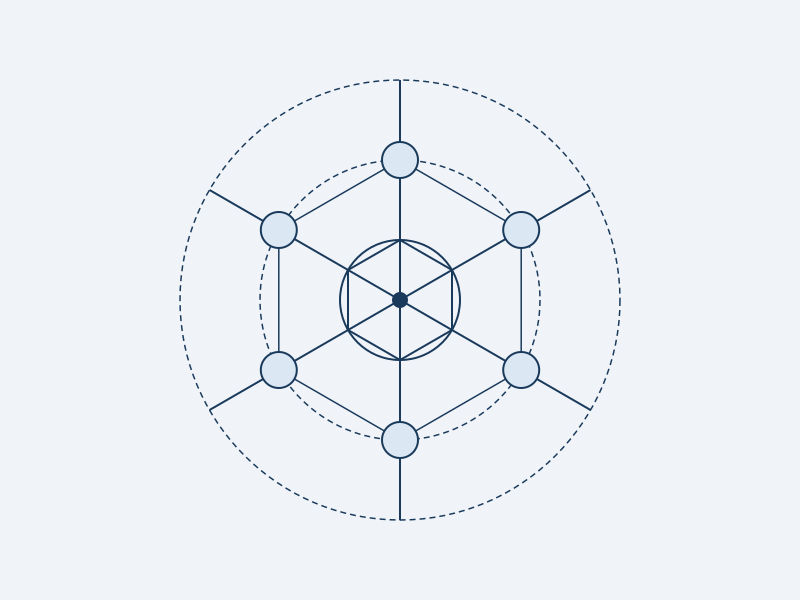
This essay examines whether Ffellonics — the 12-level relational hierarchy generated by identical spheres attaching symmetrically under free-energy minimisation — exhibits these properties, and what it means that it does. The parallel is structural rather than historical: Aristotle was not theorising about sphere packing, and Ffellonics was not developed from Aristotelian premises. What is interesting is that a physical self-assembly model, developed on independent geometric and thermodynamic grounds, satisfies criteria that Aristotle articulated for beautiful completeness — and does so in a way that illuminates why those criteria have force.
Order: Progressive, Cumulative Hierarchy
Aristotle's taxis denotes a rational, proportionate ordering of parts into a coherent whole. It is not mere sequence but meaningful sequence: each part in its proper place, contributing to the whole in a way that is both necessary and sufficient.
In Ffellonics, order is not stipulated but generated. The hierarchy begins with the first symmetric contact between two spheres and proceeds through a sequence of stable configurations, each the lowest-free-energy arrangement achievable from the one preceding it. The Platonic milestones — tetrahedron at Level 3, octahedron at Level 4, icosahedron at Level 5 — appear not as arbitrarily chosen waypoints but as the configurations that the local rule selects at those cluster sizes. Each level is causally prior to the next: the geometry of the current configuration determines which attachment positions are available and which configuration follows.
This is not static order — a fixed arrangement of parts — but developmental order: a sequence in which each stage is grounded in the last and grounds the next. Aristotle's demand for taxis was precisely this: not mere arrangement but rational progression in which the parts relate to the whole through necessity. Ffellonics satisfies it by construction, because each level is the unique lowest-free-energy configuration at that stage of assembly.
Symmetry: Dynamic Rather Than Static
Aristotle's symmetria means harmonious proportion and balance among parts — not merely visual symmetry but commensurability, the right relationship of each part to every other. For Aristotle, symmetry is a property a form has at completion.
Ffellonics adds a dimension to this: symmetry in the hierarchy is not only a property of the endpoint but a condition maintained actively throughout the developmental process. At each stage of assembly, the local rule selects the attachment position that preserves the highest achievable global symmetry for that cluster size. Configurations that break symmetry — that place a new sphere asymmetrically relative to the existing cluster — are thermodynamically disfavoured: they have higher free energy, fewer contacts, and lower Boltzmann weight. The system is under continuous thermodynamic pressure to solve the symmetry problem at each step.
This means that symmetry in Ffellonics is not a passive feature of the final lattice. It is an active selective criterion operating at every transition. The perfectly isotropic 12-fold ground state at Level 12 is reached precisely because each intermediate step has maintained the highest symmetry achievable at that cluster size. A different sequence — one that permitted asymmetric intermediates — would not reach the same endpoint.
This is a refinement of Aristotle's symmetria rather than a departure from it. Aristotle recognised symmetry as a mark of completeness in the finished form; Ffellonics shows it as the generative condition that makes completeness achievable.
Limitation: The Power of a Definite End
Aristotle was insistent that genuine beauty and actuality require horismenon — definiteness, boundary, a determinate magnitude. In the Poetics he specifies that a beautiful animal must be of a size that can be taken in by the eye; in the Metaphysics he connects definiteness to completeness, contrasting the determinate (which can be grasped and understood) with the infinite (which cannot). An unbounded or indefinite form cannot achieve wholeness. Limitation is what gives a form its integrity.
Ffellonics satisfies this criterion with unusual clarity. The hierarchy has a precise beginning — the first symmetric contact at Level 1. It has a fixed number of stages — exactly twelve. And it has a definite endpoint — the 12-fold coordination lattice, the configuration in which every sphere achieves the maximum symmetric coordination possible in three-dimensional space. This maximum is not a design choice but a geometric theorem: the kissing number in three dimensions is 12, proved by Schütte and van der Waerden in 1953. There is no Level 13 because three-dimensional Euclidean geometry does not permit it.
The limitation is therefore intrinsic rather than imposed. The hierarchy ends at Level 12 because the geometry of space makes further hierarchical development impossible. Once Level 12 is reached, the structure extends laterally in the same pattern without adding new levels. The limitation gives the progression its coherence: a complete arc from first contact to maximum coordination, bounded by geometric necessity.
This is precisely what Aristotle meant by horismenon. The definiteness of the Ffellonic hierarchy is not a constraint that truncates something that might have continued. It is what turns the progression from an open-ended sequence into a complete and graspable whole.
What the Parallel Establishes
The Ffellonic hierarchy exhibits order, symmetry, and limitation in ways that are structurally consonant with Aristotle's criteria for beautiful completeness. This is not coincidental but it is also not a proof of anything about Aristotle's philosophy. The parallel illuminates two things.
First, it suggests that Aristotle's criteria, developed through reflection on tragedy and natural form, may track something real about how ordered structure arises in physical systems. The Ffellonic hierarchy is not designed to satisfy aesthetic criteria; it is what thermodynamics produces when identical units interact under a single local rule. The fact that the result exhibits taxis, symmetria, and horismenon suggests these properties are not arbitrary aesthetic preferences but may reflect the conditions under which stable, coherent structure is achievable at all. A system without developmental order would not reliably reach a ground state. A system without symmetry preference would not produce the coordination geometries that minimise free energy. A system without a definite endpoint in configuration space would not terminate.
Second, the parallel provides a philosophical vocabulary for describing what Ffellonics produces that is more precise than loose appeals to beauty or harmony. To say the Ffellonic hierarchy exhibits Aristotelian order is to say something specific: each level is necessary and sufficient for the next, and none is arbitrary. To say it exhibits symmetria is to say that symmetry is the active criterion at each transition, not merely a feature of the endpoint. To say it exhibits horismenon is to say that its termination at Level 12 is geometrically necessitated, not stipulated.
Limits of the Parallel
Two limits should be stated clearly.
Aristotle's framework was developed for objects of human perception and human making — animals, tragedies, artworks. Extending it to physical self-assembly is an application of the framework outside its original domain. The parallel is structural and suggestive, not an argument that Aristotle's metaphysics is vindicated by sphere packing, or that sphere packing is beautiful in the aesthetic sense Aristotle intended.
Additionally, Aristotle held a broadly teleological view of nature — he thought natural things move toward ends that are intrinsic to their natures. The Ffellonic hierarchy has the appearance of teleology (it proceeds toward a definite ground state) but the mechanism is non-teleological: free-energy minimisation at each step, with no representation of the endpoint guiding the process. The hierarchy reaches Level 12 because each local step is thermodynamically downhill, not because the system is oriented toward Level 12 as a goal. This is an important disanalogy that the structural parallel does not resolve.
Conclusion
Aristotle taught that genuine completeness requires order, symmetry, and definite limitation — not as aesthetic decoration but as the conditions under which a form achieves full actuality. Ffellonics, developed independently on geometric and thermodynamic grounds, produces a hierarchy that exhibits all three: developmental order in which each level is causally necessary for the next, symmetry maintained dynamically as the active criterion at every transition, and limitation grounded in the geometric theorem that places an absolute ceiling on coordination in three-dimensional space.
The parallel does not make Ffellonics Aristotelian, nor does it make Aristotle a sphere-packing theorist. It suggests that criteria developed through philosophical reflection on form and completeness converge with criteria that physical self-assembly satisfies by thermodynamic necessity — and that this convergence is worth taking seriously as evidence that both are tracking something real about the conditions under which stable, coherent wholes arise.
Comments
No comments yet. Be the first to share your thoughts.