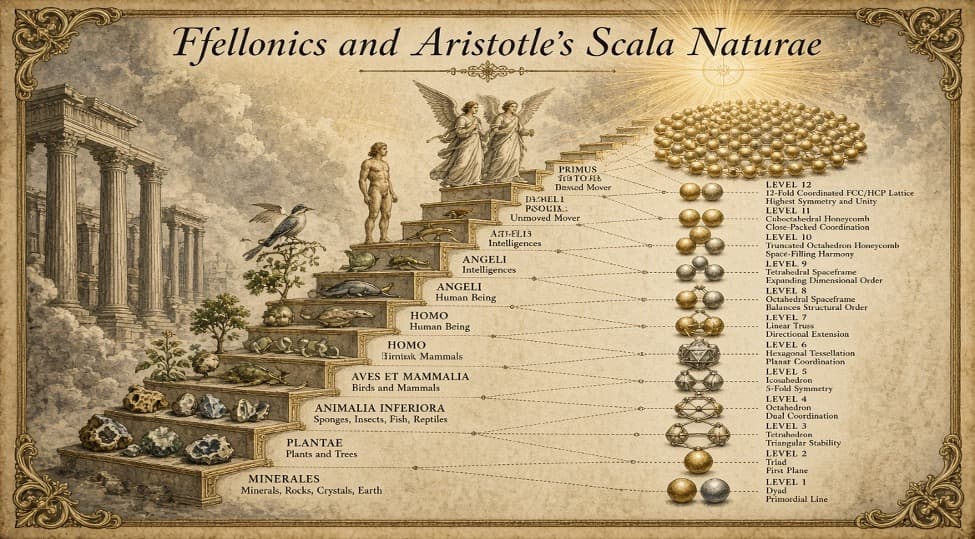
Ffellonics and Aristotle's Scala Naturae: A Geometric Resonance in Hierarchical Emergence
Aristotle's scala naturae — the "ladder of nature" — is one of the most enduring images in Western philosophy: a hierarchical progression of beings from inanimate matter to rational humans, where each level actualizes potentials latent in the ones below it. The term and the fully assembled ladder, running from the elements through plants, animals, and humans to divine intellect, is more a later synthesis — built up by scholastic and Neoplatonic commentators and formalized as the "Great Chain of Being" in Arthur Lovejoy's history of ideas — than a single doctrine Aristotle sets out in one place in his own words. But its component parts are genuinely his: the graded psychological faculties of De Anima, the graded hierarchy of living things in the Historia Animalium, and the account of pure actuality in the Metaphysics. It's this synthesis, drawn honestly from Aristotle's actual texts, that Ffellonics — David Fell's geometric hierarchy of relational sphere attachments — resonates with. This article explores that resonance, including the one place where Ffellonics doesn't just extend Aristotle's picture but explicitly departs from it.
Aristotle's Scala Naturae: A Ladder of Potential and Actualization
In Aristotle's cosmology, nature is ordered along a hierarchical continuum, ranking entities by their capacities and degree of actuality — from the inanimate elements (earth, water, air, fire) through plants, animals, and humans, toward the fullest actuality Aristotle recognizes, the divine intellect.
Key elements include:
Hierarchical progression: each rung builds on the last, with lower forms providing the matter for higher actualization. In De Anima, Aristotle layers souls (psyche): plants have nutritive soul (growth, reproduction), animals add sensitive soul (perception, motion), and humans possess rational soul (thought, deliberation).
From potential to actual: hylomorphism (matter-form theory) drives this. Matter (hyle) is potential, actualized by form (morphe) — an acorn, as potential oak, realizes its telos through natural processes.
Nature-driven motion: in the Physics, motion arises from each thing's own internal principle — its nature inclines it toward its proper place (earth downward, fire upward) not because of a relation it stands in to other things, but because of what it intrinsically is. This matters for what follows: Aristotle's physics, like his metaphysics generally, explains motion and change primarily by appeal to a thing's own nature, not to relations between things.
Emergent order and teleology: higher levels emerge with new faculties, guided by final causes (telos) — each kind of thing tending toward the fullest realization of its own proper end.
Aristotle's ladder is teleological and continuous, blending biology with metaphysics: from mere existence to rational contemplation.
Ffellonics: A Geometric Ladder of Relational Emergence
Ffellonics starts with identical spheres as its starting units — undifferentiated, with structure emerging only through symmetric attachment that minimizes energy and maximizes contacts. The twelve-level hierarchy unfolds from dyads through hexagonal tessellations (Levels 1–6) to trusses and dense, maximally coordinated lattices (Levels 7–12). This is a dissipative process throughout — each attachment lowers free energy, exporting entropy as bonds form — mirroring natural development, but rendered in purely geometric terms.
Resonances: Hierarchical Progression from Potential to Actual
Ffellonics echoes Aristotle's ladder in its basic shape:
Isolated spheres — undifferentiated, structureless — actualize through attachment, echoing hylomorphism's matter awaiting form. The first touch initiates actualization, the way form is said to actualize matter in Aristotle's account of soul and body.
Continuity: Aristotle's scale is meant to be seamless, without gaps between adjacent forms of life; Ffellonics' levels are similarly graded, each building on the last without discontinuous leaps.
Teleonomic direction: attachments proceed toward maximal coordination (Level 12) through energy minimization at each step, the way Aristotle's hierarchy proceeds toward fuller actuality at each rung.
Beyond this structural resonance, it's worth being honest about where a specific correspondence between geometric level and psychological faculty would need real justification rather than assertion. It's tempting to say a tetrahedron's enclosure of volume resembles nutritive soul, or an icosahedron's efficient packing resembles sensitive soul's adaptive responsiveness — but nothing about volume-enclosure specifically tracks nutrition rather than, say, perception, and nothing about icosahedral efficiency specifically tracks sensation rather than nutrition. These would be poetic pairings rather than argued ones unless a real structural link between the geometric property and the faculty were established, so this piece keeps the comparison at the level it can actually support: both are graded, continuous hierarchies moving from minimal to maximal actualization, without claiming a rung-by-rung correspondence between specific shapes and specific faculties.
Where Ffellonics Departs From Aristotle, Not Just Extends Him
This is the place the comparison needs the most care, because it's where the resonance actually breaks — and naming the break is more useful than smoothing it over.
Aristotle's metaphysics is substance-first. In the Categories, substance (ousia) is primary being — a particular thing, with its own nature, existing in its own right. Relation (pros ti) is one of the least fundamental categories, an accident that depends on substance for its existence rather than the reverse. This is consistent with the natural-place account above: an element moves toward its proper place because of its own intrinsic nature, not because of a relation it stands in to other elements. Aristotle's system, in other words, is close to the historical paradigm case of a philosophy where things have their natures first, and only secondarily stand in relations to each other.
Ffellonics inverts this directly. An isolated sphere has no structure, direction, or identity of its own — nothing intrinsic to actualize. Only the first touch, a genuine relation between two units, introduces any distinction at all. Where Aristotle's hylomorphism actualizes a substance's own latent form, Ffellonics generates form only through relation, with nothing analogous to Aristotelian prime matter's own intrinsic tendency doing any of the work.
So the honest relationship between the two isn't equivalence, and it isn't even quite "extension" — it's an inversion applied to a shared shape. Both describe hierarchical, continuous progressions from minimal to maximal actuality. But Aristotle's rungs are actualizations of each thing's own nature, while Ffellonics' rungs are constituted entirely by relation, with no analogue to an intrinsic nature doing prior work. Calling this an update, in the sense of keeping the ladder's shape while replacing what drives the climb, is the more accurate way to put it than claiming the two systems already agree on what's fundamental.
Emergent Order: Teleology in Dissipative Terms
Aristotle's teleology explains change by appeal to final causes — each kind of thing tending toward its own proper end. Ffellonics offers a structurally similar but mechanistically different picture: attachments proceed toward maximal coordination (CN = 12) through energy minimization, with no forward-reaching final cause pulling the process along — each step is fully explained by the local rule applied to the current state, not by the future state it happens to arrive at. This is closer to teleonomy than to Aristotelian teleology proper: retrospectively coherent, prospectively blind, in contrast with Aristotle's own view that a thing's end genuinely explains its development.
Ffellonics' relational, dissipative picture — resonant with Ilya Prigogine's account of dissipative structures — updates the ladder's teleological drive into something that doesn't need final causes to do the explanatory work Aristotle gave them, while keeping the same overall shape: a continuous, graded progression from minimal to maximal actuality.
Conclusion
Ffellonics resonates with Aristotle's scala naturae in its basic shape — a continuous, graded hierarchy moving from potential toward actuality — while inverting what drives the climb: relation rather than each thing's own intrinsic nature, energy minimization rather than final causation. That's a more precise way to state the connection than claiming shared metaphysical commitments Aristotle's own texts don't support, and it leaves the genuinely interesting question open rather than papering over it: whether a hierarchy built entirely from relation, with nothing playing the role of Aristotelian prime matter's own tendency, can do the same explanatory work Aristotle needed a substance's own nature to do.
Comments
No comments yet. Be the first to share your thoughts.