Ffellonics and "From One Touch Comes Everything": The Ontological Depth of Relational Emergence
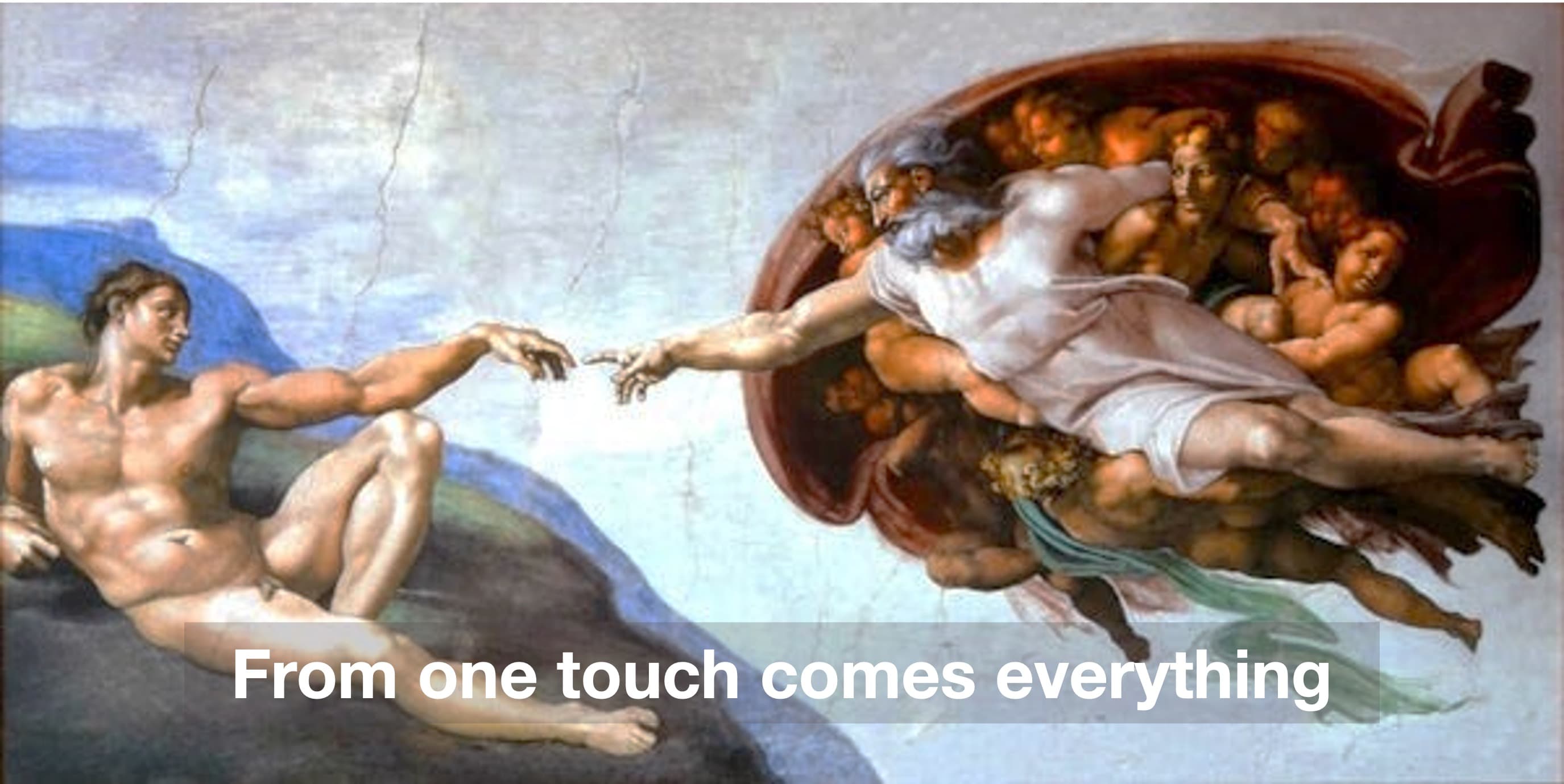
Ffellonics represents a distinctive way of conceptualizing structure and order in nature. Built on the premise of identical spheres attaching through symmetric nearest-neighbor contacts, it generates a 12-level progression from minimal dyads toward maximally coordinated lattices, emphasizing low-energy dissipative paths and emergent symmetry. At the heart of this system lies the phrase "from one touch comes everything," which captures Ffellonics' central ontological claim: that relational events, rather than isolated entities, are the foundational building blocks of the structure it describes. This article examines what that phrase means, what it does and doesn't commit the framework to, and where it genuinely connects to existing philosophical positions rather than merely resembling them.
The Core Mechanism: Spheres as a Starting Point
In Ffellonics, identical spheres serve as the starting point — geometric objects standing in for any set of units capable of symmetric attachment. An isolated sphere has no structure, direction, or distinguishing feature beyond its bare existence. The framework's generative rule — symmetric attachment that maximizes contacts while minimizing free energy — is what turns that undifferentiated starting point into structure. The first attachment, the "one touch," is the event that matters: two spheres form a dyad (Level 1), creating the first link, the first distinction between inside and outside the bond, and the first measurable relation in the system.
From that single relational act, the rest of the hierarchy follows: triangles (Level 2), tetrahedra (Level 3), octahedra (Level 4), icosahedra (Level 5), and on through progressively denser coordination shells to a maximally coordinated lattice at Level 12, where each sphere reaches 12 neighbors — the three-dimensional kissing number. As with the rest of this series, one caveat belongs here too: the terminal lattice is often described as a single, uniquely preferred FCC ground state, but FCC and the alternative close-packing HCP are extremely close in energy for hard spheres, and which is actually favored remains an open question in the colloidal-physics literature. Level 12 is best read as the class of maximal 12-fold coordination, not a single determined endpoint — nothing in the ontological argument below depends on resolving that question.
One further note, carried over from elsewhere in this series: descriptions of the intermediate levels (roughly 6 through 8) have varied across different accounts of the hierarchy — sometimes named by their resulting structure (tessellations, trusses, spaceframes), sometimes by explicit connection counts, and at least one version uses the engineering term "Octet Truss" for a level another version describes differently. Anyone treating a specific intermediate level as load-bearing for an argument should confirm which description is current, since these haven't yet been reconciled into one consistent account.
"From One Touch Comes Everything": What the Inversion Actually Claims
The phrase articulates a real philosophical move: a reversal of priority between entities and relations. In a substance-first ontology — the kind associated with Aristotle's distinction between substance and accident — entities exist first, with their own inherent properties, and relations between them are secondary, additional facts layered on top of things that were already fully what they are. Ffellonics proposes the reverse: relations are primary, and whatever structure or identity a sphere gains, it gains through relation. An isolated sphere is mere undifferentiated potential; the first touch is what introduces difference at all — a shared axis, an inside and outside to the bond, a constraint on what was previously unconstrained isotropy. Geometry itself — lines, planes, volumes, symmetries — unfolds from that first relational event as a consequence, not as something imposed from outside it.
This is a real and substantive philosophical position, and it has real contemporary company — not primarily in the historical figures sometimes invoked for this kind of claim, but in ontic structural realism, a position developed by philosophers of science including James Ladyman and Steven French. Structural realists argue that relations and structure are ontologically prior to the objects that seem to stand in them — that, at least at the level of fundamental physics, what's real is the pattern of relations itself, and "objects" are better understood as nodes in that pattern rather than independently-existing things that happen to be related. This is a live, actively debated position in current philosophy of science, motivated by cases (particularly in quantum mechanics, where particles of the same type are strictly indistinguishable except via their relations) that bear a real structural resemblance to what Ffellonics is describing: individual spheres carry no intrinsic identity beyond their relational history within the hierarchy. Citing this position, rather than reaching further back for a historical precedent, connects the claim to where the actual argument about relational priority is currently being made and tested.
A second, more limited comparison is worth keeping, stated carefully: Deleuze's process philosophy treats difference and differential intensity as preceding stabilized identity — actualized, identifiable things are, on this view, always a later development out of a prior field of difference. Ffellonics' claim that identity emerges only after relation is a structural echo of that ordering, though the frameworks aren't doing the same work — Deleuze's virtual multiplicities are a considerably more elaborate apparatus than a geometric attachment rule, and the comparison should be read as a family resemblance in the shape of the claim (difference or relation before identity), not a claim that Ffellonics and Deleuzian process philosophy share a method or a vocabulary beyond that shape.
Implications for Emergence and Beyond
Taken as a claim specifically about the geometric hierarchy, "from one touch comes everything" is well-supported: every subsequent level really is generated from the local rule applied at the first contact, and the framework doesn't need anything external to the rule to produce the rest of the hierarchy. In physics, this describes real dissipative self-assembly processes — crystal growth and viral capsid formation both involve identical or near-identical units settling into low-energy configurations through repeated local interactions, and Ffellonics offers a clean geometric account of what that settling process looks like structurally.
Extending the claim beyond physical spheres — to human systems, where "touches" might represent social bonds or the connection of ideas — is a further, more speculative move, and it's worth marking the difference in kind. The geometric claim is precise and mechanistic: given the rule, this sequence follows. The extension to social or cognitive systems trades on an analogy (things that can "interact symmetrically" produce the same kind of progression) rather than on the same generative mechanism, since neither social bonds nor ideas obviously minimize a Gibbs free energy in any literal sense. The analogy may still be a fruitful one to explore, but it's a different, weaker kind of claim than the geometric one, and treating them with the same confidence would overstate what's established.
Conclusion
"From one touch comes everything" names a genuine ontological commitment — that within Ffellonics' hierarchy, relation precedes and generates identity rather than the reverse — and that commitment has real philosophical company in contemporary structural realism, not just an evocative resemblance to historical process philosophy. The geometric version of the claim is well-grounded: the first contact really does generate everything that follows, deterministically, from a single rule. Whether the same inversion applies usefully beyond physical spheres — to social bonds, ideas, or other domains where "touch" is a metaphor rather than a literal contact minimizing free energy — remains an open extension of the idea, worth exploring, but distinct from the geometric claim the essay can actually stand behind.
Comments
No comments yet. Be the first to share your thoughts.