Ffellonics and Global Workspace Theory: Resonances in Relational Emergence and Global Integration
Ffellonics and Global Workspace Theory: Resonances in Relational Emergence and Global Integration
Ffellonics (Ffellonic geometry), is a hierarchical geometric model in which identical spheres act as ontological primitives. Through symmetric nearest-neighbor attachments, these spheres generate a 12-level progression from minimal dyads to maximal dense lattices, guided by the principle of energy minimization and symmetry maximization. At its heart is the relational ontology expressed as “from one touch comes everything.”
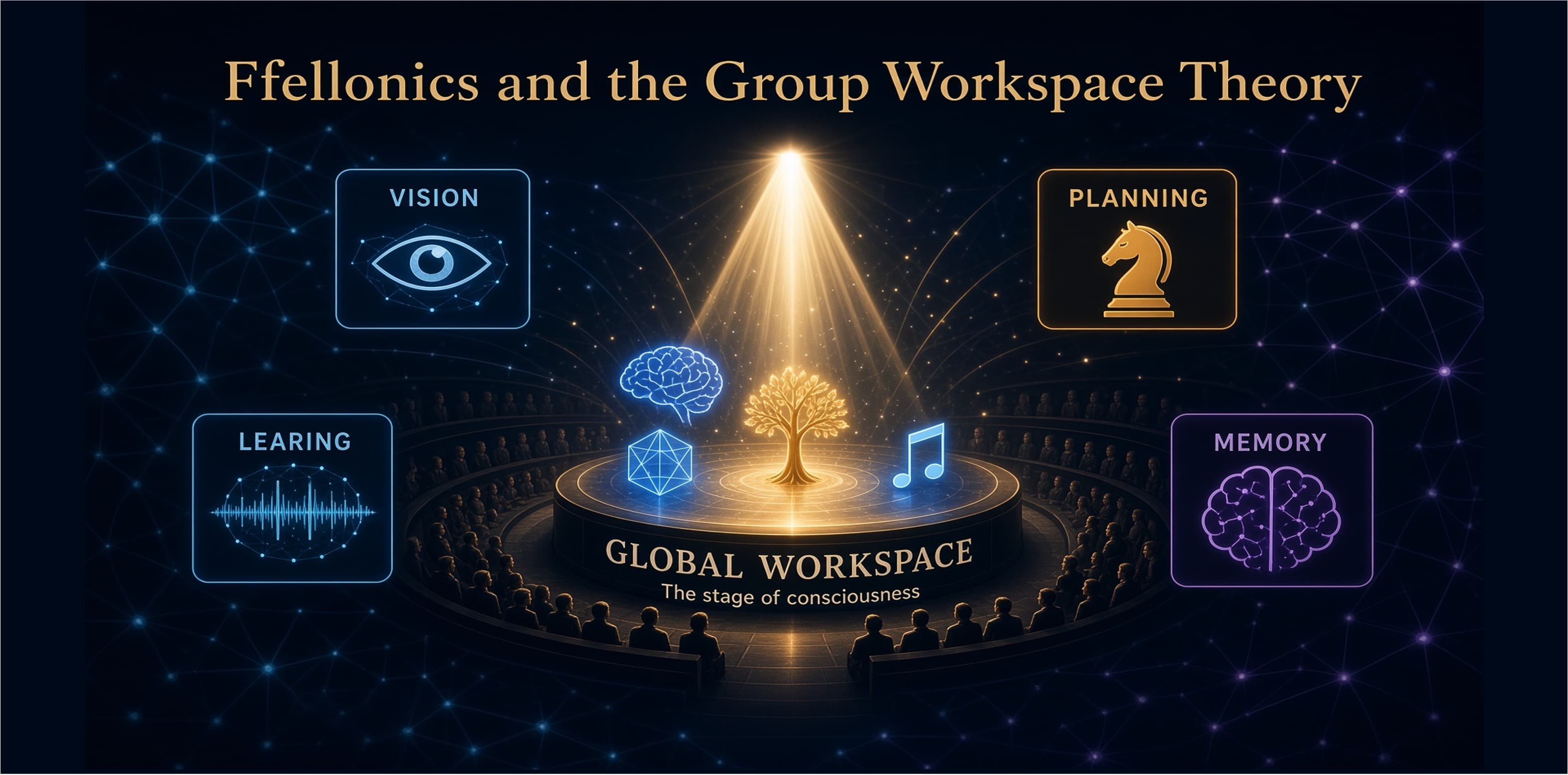
Global Workspace Theory (GWT), proposed by Bernard Baars and significantly advanced by Stanislas Dehaene and colleagues, is one of the leading neuroscientific theories of consciousness. It proposes that consciousness arises when selected information is globally broadcast across the brain, making it widely available for report, decision-making, memory encoding, and voluntary control.
Although these two frameworks originate in entirely different domains—geometric ontology versus cognitive neuroscience—they exhibit a deep conceptual resonance. Both describe how distributed, local elements coalesce into a unified, higher-order state through relational integration. This article explores those parallels and the mutual enrichment they offer.
The Shared Architecture of Emergence
Both theories rest on the same foundational insight: complex, unified phenomena emerge when local units become richly and symmetrically interconnected.
• In Ffellonics, isolated spheres have no intrinsic structure. Only through successive “touches” (attachments) does form, symmetry, and hierarchy arise. Each level resolves the incompleteness of the previous one, culminating in the 12-fold coordination lattice where every sphere is symmetrically linked to every other in its local environment.
• In GWT, specialized unconscious modules (sensory, memory, motor, emotional) process information in parallel. When one piece of information wins the competition for access, it triggers a nonlinear “ignition” and is broadcast globally. This broadcast turns parallel, modular activity into a single, integrated conscious state.
The first touch in Ffellonics is the geometric counterpart of ignition in GWT. Both represent the critical transition from isolation to global relational coherence.
Global Integration as the Defining State
The highest levels of both systems are characterized by maximal connectivity and accessibility:
• Ffellonics reaches its apex in the FCC/HCP lattice (level 12), where every sphere has 12 equidistant neighbors. This creates omnidirectional symmetry, redundancy, and resilience: information (or structural influence) is distributed evenly and robustly.
• GWT’s global workspace is a functional “stage” in which selected information is simultaneously available to many distant brain regions (prefrontal, parietal, sensory, motor, memory systems). This creates the same functional outcome: high accessibility, redundancy, and resilience.
In both cases, the “global” state is not merely larger—it is qualitatively different. It transforms local, private processing into a shared, publicly accessible network.
Dissipative Nature and Energy Cost
Both frameworks are dissipative structures—they require continuous energy throughput to maintain order:
• Ffellonics: Each attachment dissipates kinetic energy into stable bonds, and the entire hierarchy is sustained by the ongoing flow of new spheres (open system).
• GWT: The brain continuously expends metabolic energy to sustain recurrent activity, long-range broadcasting, and the ignition process. Without this ongoing dissipation, the workspace collapses and consciousness fades (as seen in anesthesia or deep sleep).
The ordered state in both cases is expensive to maintain but highly stable precisely because of that continuous energy flow.
Hierarchical Progression
Both systems exhibit staged, cumulative development:
• Ffellonics: Each level is a necessary precondition for the next (planar symmetry at level 6 enables 3D integration at level 7).
• GWT: Information must pass through multiple processing stages and compete successfully before reaching the workspace and becoming globally available.
This shared hierarchical logic suggests that both theories are describing the same underlying principle: progressive integration of local elements into ever-richer global wholes.
Mutual Enrichment
The two frameworks illuminate each other beautifully:
• RFT adds psychological dynamism to Ffellonics: GWT’s ignition, broadcast, and competition introduce temporal, functional, and motivational layers to Ffellonics’ static geometry. The hierarchy can be read as stages of neural integration leading to conscious access.
• Ffellonics provides a visual scaffold for GWT: The 12-level progression offers a clean geometric metaphor for the build-up toward workspace ignition. Isolated modules become increasingly connected clusters until a critical “touch” triggers global broadcast.
Together, they suggest a deeper principle: the richest states—whether phenomenal consciousness or maximal geometric harmony—arise when local elements become maximally and symmetrically interconnected.
In conclusion, although Ffellonics and Global Workspace Theory come from different intellectual traditions, they converge on the same elegant truth: relation is the engine of emergence. From the first touch to the global workspace, both reveal how distributed isolation gives way to unified, resilient, and meaningful order. This resonance points toward a broader relational science that could one day unify geometric, physical, and cognitive descriptions of complexity.
Comments
No comments yet. Be the first to share your thoughts.